Showing posts with label burgers. Show all posts

Tuesday, January 15, 2013

Horse Meat Found In Tesco Burgers - Every Little Pony Helps


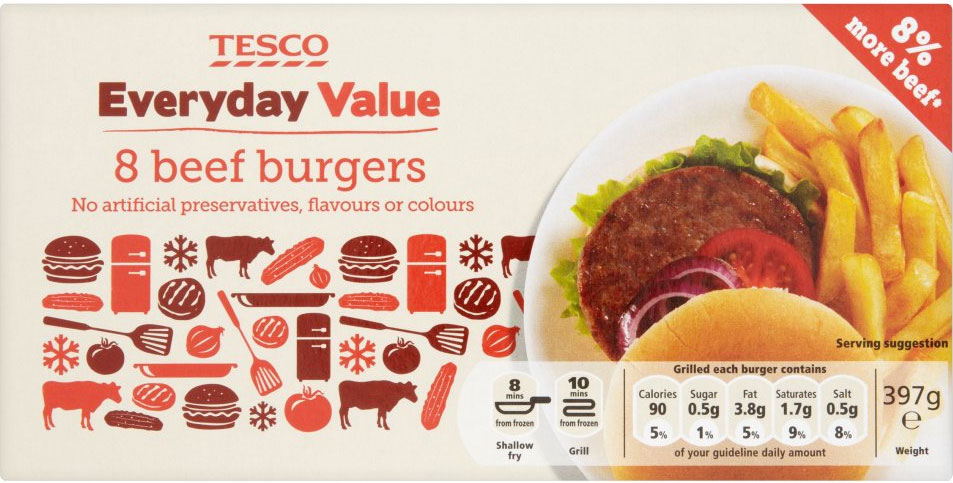
It says 8 per cent more beef on the Tesco Everyday Value Beef Burgers box, and promises no artificial preservatives, flavours or colours. But what Tesco doesn’t tell you is the pink slimy patties inside are made up of 29 per cent horse meat.

The supermarket chain says it wants to “apologise sincerely” to customers following the discovery of its Shergar burgers from DNA tests by the Food Safety Authority of Ireland (FSAI). Tesco lists the, err, mane ingredients on the box as 63 per cent Beef, 10 per cent Onion, which I suppose in fairness might actually be the horse’s name, followed by wheat flour, water, and beef fat.

The meat came from Dalepak Hambleton processing plant in Yorkshire, and two plants in Ireland, Liffey Meats and Silvercrest Foods. The burgers were sold by Tesco and Iceland in the UK and Ireland. And Lidl, Dunnes Stores, and Aldi supermarkets in Ireland.

Investigators said 27 burger products were analysed - and 10 contained horse DNA and 23 revealed pig DNA. Another 31 beef ready meals, including cottage pie and lasagne, were  tested, and two thirds contained pig DNA.

Professor Alan Reilly, chief executive of the FSAI, said there was no health risk but also no reasonable explanation for horse meat to be found.

"Whilst there is a plausible explanation for the presence of pig DNA in these products due to the fact that meat from different animals is processed in the same meat plants, there is no clear explanation at this time for the presence of horse DNA in products emanating from meat plants that do not use horse meat in their production process," he said.

"In Ireland, it is not in our culture to eat horse meat and therefore, we do not expect to find it in a burger. Likewise, for some religious groups or people who abstain from eating pig meat, the presence of traces of pig DNA is unacceptable."

The FSAI also found traces of horse DNA in batches of raw ingredients, including some imported from the Netherlands and Spain.

Horse meat was found in Tesco Everyday Value Beef Burgers 29.1 per cent; Tesco Beef Quarter Pounders 0.1 per cent; Oakhurst Beef Burgers in Aldi 0.3 per cent; Moordale Quarter Pounders in Lidl 0.1 per cent; Flamehouse Chargrilled Quarter Pounders in Dunnes Stores 0.1 per cent; two varieties of Iceland Quarter Pounders 0.1 per cent.

Retailers said they have now removed the burgers from their shelves and are investigating.

A Tesco spokesman said: "We are working with the authorities in Ireland and the UK, and with the supplier concerned, to urgently understand how this has happened and how to ensure it does not happen again. We will not take any stock from this site until the conclusion and satisfactory resolution of an investigation."

He added: “We understand that many of our customers will be concerned by this news, and we apologise sincerely for any distress. Our customer service team is standing by to answer any questions customers may have.”

It seems Tesco will resort to anything in its unbridled pursuit of profits, and there must be some very long faces in the press office today, all hoping it won't go on furlong, and sales remain stable etc etc.

From Twitter:

@moanup: Just had a Tesco burger, it's given me the trots."
@HylandIan: Think I might give these Tesco 'smoked paddock fishcakes' a miss.
@karlpweb: "Horsemeat in the burgers? That's a bit rum. A bit red rum to be precise. For shame."
@TheRealJackDee: "Nothing about Tesco surprises me. A burger is like Noah's Ark in a bap."
@feintzebra: "What's the difference between a Tesco burger and a McDonald's burger? A Tesco burger will filly you up."

:: MORE: What's really in your doner kebab?

Thursday, September 29, 2011

Restaurants & Dealing With Awkward Diners


I've been running the kitchen at a friend's restaurant in Cambodia for the past couple of weeks. It's the wet season, so there aren't many customers about. But it's been good fun getting back into the kitchen, and teaching the Khmer cooks how to make Western dishes, and learning a few Khmer staff meals from them.

But although it started well, I’d forgotten just how irritatingly tight-fisted some customers can be, especially the sort of drinkers and loners that wash up on Cambodia’s beaches. I know it’s a third world country, but it’s astounding how many expats want something for nothing out here. And it’s not just thrill-seeking pensioners stretching out their money each month - the worst ones are the ones with money.

There’s one extremely wealthy Austrian man, for instance, who’s been known to buy a draft beer from one bar for $0.75 (less than 50p), and then wander over the road to drink it in another bar, where it’s $1 a glass. He eats in our restaurant some nights, but always brings his own bottle of wine and asks for a glass.

When the previous owner got fed up with it, and said he was going to start charging him a $1 corkage fee, the pensioner got quite upset. One night he complained that the lasagne was too big.

“Next time, I think I’ll just ask for half,” he said.

“Well, you’re still paying $5!” the owner snapped.

Message aimed at drunken foreigners in Phnom Penh...

But the worst of the lot is a railway contractor called Steve, who regularly boasts about how he’s getting $200,000 a year in a country where the average annual income is $650, and shells out just $5 a night for our delicious, slaved-over food – and picks fault with everything.

Every night he comes in with a new request. It started off with cauliflower. He said he wanted a few florets with his next meal, and then it was pumpkin, and then he started dictating orders into the kitchen.

“Can you prick the sausages before you cook them,” he asked.

“I can do more than that,” I muttered.

The next night, Steve ordered the spaghetti bolognese I’d put on the specials board and I nearly exploded. I counted to ten in my head and bit my lip, but still the bile was rising.

I knew how to make bolognese. I’d spent 15 months of my life I’ll never get back making bucket load after bucket load of the stuff and wheelbarrows of lasagne in a kitchen supplying very demanding Italian clients who would scream down the phone if there was ever the slightest deviation.

The recipe – which had apparently been handed down by the chef-owner’s grandmother and mentor - was perfect. There’d even been an oil painting of the old crone glaring down at us as we chopped the precise amounts of garlic, pancetta and plum tomatoes to make “Grandma’s Bolognese”.

I hadn’t skimped on anything, and it took me three trawls of the local markets just to find celery. There was so much red wine in it, we were barely making a dollar on the dish.


I’d even cured the pancetta myself with salt, sugar, and the local delicious Kampot pepper (the trouble is I can’t get any saltpetre here, which although isn't essential, helps keep the bacon pink, and stops it going grey when cooked. The closest I got was a packet of “powder for fermenting pork” from Thailand, which contained sodium nitrite, and worked fairly well to keep it pink).


But it was all lost on Steve. And it didn’t help knowing that he’d earned far more that day than I would in a whole month cooking bespoke meals for him.

“I don’t like it when the meat is runny, you know what I mean?” he said. “Can you cut up the spaghetti into small pieces and then mix it with the sauce – you know how Heinz does it?”

I fought the urge to ask whether he wanted me to fetch him a little bib to eat it in. The next day he ordered a pizza and threw the Khmer staff into chaos when he asked for “the crust to be turned inwards to keep the cheese in”. Then he asked if we could make him rissoles the next night.

“But they’ve got to have onion in. Chopped up small and everything, know what I mean?”

Later, I was showing the Khmer staff how to cook a half-pound steak burger, made from fillet steak I’d aged in the fridge for 10 days and then minced. Khmer beef is so cheap - you can buy a whole fillet for $9 a kilo down at the market. The ‘normal’ stuff is $8 a kilo. They don't really understand cuts here, as I’d learn. Meat is just meat, although head and offal are cheaper.


When I went down to the market with one of the Khmer cooks to buy three kilos of tenderloin, and they charged us $27 instead of the normal $24 for chuck and shin, she began screaming at the butcher because she thought he was trying to rip us off.

I’d made a sauce from mayonnaise, mustard, and a little ketchup, chilli sauce and finely chopped gherkins, and had given the Khmer girl down the road some sesame seeds to bake me some buns, and it was all going well until Steve stuck his head into the kitchen.

“Yeah, that’s it. Nice and crispy on the outside like that,” he said.

He honestly thought we were practising his rissoles. He’d been in Asia for far too long.

“This is a burger,” I told him, but he wasn’t listening.

“Oh good, you’ve got the onions in already...can’t make rissoles without them.”

THEN THERE was the Sunday roast. I did roast chicken with all the trimmings - stuffing, cauliflower cheese, bread sauce, steamed veg, pigs in blankets (using my own bacon), roast spuds etc. I’d made stock from the off-cuts I’d got from trimming the eye fillets, and the gravy was pretty good. It must have been, because the only complaint I got was from a miserable old American hippy, who moaned that it wasn’t as thick as the lumpy, gravy granules version he had with his pies.

He was the one who’d complained about my Cornish pasties the day before. The Khmer cooks had been putting gravy in the pasties until I stopped them. I got them to make them the proper way, using raw beef, onion, potato and a type of sweet potato you get out here that tastes a bit like swede, but doesn’t stay firm like swede when cooked.

The old hippy ordered a pasty for lunch every day, as I was to find out, and was pretty much the only person who ate them. When the next one arrived at his room, he cut it open, complained it was too dry because there was no gravy inside, and threw it back at the delivery boy. He didn’t even try it.


THE ROAST must have gone down quite well though because we were the busiest restaurant on the street, and we even got a few of the more sniffy French customers eager to find fault with a 'rosbif’ cook. But there was still the usual list of bizarre requests.

A party of English publicans phoned up to say they wouldn't come over unless there was Yorkshire pudding, which I had to hurriedly knock out because they are relatively big spenders, and some idiot asked whether we had any mint sauce for the chicken.

The plates came back empty. But there was little praise or appreciation. No understanding of all the hard work and expense that had gone into their meals. Just a cold, clinical evaluation of whether it was worth $5, and what else that could have bought in Cambodia.

The only feedback I got was from one regular, who said the meal was so big he could barely finish it, and suggested we give people the option of buying a smaller one for $4 next time.

After another week, I’d had enough and walked out. I realised that the only way to cook out here was to run my own place, then I could serve the customers I liked, and be able to tell Steve exactly what he could do with the pumpkin he’d requested for next week’s roast.

So instead of spending the next Sunday in a cramped sauna, I spent the day lazing on the beach at a restaurant shack, talking to the owner. I was doing a bit of homework because the hut next to him was for rent for $350 a month – and I was toying with the ridiculous notion of turning it into a seafood shack, building up the business, and then selling it on.

Alright, I knew I wasn’t going to make any money running a restaurant in Cambodia, but that wasn’t the point. I gazed out to sea and the peaceful, soon-to-be-developed, mist-shrouded islands. Where else in the world could you own a lease on a restaurant on a white sand beach just 20 yards from the sea?

Later that night, I was sat at a bar when Steve walked past.

“They missed you in the kitchen with the Sunday roast today,” he said.

I put my head in my hands briefly, and waited for it.

“Why, what was wrong with it this time?” I said.

“Well...there wasn’t one...they said they couldn’t remember how to cook roast potatoes.”