Showing posts with label Cornish pasties. Show all posts

Wednesday, May 13, 2020

Georgia's Khachapuri: A Culinary Journey In Tbilisi (Part 4)


I put on my rucksack and followed Babar as we headed off to the sulphur baths. He told me to take a towel from the hostel, as it would save me two laris not hiring one at the baths. He was worried it might be closed as it was Christmas Day, but a few of the shops and restaurants on Rustaveli Avenue were open. He changed £20 on the way for laris. The first bureau only took euros, dollars and roubles, but the second took pounds. Every other shop seemed to be a money exchange. The rates were given outside in neon numbers, but I soon found it was rarely what you got inside.

Babar said we’d stop on the way to get breakfast at his usual haunt. It was a small kiosk in an underpass and was run by two women. It specialised in khachapuri – Georgia’s famous cheese-filled bread. The walls were painted bright pink and there was a coffin-like black oven. 


A woman in an apron was at the far end rolling out dough into circles and squares and filling them with cheese. The baked breads lay on silver trays at the front of the kiosk. Some were shaped like Cornish pasties. They were golden brown and looked delicious.

Babar asked which ones had potato in. The woman serving pointed at a tray containing flat oval-shaped bread. He ordered two. They came in plastic bags and were two laris each. They were delicious and we ate them as we walked. They were like cheese and onion pasties, but much better because there wasn’t the grease of pastry. It was a superb breakfast and a hearty introduction to Georgian cuisine.


I read later there are a dozen or so regional types of khachapuri, defined by the shape of the bread, cooking method, but most importantly by the type of filling – everything from minced meat and trout to nettles, spinach, beans and mushrooms. The ones we had, stuffed with buttery mashed potato and cheese, were called khabidzgina - specialities of the Russian-occupied South Ossetia region to the northwest of Tbilisi, a cooler climate where potatoes grow in abundance.

Khachapuri apparently gets its name from two Georgian words – khacho (cottage cheese) and puri (bread). Most are filled with chkinti, a curd-like cheese, and a salty, elastic-like cheese called sulguni. The yeasted dough is similar to naan or pizza in taste and texture. There are numerous recipes, but most contain flour, fermented milk (a yoghurt-like liquid made with kefir grains), eggs, yeast and a little salt and sugar, although there are simpler versions with just flour, water and yeast. It is such a staple of the Georgian diet that economists use a Khachapuri Index – inspired by the Big Mac Index created by The Economist magazine in the 1980s – to monitor inflation by tracking the price of its ingredients.

Khachapuri has such a special place in the country’s gastronomic culture that every family seems to boast its own secret recipe, and no feast is complete without it. However, despite being one of Georgia’s national dishes and certainly its most common food, historians are unsure of its origin. Some whisper – to the fury of proud patriots - it might not be Georgian at all and may be a cousin to pizza. Indeed, the round, thin Megrelian varieties topped with bubbling cheese certainly resemble pizza bianca. Food writer Dali Tsatava, a former professor of gastronomy at the Georgian Culinary Academy in Tbilisi, points out that Roman soldiers travelled through the Black Sea area, bringing recipes for something that resembled pizza. She says tomatoes did not exist in Europe until the 1500s, so it was just cheese and bread, not unlike khachapuri.

The only regret I had was not trying the Gurulian khachapuri which are only baked at Christmas. They are half-moon shaped and contain boiled eggs smoked in the chimney for a couple of days. We walked another 10 minutes as Babar told me about his plans to buy a property in the city. He took me down an alley and pointed at a house for sale that he’d looked at on his last visit. He said the owner had shown him round. Every time he asked the price, she talked about the square meterage and how central it was.

“But how much is it?” he’d asked in exasperation. Babar shook his head and laughed. “She told me it was one million dollars! She didn’t even bother to calculate the price in euros,” he said. “She thought that by joining the EU, she was going to become a millionaire. You can buy an apartment here for 10,000 dollars! Put it this way, you can buy the President for 22,000 dollars, so use that as a yardstick when they talk about prices and work downwards. One million dollars! I just thanked her and walked out.”

We headed south to the ‘old town’ Abanotubani district, on the bank of the Mtkvari River. The sulphur springs had apparently been discovered in the fifth century by King Vakhtang I of Iberia (present-day eastern Georgia) when the area was just thick forest. He had been hunting with his falcon or hawk, depending on the tale, when it took a pheasant and both birds fell into a hot spring and died from burns. He liked the springs so much, he cleared the forest and built a settlement around it. Tbilisi (meaning “warm place” in Georgian) became a popular bathing spot with merchants travelling the Silk Road between Europe and Asia, and the city grew from there.

We got to the baths and headed in. I don’t know what I was expecting. Babar said there was a scam going where all the travel guides and tourist information leaflets directed you to the private baths that you hired by the hour – not the far cheaper public ones. “It’s top of the list on Tripadvisor, the private rooms. But they don’t mention the public ones and it took me a long time to find them. They should tell you about these things. Tripadvisor should tell you. What else are they there for if they don’t tell you?” I nodded and smiled and thought about mentioning how people used to pay for editorial content until the internet took over and changed everything. But I was here to enjoy myself and I didn’t want to dwell too long on what a dead-end job journalism had become.


The private rooms were in brick-built huts, curved at the top, like brown Daleks. A group of tourists had climbed on to the roof of one of them. There was a small park and the public baths lay beyond. We walked down some steps and paid at a kiosk. The cost was five laris each. At the bottom was a long, steamy room full of lockers. The gatekeeper was a fat, angry-looking, bald man who demanded to see our tickets. He asked where Babar was from. “Pakistan,” he said brightly. “Pakistan,” the man repeated, nodding his head gravely. He tried to make us pay for towels but Babar said we’d brought our own. The man said something to the crowd in the room. Babar asked about lockers and the man waved his hands in a shooing gesture and said: “You lock, I don’t open.”

We undressed, wrapped our towels around our waists, and headed into the steam room. It was a dome-shaped building decorated in mosaics. The air was so thick you could barely see more than 10ft. Hot water poured from taps in the ceiling. Some men shaved, some lathered. We showered then sat in a deep bath. The thing that hit you first was the overpowering stench of egg from the sulphur springs. Once it got into your pores it didn’t leave you and I could still smell egg on my skin a day later. But the water was hot, and after that chilly breeze outside, it was wonderful sitting in that steaming tub.

There were two masseurs at work. Large men lay down like slabs of meat on marble platforms and the masseurs got to work, scrubbing them hard with soapy towels. After a few minutes in the bath, I showered again and went into the sauna. There were soggy leaves everywhere. Some of the locals liked to beat themselves with nettles to get the blood flowing, another hangover from the Romans. Or maybe they were just beating away the stench of egg.

Babar said he was going to have a massage for his bad leg. He said it was the main reason he had been to Georgia so many times. He had steam massages in Birmingham, but they cost far more - normally £30 for 30 minutes, but he bought them in blocks of 20 massages for £500. The masseur was a friend and offered “mate’s rates” and wasn’t too happy about the extra discount, but Babar would point out that it was money in the bank, and besides he had to pay interest on the £500.

I went back to the locker room. A side room was open and I could see men in there smoking cigarettes. If I’d known Georgian, I would have seen the sign said “staff only” or “keep out” or something similar. I rolled a cigarette and went in. I heard a shout behind me. One of the masseurs was walking towards me aggressively. Behind him was the fat gatekeeper. I saw the resemblance for the first time. They were definitely father and son. I held out my rolled cigarette for inspection. “No smoking in here,” said the masseur. “No smoking!” said the gatekeeper.

I got changed and was about to head out for some air. Near the stairs was a barber in a tiny dungeon. I asked the gatekeeper about a haircut, but he made a scowling face and pointed at my hair. He was a hard friend to make. He shouted something to the customers towelling themselves near the lockers. It was something like: “Can someone speak to this idiot in English?”

A shy-looking man answered. There were a few words and the young man said: “You need to dry your hair or the machine won’t work.” I thought it was another attempt to get me to pay for a towel. I went to speak to the barber, but through sign language and broken English it turned out that no matter of towel-drying was going to convince him to give me a cut. It would foul up his clippers. I thought about how British barbers charged extra for a wet-cut and why he couldn’t just manage with scissors. He said next time I should get my haircut first, then go for a steam bath afterwards.

I walked outside and waited for Babar. The barber came out a minute later and looked horrified. He gestured for me to put my hat on. I thought at first it would help dry my hair and I could return for a cut, but he was just worried about me getting a cold after going from the heat of the steam room into that freezing wind.

Thursday, November 12, 2015

Bulletproof Recipe For Pate Brisee


This is a classic French pie pastry, which works well for both sweet and savoury dishes. It's almost the same as traditional short crust pastry - which uses one portion of fat to every two of flour - but uses egg and a higher fat ratio (64% rather than 50%) and rolls much better.

It also has a richer flavour and crumblier texture, and is perfect for Cornish pasties or similar. Indeed, we used this to make amuse bouche pasties filled with confit pheasant and grapes for a function at the college where I'm studying my Level 2 NVQ Diploma in Catering (see pics below).


As with all pastries, it's vital not to overwork the dough. Just bring it together with a spoon, and when using your hands, use your fingers rather than the heel of your palm as you would with bread dough, as the heel is the warmest part of your hand. It's also essential to chill the dough well before you roll it out.

Pate Brisee

160g butter
5g salt (or one level teaspoon)
250g plain flour
1 egg
1 tbsp cold water

Use chilled butter straight from the fridge and cut it into small squares. Sieve the flour and salt into a bowl and add the butter. Using the tips of your fingers, crumble the flour and fat together to make breadcrumbs.


Then add the egg and water, and using a spoon, work it all together into a ball. Wrap in clingfilm and leave in the freezer for 20 minutes.


Roll out the pastry to about the width of a £1 coin and use for tarts, pasties, pies etc.

Wednesday, January 16, 2013

Poems Written In Kitchens: Tintagel Castle


This is the first of a number of poems I wrote while working in restaurant kitchens in Cornwall, and hallucinating from sleep deprivation. They were scribbled down in a plastic-coated notebook filled with recipes and cooking notes. 

Head chefs always told me to never write down recipes unless I’d cooked them myself and knew they worked. I suppose the same should be said for poems, here it is anyway...


Tintagel Castle

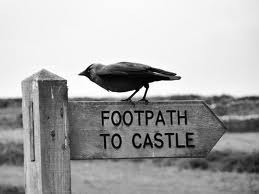
See the jackdaws by the castle,
Like ancient chess knights in black,
Peering across the stones they have guarded,
Since the time of Camelot way back.

And if you are searching for King Arthur,
And think Excalibur’s just well hid,
Then have a look in the village gift shop,
Because there’s a plastic one for each kid.

And if it’s Avalon you’re really after,
And your quest is to find the Grail,
Then read all about it in the village gift shop,
But only the jackdaws know the tale.

Because they were here when the walls were scarlet,
With the blood of a thousand knights,
And gouged and gorged as the dead lay dying,
Scattered over the rocks after every fight.

So if you are searching for King Arthur,
And climb through ruins to Merlin’s Cave,
Then look a bit further from the ley lines,
And behold those birds as bold as day.

Because they no longer feast on the flesh of fighters,
Their carrion call is no death knell,
It’s the crumbs of the pasties they’re after,
Which is why they will never tell.

Thursday, September 29, 2011

Restaurants & Dealing With Awkward Diners


I've been running the kitchen at a friend's restaurant in Cambodia for the past couple of weeks. It's the wet season, so there aren't many customers about. But it's been good fun getting back into the kitchen, and teaching the Khmer cooks how to make Western dishes, and learning a few Khmer staff meals from them.

But although it started well, I’d forgotten just how irritatingly tight-fisted some customers can be, especially the sort of drinkers and loners that wash up on Cambodia’s beaches. I know it’s a third world country, but it’s astounding how many expats want something for nothing out here. And it’s not just thrill-seeking pensioners stretching out their money each month - the worst ones are the ones with money.

There’s one extremely wealthy Austrian man, for instance, who’s been known to buy a draft beer from one bar for $0.75 (less than 50p), and then wander over the road to drink it in another bar, where it’s $1 a glass. He eats in our restaurant some nights, but always brings his own bottle of wine and asks for a glass.

When the previous owner got fed up with it, and said he was going to start charging him a $1 corkage fee, the pensioner got quite upset. One night he complained that the lasagne was too big.

“Next time, I think I’ll just ask for half,” he said.

“Well, you’re still paying $5!” the owner snapped.

Message aimed at drunken foreigners in Phnom Penh...

But the worst of the lot is a railway contractor called Steve, who regularly boasts about how he’s getting $200,000 a year in a country where the average annual income is $650, and shells out just $5 a night for our delicious, slaved-over food – and picks fault with everything.

Every night he comes in with a new request. It started off with cauliflower. He said he wanted a few florets with his next meal, and then it was pumpkin, and then he started dictating orders into the kitchen.

“Can you prick the sausages before you cook them,” he asked.

“I can do more than that,” I muttered.

The next night, Steve ordered the spaghetti bolognese I’d put on the specials board and I nearly exploded. I counted to ten in my head and bit my lip, but still the bile was rising.

I knew how to make bolognese. I’d spent 15 months of my life I’ll never get back making bucket load after bucket load of the stuff and wheelbarrows of lasagne in a kitchen supplying very demanding Italian clients who would scream down the phone if there was ever the slightest deviation.

The recipe – which had apparently been handed down by the chef-owner’s grandmother and mentor - was perfect. There’d even been an oil painting of the old crone glaring down at us as we chopped the precise amounts of garlic, pancetta and plum tomatoes to make “Grandma’s Bolognese”.

I hadn’t skimped on anything, and it took me three trawls of the local markets just to find celery. There was so much red wine in it, we were barely making a dollar on the dish.


I’d even cured the pancetta myself with salt, sugar, and the local delicious Kampot pepper (the trouble is I can’t get any saltpetre here, which although isn't essential, helps keep the bacon pink, and stops it going grey when cooked. The closest I got was a packet of “powder for fermenting pork” from Thailand, which contained sodium nitrite, and worked fairly well to keep it pink).


But it was all lost on Steve. And it didn’t help knowing that he’d earned far more that day than I would in a whole month cooking bespoke meals for him.

“I don’t like it when the meat is runny, you know what I mean?” he said. “Can you cut up the spaghetti into small pieces and then mix it with the sauce – you know how Heinz does it?”

I fought the urge to ask whether he wanted me to fetch him a little bib to eat it in. The next day he ordered a pizza and threw the Khmer staff into chaos when he asked for “the crust to be turned inwards to keep the cheese in”. Then he asked if we could make him rissoles the next night.

“But they’ve got to have onion in. Chopped up small and everything, know what I mean?”

Later, I was showing the Khmer staff how to cook a half-pound steak burger, made from fillet steak I’d aged in the fridge for 10 days and then minced. Khmer beef is so cheap - you can buy a whole fillet for $9 a kilo down at the market. The ‘normal’ stuff is $8 a kilo. They don't really understand cuts here, as I’d learn. Meat is just meat, although head and offal are cheaper.


When I went down to the market with one of the Khmer cooks to buy three kilos of tenderloin, and they charged us $27 instead of the normal $24 for chuck and shin, she began screaming at the butcher because she thought he was trying to rip us off.

I’d made a sauce from mayonnaise, mustard, and a little ketchup, chilli sauce and finely chopped gherkins, and had given the Khmer girl down the road some sesame seeds to bake me some buns, and it was all going well until Steve stuck his head into the kitchen.

“Yeah, that’s it. Nice and crispy on the outside like that,” he said.

He honestly thought we were practising his rissoles. He’d been in Asia for far too long.

“This is a burger,” I told him, but he wasn’t listening.

“Oh good, you’ve got the onions in already...can’t make rissoles without them.”

THEN THERE was the Sunday roast. I did roast chicken with all the trimmings - stuffing, cauliflower cheese, bread sauce, steamed veg, pigs in blankets (using my own bacon), roast spuds etc. I’d made stock from the off-cuts I’d got from trimming the eye fillets, and the gravy was pretty good. It must have been, because the only complaint I got was from a miserable old American hippy, who moaned that it wasn’t as thick as the lumpy, gravy granules version he had with his pies.

He was the one who’d complained about my Cornish pasties the day before. The Khmer cooks had been putting gravy in the pasties until I stopped them. I got them to make them the proper way, using raw beef, onion, potato and a type of sweet potato you get out here that tastes a bit like swede, but doesn’t stay firm like swede when cooked.

The old hippy ordered a pasty for lunch every day, as I was to find out, and was pretty much the only person who ate them. When the next one arrived at his room, he cut it open, complained it was too dry because there was no gravy inside, and threw it back at the delivery boy. He didn’t even try it.


THE ROAST must have gone down quite well though because we were the busiest restaurant on the street, and we even got a few of the more sniffy French customers eager to find fault with a 'rosbif’ cook. But there was still the usual list of bizarre requests.

A party of English publicans phoned up to say they wouldn't come over unless there was Yorkshire pudding, which I had to hurriedly knock out because they are relatively big spenders, and some idiot asked whether we had any mint sauce for the chicken.

The plates came back empty. But there was little praise or appreciation. No understanding of all the hard work and expense that had gone into their meals. Just a cold, clinical evaluation of whether it was worth $5, and what else that could have bought in Cambodia.

The only feedback I got was from one regular, who said the meal was so big he could barely finish it, and suggested we give people the option of buying a smaller one for $4 next time.

After another week, I’d had enough and walked out. I realised that the only way to cook out here was to run my own place, then I could serve the customers I liked, and be able to tell Steve exactly what he could do with the pumpkin he’d requested for next week’s roast.

So instead of spending the next Sunday in a cramped sauna, I spent the day lazing on the beach at a restaurant shack, talking to the owner. I was doing a bit of homework because the hut next to him was for rent for $350 a month – and I was toying with the ridiculous notion of turning it into a seafood shack, building up the business, and then selling it on.

Alright, I knew I wasn’t going to make any money running a restaurant in Cambodia, but that wasn’t the point. I gazed out to sea and the peaceful, soon-to-be-developed, mist-shrouded islands. Where else in the world could you own a lease on a restaurant on a white sand beach just 20 yards from the sea?

Later that night, I was sat at a bar when Steve walked past.

“They missed you in the kitchen with the Sunday roast today,” he said.

I put my head in my hands briefly, and waited for it.

“Why, what was wrong with it this time?” I said.

“Well...there wasn’t one...they said they couldn’t remember how to cook roast potatoes.”