Showing posts sorted by date for query Heston. Sort by relevance Show all posts

Wednesday, February 28, 2018

What’s All The Fuss Over Nando’s Using McCain Frozen Chips – Top Restaurants Are At It As Well


Anyone who has ever eaten at Nando’s will know the chips are the soft, puffy, mulchy sort that bring back unpleasant memories of school dinners. You know that sort of half-baked, oven chip taste. A film of jaundiced, fried potato barely holding in a pillow of tasteless white mush.

So, it is perhaps no surprise that the chicken chain has admitted using McCain frozen chips in its restaurants. It came after a student working at Nando’s grassed them up to the Leicester Mercury newspaper, and other media outlets lifted, I mean followed up, the story.

Nando’s was quick to point out that these were not the sort of McCain chips you might bung in the oven at home. But instead were a “specific recipe” exclusively made for the chain – which does make you wonder just how much effort went into making the chips as unpleasant as they are.

It hardly needs to be said that the outrage over this damning indictment caused much merriment and vitriol on Twitter and other social media dungeons, perhaps more so than usual because the snow meant more people than normal were sitting in their underpants, firing off tweets that no-one would ever read, rather than braving two inches of snow and struggling into work.

I haven’t the fortitude of character to bother checking whether there is now a chipgate hashtag in circulation, as I suspect there probably is. Just a handful of quoted tweets, for what now passes as journalism on the BBC website, was enough to put me off, with one moronic tweeter going as far as describing it as the “revelation of the year”.

KFC staff caught gobbing into chicken buckets or McDonald’s workers filling salt sachets with ricin might be worthy contenders for revelations, perhaps even of the year. But buying in chips from McCain is hardly a hanging offence, and Nando’s could help itself much more by simply training its kitchen staff to cook the chips properly.

To say the story is overdone is an understatement. What I find interesting is the attention these reports about what goes on in the kitchens of budget restaurants get. You can sense a definite snobbery and delight in middle-class foodie circles (i.e. foodie circles), presumably from people who would never lower themselves to eat in Nando’s or KFC, or at least would never admit to doing so. The schadenfreude at such ‘revelations’ is palpable among those who dine in far more expensive restaurants.

What I have never understood is how this level of outraged, puritan scrutiny rarely targets the top restaurants. Perhaps these places are just far better at concealing their tracks? Surely it is far more of a crime to pay ten times more than you would at Nando’s and then be served bought-in food.

At Rick Stein’s Seafood Restaurant, the chips arrived in sealed plastic bags ready to be fried – or at least they did when I worked there. They are not from McCain. Instead they are made at an industrial estate on the outskirts of Padstow, by Stein’s staff who also churn out all the Cornish pasties and chutneys that have made him one of the richest men in Cornwall - upsetting the locals no end (and not for just using the wrong type of pastry).

He can hardly be criticised for that. The explanation when I asked was that it was a space-saving ploy and there was not enough room in the seafood restaurant’s large, airy kitchen to peel potatoes and hand cut chips. Same as much of the other veg.

However, what did slightly irk was seeing other food come directly out of a jar or packet. As I say, you’d forgive this in a cafĂ© selling £6 or £7 lunches, but not in a restaurant that charges Michelin star prices, without actually having one.

When I did my brief stint in the kitchen there (admittedly a long time ago, but I’d be surprised if much has changed), if you ordered the potted shrimp, all the chef had to do was open a bought-in pot and put the contents on a plate with (home-made) toast. You could have saved yourself a small fortune just by going to Asda. The seafood pasta dish was almost as easy. But for that price you might think Stein’s staff were making the pasta themselves. Instead, they just boiled up packets of dried De Cecco linguine, which is a very good one, but you take my point.

I have heard countless tales from chefs working in many of the top restaurants in Britain, who can tell similar stories. Even the three-star Fat Duck was no stranger to the practice. The bread arrived each morning, supplied by a boutique baker, which is forgivable given the size of Heston Blumenthal’s coffin-sized kitchen. And Waitrose helped out with the sardine on toast sorbet. The pastry chefs could never have been accused of shouting it from the rooftops, and you got the feeling that any bought-in food would have been kept under lock and key away from prying eyes, as the great and the good were sometime given tours of the kitchens.

It was only when the pastry cooks on ice cream duty said they had run out of tinned sardines one day, that a hapless chef was sent off to the nearby Waitrose in Maidenhead for a few tins of own-brand fish, that it became obvious. 

Sunday, June 23, 2013

Heston Blumenthal Axed By Little Chef


The first sign that Heston Blumenthal’s makeover of Little Chef had failed was in January last year when the roadside restaurant chain announced it was closing 61 of its 161 outlets and shedding 600 staff.

No doubt the sacrificed wage slaves were delighted to learn that the millionaire chef would remain on the payroll as a consultant despite the mass redundancies.

But now they’ll be even more pleased to learn that Blumenthal, 47, has been axed and all his dishes dropped from the ten eateries they were served in.

In a strongly-worded statement, Little Chef bosses said his dishes - such as braised ox cheek, and serving fish and chips with a small bottle containing essence of pickled onion so diners could replicate the “smell of the chippy” - were deeply unpopular with customers.

The TV chef approached the chain in 2007 and persuaded them to let him film a three-part documentary for Channel 4 called Big Chef, Little Chef, focusing on his efforts to revamp its restaurant on the A303 at Popham, Hampshire.

Little Chef allowed him to change its decor and even install urinals playing recordings of Spike Milligan reciting nonsense verse.

But Little Chef said the experiment had not worked - and Blumenthal had “taken everything away from its core”.

“The problem is that no one wants his food. None of his dishes are popular,” said a spokesman. 

“We’ve dropped all his dishes from the ten restaurants where his food was available. That’s all gone as of this week. He’s been wiped off the menu. Little Chef needs to get back down to earth and that’s what we’re doing.”

Cue violins...

Friday, January 04, 2013

Celebrity Chefs’ Farts: The 2013 Food Trend Everyone Missed


After being bombarded with endless listicles predicting food trends for 2013, I wonder if there’s one that’s been left off? Or let off. And by that, I mean celebrity chefs’ farts. Perhaps sealed in vac-pack bags and poached gently in a sous vide water bath at exactly 37.2C for 37 minutes and then carefully unsealed at the table to be sniffed eagerly while licking a shit-caked brick served by a cook who talks about himself in the third person?

Eau de Heston? Ramsay No.5? And what about an iPod playing the actual sound of the famous chef’s trump that created such a umami-bubbling bouquet as thrill-seeking, trendsetter diners tuck into the food his slaves have cooked in his own name?

I’m joking, of course, but it does give me the opportunity to point out once again how many bullying, megalomaniac, deviant psychos you’ll find in professional kitchens. I wrote about this in my book Down And Out In Padstow And London about the insane characters you find behind the stove and the abuse they regularly inflict on their staff.

But I was still surprised to read about the actions of an apparently fairly well-known American chef who started out on a culinary mission five years ago to fart on every one of his 37 employees - including his accountant - and to chronicle his attacks in some sort of bilious journal, the same way a stalker might keep disturbingly detailed, breathless notes of interactions with victims.

The mystery carrot chopper claims to have had one or two shows on something called the Food Network, which narrows him down to about 100,000 and counting, because everyone’s a celebrity chef now aren’t they. You only have to do a quick news search on Google to find idiots you’ve never heard of donating mince pies they’ve incredibly made themselves - in their own time, and out of the very goodness of their heart - for some charitable cause and a few lines in the local paper.

The chef, who claims to have a restaurant in New York’s Meatpacking District, apparently even has a colour code for the offending farts he forced his employees to inhale, and has recorded his parps in a “rant and rave” section on Craigslist.

In the first strike, inflicted on a lowly kitchen worker on January 21 2008, he says: “It was hot as hell in the kitchen that night, sometimes I like to turn off the air conditioning to give my staff a bit of a stir, it makes their blood flow, their tempers flash, but for some reason, their discomfort turns out better quality food.

“So with all the air off, there is no air flow in our downstairs kitchen, and its small and cramped and really, really fucking hot, even in January. We have our plates in the warmer under our pass, so i was helping my hot apps guy plate a new fungi misti when it happened.

“He had the pan in his right hand, and we both reached to bend over to get the hot plate, i got there first, so he inhaled the entire hot air load that i let roar out of my pants. It was bold, loud, and completely unapologetic...”

He was so delighted, he decided to fart on the rest of his kitchen crew in alphabetical order of their surnames. One by one. And two days ago, his quest was complete.

“I think it took them out of whatever musical they thought they were living in, and made them alive, made them smell, made them want to throw up for a valid reason,” he muses.

“I think all farts should have a color assigned to them, because you know when that one fart comes out and lingers in the air and wont leave, I mean its obvious that is a green fart. Everyone should know this by now, its even documented in cartoons.

“A red fart is a spicy one, probably incurred by some type of spicy ethnic food with a great amount of chilis and onions. A yellow fart, well these are worse on the farter, than they are on the fartee. These are sick farts, the ones that are on the verge of being sharts. Just imagine the fart that comes after downing like gallon of vodka, eating like 5 gyros on st. marks, then bagging a hooker named natasha, who acts like she is from russia etc etc.”

The chef - who describes himself as “definitely known in and around NYC” and brags that he has had “several specials on foodnetwork (sic)” - promises to detail the story of each fart over the next 37 days. Well, he would have done if his odious postings hadn’t already been removed by Craigslist. If his tales are true, let’s hope there were lawyers reading...

Saturday, October 27, 2012

Heston Blumenthal Finally Jumps The Shark


Heston Blumenthal has been touring the UK for his latest TV programmes, taking part in increasingly ridiculous stunts in the chase for ratings, and ultimately more exposure for his brand, which now stretches to everything from airline grub to supermarket meals to hawking spectacles for Vision Express.

But the celebrity chef’s latest culinary trick of sucking on tampons seems a tad on the ludicrously trite side even by his own standards. Clearly revelling in his nerdy image, he comes across as a hot-breathed schoolboy who’s found his way into the women’s’ changing rooms, as he talks excitedly about how stuffing his mouth with a tampon to remove saliva helps improve the taste of food.

"If you drain the moisture in your mouth you experience richness, creaminess and sweetness more intensely," he told The Guardian. "If you have a spoonful of ice-cream then put a tampon on the tongue for a couple of minutes, when you eat the ice-cream again the taste will be richer."

He says he was put on to the idea in a Dutch food lab by oral physiologist Don Prince. Before long the pair were "playing around with different tampons".

Why he finds tampon munching a useful experiment is anyone’s guess because tampons won’t be featuring at any of his eateries he never cooks at. You won’t see diners at Dinner or the Fat Duck with pieces of string dangling from their mouths, like mouse-eating lizard people from V, iPod headphones clamped to their ears as they listen to the sound of toilets flushing.

Back at his lab above his prep room at the Fat Duck, he’s already been tinkering with yoghurt and tampons for an “interactive presentation”. He glosses over why he uses tampons rather than any other equally absorbent material, or one of those mini vacuum cleaners dentists use to suck saliva from your mouth. But then that’s because tampons are far more of a gimmick, and there wouldn’t be nearly as much publicity if he just used a wad of kitchen roll.

He’s been described as either one of the world’s most talented, innovative chefs or one of the biggest confidence tricksters of his generation - with some who have eaten the Fat Duck tasting menu left wondering whether the joke is really on the customer. But the way his gastronomic stunts have been going of late, he’s beginning to resemble one of those creepy TV magicians.

What will he do for his next trick? Starve himself for a month in a glass box, suspended over the Thames, to see how nice a doner kebab tastes at the end of it? As for the tampons, as an Aussie friend pointed out on Twitter: “How on earth is Waitrose going to market this one...” Heston from Waitrose tampon palate cleansers? What’s next a bin bag, and an amyl nitrate-filled hidden orange pudding in his mouth?

Monday, June 25, 2012

The Food They Won’t Be Serving At The London Olympics


With the Olympics just a few weeks away, it appears every feature writer in the country has been hard at work trying to find ways to nose articles on London 2012.

We’ve had daily pieces on the stately homes, towns, former pit villages and rough estates the Olympic Torch has passed through on its 70-day journey around Britain. Nature writers penning columns on the 2,000 ash, alder, cherry, willow, birch and hazel trees planted in the Olympic Park. And history nuts casting their eyes back 64 years to the last London Olympics, when athletes apparently travelled by bus, stayed in shabby flats, and sewed their own kit.

Then, there was rationing. Now there are trendy food markets and pop ups on every corner, and a never ending appetite, it seems, for food and drink features with an Olympic theme, however desperately crowbarred in. I even spotted a journalist the other day on Twitter desperately asking whether anyone “could think of a way of linking a feature about drink with the Olympics”.

There have been endless, clichéd articles about how British food is trying to throw off its stodgy image of stringy beef and boiled, overcooked vegetables with everything. Apparently, according to some food writers, the world still sees us a culinary wasteland built on deep-fried Mars bars, instant mash and baked beans. Where have they been for the past 20 years?

Even David Cameron has got in on the act, espousing the virtues of sticky toffee pudding from Cartmel, oysters from Whitstable, salt marsh lamb from North Wales, and smoked salmon from Scotland, as the key to our cultural identity - showcasing “our heritage, openness, creativity and diversity". He didn’t mention what he plumps for at his country suppers.

We’re told spectators will be able to enjoy roast pork on a roll, Red Leicester cheese and apple chutney sandwiches, and, of course, fish and chips - as well as dishes from far away places like Asia, Africa, and the Malvinas. Roast penguin anyone? And if that wasn’t enough, the world's biggest McDonald's in the Olympic Park. Well, they had to do something for the sponsors I suppose.

But however ethnically diverse the offerings, thankfully you won’t find some of the foods I ate while covering the last Olympics in Beijing. In the weeks I spent there suffocating in smog, I wrote an article on the city’s Donghuamen night market, which the Chinese government had rebuilt to showcase 100 "dainty snacks" from all corners of China. Dainty wasn’t the word immediately on my lips when I conducted a Bushtucker trial with tourists in the market. Here it is, if you want a read...


I THREW up five minutes after visiting Donghuamen night market. It wasn't the snake, or the scorpion, the lamb's penis, testicles, bees, centipede, or the beer I downed trying to banish the taste. It was the silkworm.

It exploded in my mouth and it was everything I could do to stop myself instantly gagging on the musty, yellow gunk. I managed to last until the filming stopped - and then threw up in one of the bins.

All to the bemusement of the locals, who clearly found the array of creepy crawlies, and other things that go crunch in the night, delicious.

A sign in English said the people's government had rebuilt the market, off Beijing's central Wangfujing Street, to showcase 100 "dainty snacks" from all corners of China.

They said they wanted to "enhance the friendly exchanges with foreign countries."

But when I offered the delicacies to the hordes of Olympics fans who had descended on the infamous tourist spot, I think the most complimentary comment was "absolutely disgusting".

Only the French seemed to like it. A gaggle crowded round the scorpion stand and made pleasing, lip-smacking gestures in the way they would if they were tucking into a truffle or slice of foie gras, or a frog for that matter.

The whole thing was a dreadful experience, but the politburo was right: it did lead to some friendly - and hilarious - exchanges. I even found myself having a new-found respect for the likes of Peter Andre and Paul Burrell.

The Bushtucker Trials on TV show I'm A Celebrity… Get Me Out Of Here looks easy when you're munching crisps on the sofa.


But when you get that first stomach convulsion, and insect legs stick in your throat, and the deep-fried, rancid taste is with you for the next 12 hours, it takes a lot more guts than you think.

"What do you think of the silkworm then?" I ask Canadian Kim Warburton, who is on a fact-finding mission for the Vancouver Games in 2010.

"It's awful. It's definitely a local taste - and it's still in my teeth!"

Her colleague Sarah Triantafillou is having none of it. I offer her a bit of snake, or was it a baby seahorse? But the most adventurous she'll go is the noodles.

"What did you think of the baby eels?" I ask. "What! No way!" she shrieks, clutching her mouth.

A Mexican guy butts in, shaking his head with a hangdog expression. "The scorpion was interesting," he muses.

I eventually get an American, in obligatory baseball cap, to eat a three-inch centipede. "It looks horrible, what does it taste like?" he grimaces. "It tastes like centipede," I tell him.

He crunches away with a pained look. "It's terrible - it's as bad as it looks. Errr centipede!" I offer him a beer to remove the taste.

"No thanks," he says. "If I drink too much beer, I might eat another one."


:: My new book 'Down And Out In Padstow And London' about my disastrous attempt to train as a chef, including stints at Heston Blumenthal's Fat Duck, Rick Stein's and other restaurants, is available as a paperback and eBook on Amazon CLICK HERE

Tuesday, June 19, 2012

The Hand And Flowers: Can A Two Star Michelin Eatery Really Still Be Called A Pub?


I’d been wanting to go to the Hand And Flowers for a long time. The last time I’d drunk there was as a youth, when it’d been an unassuming country pub perched on the fringes of an upmarket town, and I’d thrown up in the garden. But, unlike me, it’d done a lot of growing up in that time, and was now a two-star Michelin eatery owned by fast-rising celebrity chef Tom Kerridge.

So a few days after returning from my 17-month sojourn in SE Asia, I drove to Marlow in Buckinghamshire to try out the grub. As I walked up to the front door, I was delighted to see Kerridge dealing with a van driver in the car park. The 38-year-old cook appeared rather red-faced and stressed - much more chef-like than the relaxed, smiley-faced man who stole the show on the BBC’s Great British Menu.

The fact that he was there at all, not just propping up the bar signing menus and regaling customers, but actually in whites cooking in his own kitchen, spoke volumes. Compared with the number of absentee sleb chefs you get in restaurants these days, it was a hugely refreshing sight knowing he would be behind the stove, driving on his team of nine cooks in his newly-enlarged kitchens, rather than flouncing around in front of cameras.


But as it turned out, he’d just returned from a three-week jolly to Singapore, where he’d been showcasing British pub food with his sous chef. I don’t know who’d been covering for him, or whether standards had slipped in his absence, but I was glad to be eating there when the big man was behind the stove, even if he did look a touch jet-lagged and frazzled.

The venue is hailed as the only pub in the world with two Michelin stars...but hang on a minute. Pub? Alright, it serves draught beer, has a bar, and is decked out in dark wood, but surely a pub is somewhere you drink? Somewhere you can order beer without anything more than crisps, cockles, or pork scratchings and not get frosty looks? It’s not a place that sells bottles of 1995 Chambolle-Musigny 1er Cru Amoureuses, Dmne Roumier for £1,100, or have I been away too long?

For me, there’s an easy test. If you can drink there happily without having to order grub, it’s a pub. If you can’t, it’s a restaurant. So the Hand And Flowers definitely isn’t a pub. I mean, there’s a line at the bottom of the menu saying minimum spend £15. You wouldn’t get that in a proper pub, would you? So just to check, I gave them a ring, pretending I’d just moved into the area and was checking out the local venues. Could I have a drink in there without buying food, I asked, expecting an immediate: “No, of course not. Fuck off.”.

I was wrong. The manager seemed quite well versed on the subject, schooled even. She said I was welcome to have just a drink. But only if I was standing at the bar, or standing or sitting in the garden. In short, the only way I could sit down without being rained on was by ordering food. So that’s settled - the Hand And Flowers IS a pub and is quite correct when it describes itself as “the first pub to have been awarded two Michelin Stars”. I just don’t know anyone who’d want to drink there. Five minutes of being jostled by never-ending waiters would be enough.

But as it turned out, I ate at the bar anyway. I’d booked the day before, and the only free table was at 2.45pm. “Isn’t there anything earlier?” my dining companion asked, so I tried again. The manager, who’d clearly forgotten about space needed for drinkers, said I could have a table at the bar at 12.45pm, 1pm, 1.15pm, 1.30pm...and presumably would have gone right the way through the afternoon at quarter of an hour intervals, until I said 1pm was fine.

So there I was. Kerridge looking red-faced dealing with a supplier in the car park. Me sat at the bar in candle-light. It’s for this reason, I have to apologise for the very poor quality of these photos. The place was so dark, it was like eating in a mine shaft. I ordered a pint of Greene King IPA, and my dining companion went for a similarly splendid gin and tonic. You might think there’s little that can go wrong with a gin and tonic, but apparently not. And there must be something in it, otherwise Michelin inspectors wouldn’t test the quality of a restaurant’s, sorry pub’s, beverages by ordering orange juice (is it freshly-squeezed etc) and a G&T (don’t ask).

Although the choice of items on the a la carte menu sounded fantastic - crispy pig’s head with rhubarb; loin of Cotswold venison with ox tongue; parsley soup with smoked eel et al - we went for the set lunch menu of two courses for £15, or three for £19, because I was paying. I was also intrigued how they’d pull off two-star cooking at the price of an all-you-can-eat Sunday curry buffet.

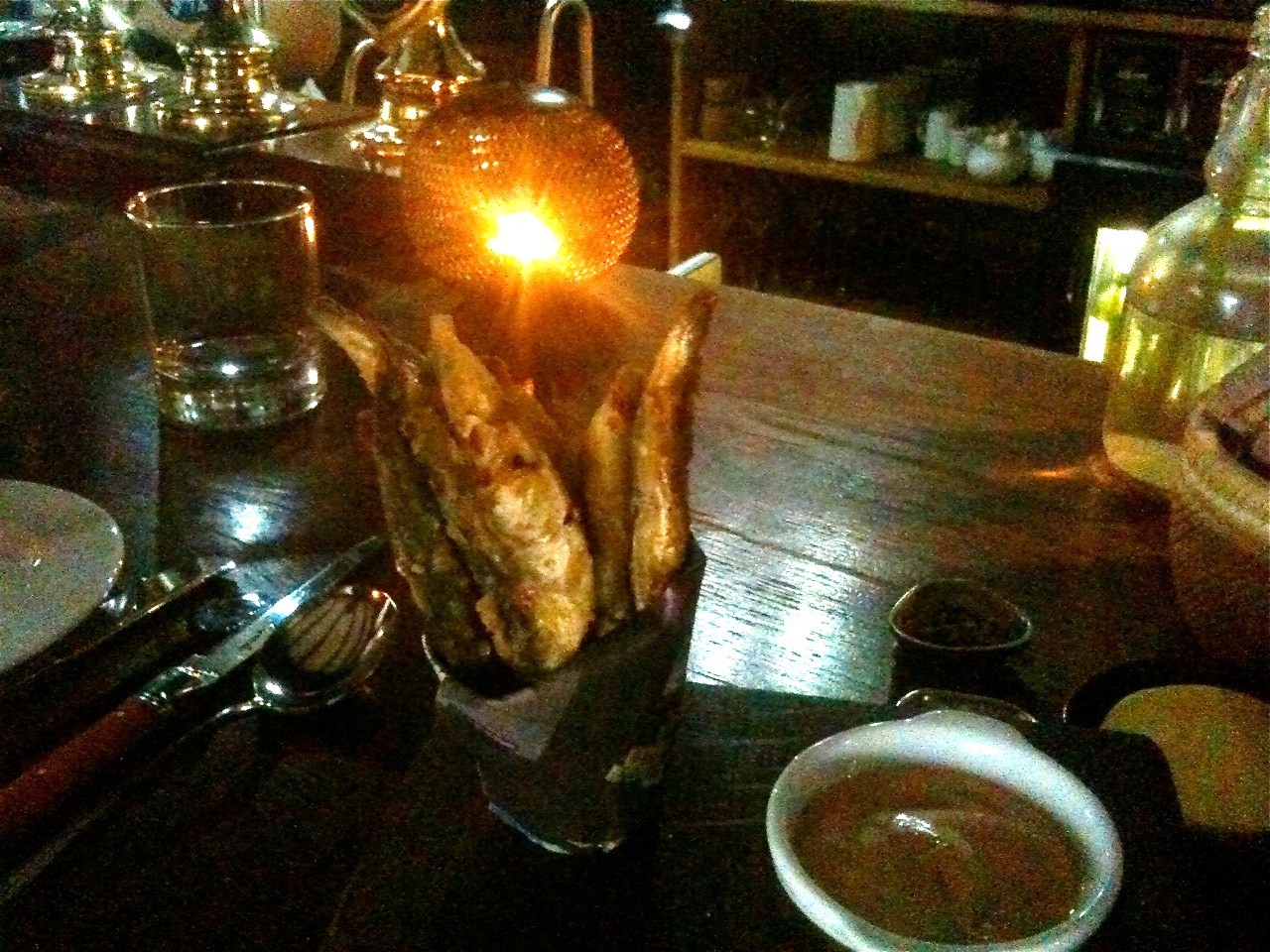
A plate of “free canapĂ©s” quickly arrived, delivered in a bounteous fashion as if they were a special favour for us. But it turns out they do this for everyone. A couple of slices of delicious bread, tiny saucers of flaked salt and freshly-cracked pepper, and a fish and chip-style cone of whitebait in a wonderfully light batter.


The cone arrived on a wooden board next to a small pot of Marie Rose sauce - which was as bad a match as it was made. Why anyone would want to dip whitebait in prawn cocktail sauce is beyond me. But when it’s the sort of pedestrian mayonnaise and over-riding ketchup flavour you’d expect from a James Martin airline meal, it’s far harder to stomach. But perhaps I’m being too harsh? They were “free canapĂ©s” after all.

The next blip was the “cauliflower soup with potato pakora and curry oil”. Cauliflower soup is never a particularly brilliant dish, for my money, but it works best when it’s done simply with just cauliflower and stock. This one was so drenched in cream, the cauliflower was left peeking out like a pervert in a Soho booth.

The soup was topped with a huge and deliciously-spiced pakora. But where was the curry oil? Normally you can’t miss it, because chefs can’t stop themselves doing fancy patterns with squeezy bottles. Then came the question of how to eat it. Do you dip the pakora in the soup? Or wolf it down, then get to the soup? Or sink it and eat spoonfuls of pakora and soup?

I went for the latter, and clearly this wasn’t the right way because as soon as I put my spoon down for a second, mid-bowl, the waiter - obviously noticing there was no longer a massive pakora terrifying my broth - snatched our plates away.

“Finished our soups gentlemen?” he said, not waiting for an answer. “How were they for you?”

Normally, I’d be annoyed. But I was pretty much creamed out by that stage. And it was the only fault in the otherwise excellent service. Sadly, in many Michelin-starred restaurants, or far worse prissy restaurants overlooked by the tyre guide, the service can be so affectedly solemn it leads to the sort of constipated atmosphere that does little for the indigestion. But it was just right at the Hand And Flowers. The Dereks were friendly and relaxed without too much pushy, while being extremely professional and attentive throughout. The only exception was the soup snatcher with the silly hair. But there’s always one.

Next came “belly of Wiltshire pork, spring turnip puree with marmalade and Italian leaves” - which was an absolutely sensational dish. Kerridge is known for his pork, and this showcased every bit of his talent. It was quite simply out of this world. It wasn’t the most generous portion of meat, but what do you expect at that price?


The belly, garnished with kohlrabi shoots, was juicily moist, and the skin beautifully crisp. It was perched on grilled and pickled endive, which was wonderfully bitter, and balanced the sweetness of the turnip puree and marmalade. The toffee-coloured gravy was divine, and having worked in a couple of Michelin restaurants, I can only guess at the fuss that had gone into creating it. Almost as good were the tiny copper saucepans of pomme boulangère we ordered from the sides to go with it. It really was a wonderful plate of food.


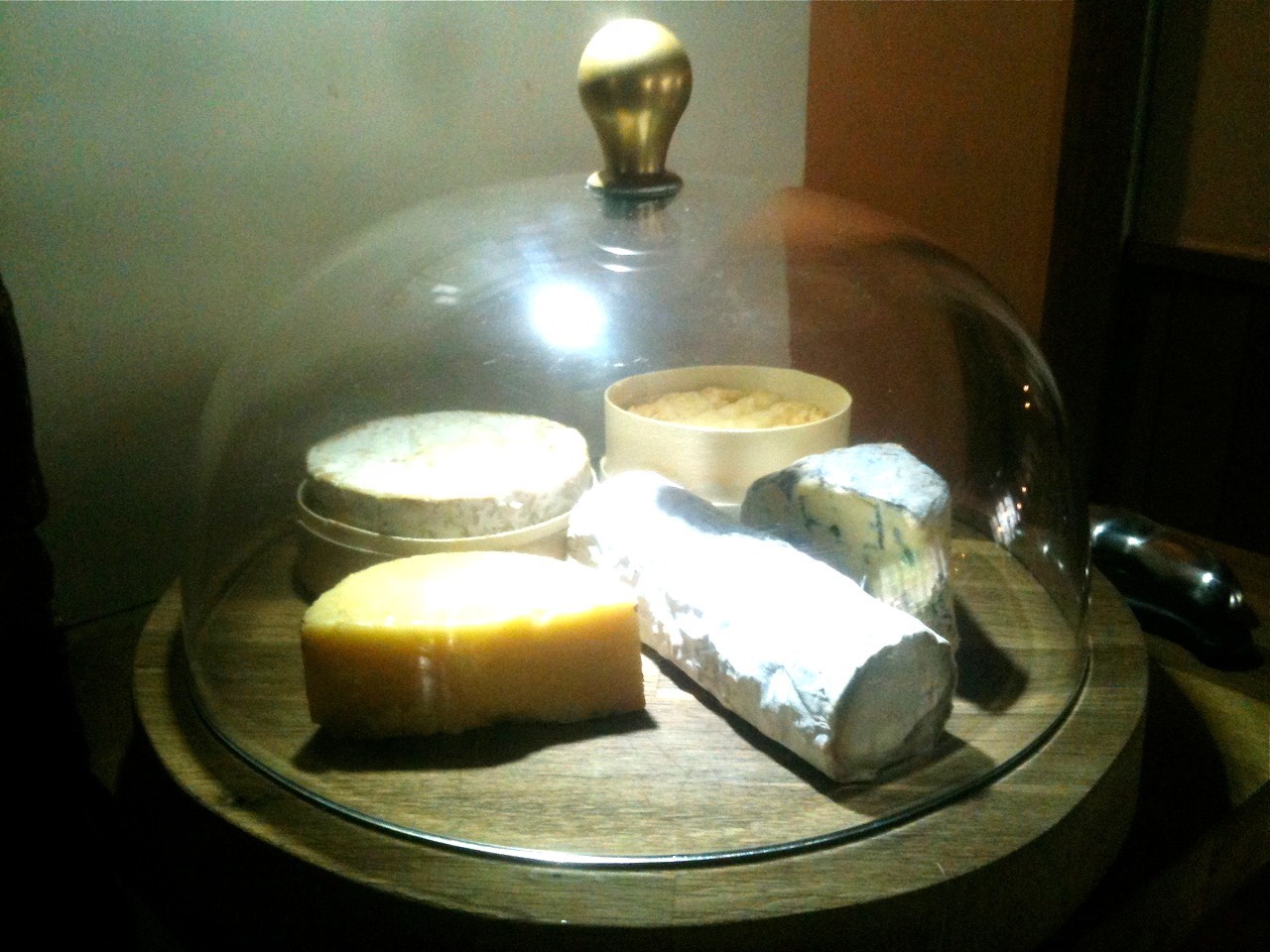
We were asked if we wanted desserts, but settled for coffee. I was tempted by the wonderful looking cheese board perched near my elbow - camembert, Wookey Hole Cave aged cheddar, Golden Cross, Barkham Blue, and the strongest of them all, plaisir au Chablis - a cheese from Burgundy washed once a week in wine.


Overall, it was a very relaxed, charming place to eat with brilliant service. And perhaps it’s unfair to judge a restaurant, sorry pub, by its lunch menu, but if it hadn’t been for the brilliance of the pork dish and boulangère side, I could have shut my eyes (or blown out the candles) and imagined myself in any one of the thousands of mediocre gastropubs that have spawned across Britain. I'd need a lot more convincing to accept it's the best one of the lot.

:: My new book 'Down And Out In Padstow And London' about my disastrous attempt to train as a chef, including stints at Heston Blumenthal's Fat Duck, Rick Stein's and other restaurants, is available as a paperback and eBook on Amazon CLICK HERE

Sunday, June 10, 2012

An Expat Returns: Food I’ve Missed - The Good Old British Pie


I mentioned in my last blog that I’d write up some of the meals I drooled over in the 17 months I spent living in hotels in SE Asia, with only a kettle to cook in. And at the top of the list, or thereabouts, was the good old British pie.

What would I cook first, now I had a kitchen again? Steak and kidney pudding? Chicken and mushroom? Minced beef and onion? A proper pork pie or Cornish pasty? Or how about one from The English Cookery Book by Lucie G Nicoll I’m re-reading? A curiously quirky and charmingly vague book that for the second season of the year (April, May, June - if indeed it is early summer now, and not late autumn which the weather seems to suggest) recommends May Pie - an unspecified pastry filled with stewed young onions, turnips, carrots, lettuce hearts, parsley, and green peas in gravy. Or salmon pie - which is more of a baked fish loaf than a pie - containing just milk-soaked breadcrumbs, salmon, butter, seasoning, and beaten egg.

To be honest, neither was what I was imagining in those long evenings supping iced beer while discussing the merits of meat pies with Kiwis - a people that seem to hold the crumbly, fat-soaked comfort of flesh and pastry in even higher esteem than the Bovril-swigging English football fan.

In fact, I had to go back to the first season of January, February and March (who said the seasons aren’t changing?) to get on to the good stuff like beefsteak and kidney pudding made with nothing more than rump steak, beef kidney, flour, and ‘suet paste’. Or calf’s head pie made with head stock and meat and boiled eggs. Or Fanny pie comprising beef, mutton, bacon, onion, carrot, potato and ‘rich paste’. Or how about vermicelli pie, mutton pie, or bacon and herb pie?

No, I’d make it my own way from whatever needed using up in the fridge and freezer - in this case three chicken breasts and a bag of 18-month-old frozen leeks - a concoction which with a midnight plunder of next door’s herb garden  became ‘chicken and leek pie in tarragon pastry’.


And I have to say I was really chuffed with the result. It was so filled with herbs, it sort of stumbled drunkenly on the tongue in a heady bouquet, like sage derby on a few crackers. And although I’d made up the tarragon pastry on the spot, it turned out crispy, delicious and thankfully golden despite the unappetising green colour before it was cooked.

Anyway, enough talk. Here it is. It’s really worth a go - especially if, like me, you’ve been pie less in a pie-filled world for far longer than you’d care to recall.

Chicken And Leek Pie In Tarragon Pastry

For the filling:

A little butter and olive oil for frying
3 shallots, finely chopped
2 sticks of celery, peeled, cut into four lengthways, and then diced
2 garlic cloves, finely chopped
2 leeks, washed well and sliced
3 thyme sprigs, chopped
3 chicken breasts, cut into 2cm-wide cubes
1 bacon rasher, thinly sliced
50g butter
50g flour
300ml milk
1/4 nutmeg, freshly grated
salt and pepper

For the pastry:

300g plain flour
150g lard
1 level tsp salt
Leaves from 3 tarragon sprigs
130ml of cold water
A greased pie dish, 8 inches wide and 2 inches deep

Melt a knob of butter and a splash of olive oil in a pan and fry the shallots for a couple of minutes until they are slightly browned. Add the leeks, garlic and celery and fry for another few minutes, stirring frequently to stop the mixture catching. 


Add the bacon and chicken breast. Lower the heat, and continue cooking for another 10 minutes, stirring occasionally.


Meanwhile, make the pastry by putting the flour, tarragon, salt and lard in a food mixer and pulsing until it resembles greeny-grey breadcrumbs. The amount of water you add will depend on how much moisture was in the tarragon. Mine took about 130ml of water. Continue pulsing the breadcrumbs while trickling in the water. Stop when the pastry forms a ball and comes away clean from the sides of the processor. Cover with clingfilm and put in the freezer to chill.


Add 50g of flour and the freshly grated nutmeg to the pie filling and stir well for a minute over a low heat. Slowly add the milk, making sure each splash is fully blended in before adding the next one. By the end, the sauce should be the consistency of thick custard. If it’s too thick, add a little water. Continue simmering for another five minutes, stirring all the time, then take off the heat. Add the chopped thyme and season with salt and pepper.


Remove the pastry from the freezer and knead a couple of times on a lightly-floured board. Take two thirds of the ball, flatten into a disc with your hands, and roll into a circle about three inches wider than the pie dish.


Drape the pastry circle over the rolling pin, and then line the heavily-buttered pie dish. Push down gently to make sure there are no air pockets. Trim the pastry from the sides.

Roll out the excess pastry until about 5mm thick. Cut into strips. Brush the trimmed pastry edge with water and lay the strips on the rim of the pie dish and gently press together. Brush the pastry rim with water. Fill the pie with the creamy chicken and leek filling.

Roll out the remaining pastry to fit the top of the dish, and press the pastry edges together. Cut round the dish to remove the excess pastry, and then squeeze the edges together with a fork. Roll out the surplus pastry and cut into leaf designs to decorate the pie. 


Brush the pastry with egg yolk. Pre-heat the oven to 180C and bake the pie for one hour, or until a beautiful golden brown colour.


:: My new book 'Down And Out In Padstow And London' about my disastrous attempt to train as a chef, including stints at Heston Blumenthal's Fat Duck, Rick Stein's and other restaurants, is available as a paperback and eBook on Amazon CLICK HERE

Friday, June 08, 2012

Panic Buying Of Bunting And A Rant About The Jubilee


After 17 months in Asia, I have finally returned to the UK and it’s been quite a culture shock as I suppose I always knew it would be. “How are you going to cope with being back here?” concerned friends and relatives asked. They answered the question themselves before I could. “You’re not. Are you?”

Well, I have no idea, if the truth be told. I arrived just in time for the Diamond Jubilee celebrations. Festivities would be too strong a word. I went to my parents’ village fete, which was opened by actor David Jason, who lives down the road, and watched the egg and spoon races and drank the awful summer bitter supplied by Chiltern Brewery.

Then I watched the military parades put on by the Army, RAF and sea cadets, and took a couple of pictures of Del Boy posing with the Royal British Legion Riders Branch, hoping the snaps might get into one or two of the papers. I could see the headline already “Lovely Jub-i-lee” - and wrote how the Only Fools And Horses star had swapped his grubby three wheeler for a shiny Harley Davidson.

But what struck me most was the massive difference between Asian culture, particularly in Cambodia, where I spent most of my months in SE Asia, and the floral-knitted lifestyle enjoyed in Britain. It seems far more tediously pedestrian than when I went away, not that it has probably changed that much however badly the country’s been run by Dave and his pasty-eating chums.

Of course, there are many things wrong with Cambodia - abject poverty, corruption, the complete lack of free education and healthcare, not to mention the impunity of officials able to gun down protesters who have the temerity to ask for little more than a slight improvement in their atrocious living standards. By comparison, the pasty tax is a tiny cold sore on the moon’s face.

But there are many things the country does much better than Britain, and perhaps the most noticeable of these is having fun. I think people here have forgotten how to do it. It isn’t just the terrible weather and the obsession with it - newspapers banging on about the Blitz spirit and how a million people lined the Thames, braving life and limb in monsoon conditions to cheer on the Queen  - it’s something far more depressing and mundane. You can’t blame it all on sodden spirits and the icy grips on umbrellas, it’s what passes for having a good time these days.

Just how did people celebrate this historic, patriotic occasion - and more importantly an extra day off from the soul-destroying office? They waved flags and held garden parties, and got local celebrities they never see for the rest of the year, to open village fetes. Some even held jam competitions and rode ponies. But nowhere, from what I could gather from idiot TV presenters interviewing people around the country about what the Queen means to them, did anyone seem to be having any fun. Nothing even close to it.

After Del Boy had done his stuff and tottered back to his mansion in his huge wellies, people gathered outside the village hall for a pig roast. And how did they enjoy this porky feast? They formed a huge queue, as only the British can. Few people spoke, no-one mingled, they just looked at the queue snaking away in front of them and wondered whether there would still be some meat by the time it was their turn to bung some apple sauce in a floury bap.

I’ve seen street beggars in Phnom Penh having more fun with a flat can of coke. It was sad to see. And for me, it largely comes down to community spirit. Or the complete absence of it. Here, villagers live a few yards from each other, just like Cambodia - and yet no-one knows who anyone is. It’s all about the fact they get in little boxes to drive to work, then work in bigger boxes, and then return in their little boxes for an evening in front of an even smaller box, which is why so many pubs are closing. And the only interaction they have is when a planning application is submitted and they get hot under their NIMBY collars and worry about how the extra homes or high speed rail link will affect property prices.

There’s tangible fear everywhere. Fear of breaking tedious bylaws and being seen to do wrong. Fear of being themselves. Fear of actually enjoying themselves. You might disagree. You might think what does this idiot know. We had a tug of war in our village, a cow pat-throwing family fun day, and a nettle eating competition. It was great fun.

But it really struck it home to me after the pig roast when everyone drove up the hill to light the beacon and listen to a jazz band in the icy rain. After frets about where you’d park and warnings from the local cadets about if you left your car on the road “it was at your own risk”, people tramped over the hill to watch 25lb cannons being fired, and silently prayed one of them might hit that terrible eye-sore of a garage their neighbour had built (we’re sure without the relevant fire certificate and building regulations). Then it was time for the fire to be lit.

You could see where it was despite the darkness and horizontal rain because there was a huge fire engine and a dozen firefighters ready to jump in should the burning crates get out of hand and somehow set fire to the sodden hillside. Or perhaps they were worried some Royalist madness might take over and people would start burning suspected witches? Not that you could really get much of a view of the fire engine because you had to stand well behind a safety cordon at least 100 yards from the action and imagine the warmth of the flames from there, and how wonderful it would be to chuck in a couple of foil-wrapped, ambient spuds.

One of my last memories of Cambodia was a three-day village party - this time not in celebration of a Royal anniversary, with the ensuing panic buying of bunting, but because they wanted to - with a spit-roast calf and a fire in a nearby field. There was no safety cordon or fire crew ordering you where to stand, or little sergeant majors telling you to cover your ears when the cannons went off, or ‘safe areas’ for the fireworks. Or even any queues for that matter.

There was just the chaotic enjoyment of the good things in life, and bottles of Mekong whisky being passed around until people got into such a state of happy oblivion they’d not so much forgotten to worry about whether the Volvo with its tucked-in wing mirrors would be safe on the grassy verge, but that they had one at all.

I remember a four-year-old boy clutching a handful of fireworks as his father lit them. Proper ones too. Bang, they went, and lit up the sky. No-one died, no-one got injured, but everyone had a good time. As I say, there are many things wrong with Cambodia, and there are many laws needed there that would desperately improve people’s lives, but we’ve gone far too far the other way until the very essence of life has been throttled out of us in perfectly-trimmed suburbia.

Yes, you can still find places in this ridiculous nanny state where people still enjoy themselves, but it’s a shame what this country has become and how any sense of community spirit has long vanished.

Anyway this rant is over. As I slowly get used to the appalling summer weather here again, I’ve been cheering myself up by cooking all the dishes I’ve missed living in hotels for the past 17 months, with only a kettle to cook in, which I’m going to post here over the next few days. Who said life isn’t fun?


:: My new book 'Down And Out In Padstow And London' about my disastrous attempt to train as a chef, including stints at Heston Blumenthal's Fat Duck, Rick Stein's and other restaurants, is available as a paperback and eBook on Amazon CLICK HERE

Tuesday, May 22, 2012

Cambodian Food: Top 11 National Dishes


I’ve just booked my ticket home to the UK after more than a year in Cambodia, and I still think I know less about the food than when I first got here. In truth, I’ve barely even scratched the surface of Cambodian cooking. I’ve not eaten every dish this beautiful country has to offer, far from it, and sometimes when I go to a new province I’ll find a dish that I’ve never even heard of.

My research hasn’t been helped by the fact that there are only a handful of books on Cambodian food, and only a couple of blogs worth reading. But I wanted to give you a list of dishes you should try if you do come here - the ones that really made an impact on me.

I began this blog scribbling in a roadside cafe in Phnom Penh, and tried to draw up a list of my top 10 Cambodian dishes. It wasn’t easy. I don’t mean finding ten, I mean whittling it down from the 20 or so I’d scrawled into my Moleskin notebook.

Which ones would I leave out? Would I shove in a couple of desserts for balance, or just the ones I liked best? In the end I settled for 11 dishes - I couldn’t see a way of cutting it down to 10 and I still had to leave out some excellent ones like squid with green Kampot pepper (pic above). So here goes...

1. Cambodian Beef Soup


This is a great dish and one of the best communal meals I’ve ever had. Cambodians love eating - they graze all day - and are very passionate about food. And I love the arguments that develop about whether, or when, the noodles should go in, whether the thinly-sliced raw beef fillet should be mixed with beaten egg first. And how long should it poach for? Forty seconds? There are few finer things in life than friends sitting around a table squabbling about food while topping themselves up with endless jugs of beer.

It begins as a bubbling bowl of beef stock containing chunks of tougher cuts that have been cooked until they dissolve in your mouth in a pleasing squelch of fat and gristle. The bowl is put on a gas burner on the table and so many side plates appear that there is hardly room for the beer jugs.

There are plates of vegetables, fresh herbs like mint, holy basil, and culantro (saw-toothed coriander), a couple of raw eggs, beef fillet, yellow balls of egg noodles, white balls of rice noodles, chillies, prahok, lemongrass, salt and always Kampot pepper. So many in fact that you could probably order the dish 100 times and never have it the same way twice - depending on who’s doing the cooking that is.

2. Prahok Ling


This is an incredibly powerful dish, flavoured with Cambodia’s notoriously foul-smelling fermented fish paste, prahok. The paste is fried with hand-chopped pork, onion, garlic, egg, and chilli.

And it’s so strong there are strict Government laws in place to ensure you only get a small saucer of the stuff, which you eat with boiled jasmine rice and chunks of raw aubergine, cucumber, green tomato, and white cabbage to take the edge off the extremely pungent taste. 

I’ve always been into bold, salty flavours, and for me it’s absolutely delicious, but it wouldn’t suit everyone. Recipe here...

3. Spit-Roast Calf (Koo Dut)


When I first got here, you used to see whole calves being slowly cooked in the street, and what a lovely sight it was too. But a couple of months ago, the Cambodian government, in its wisdom, decided to ban restaurants and stalls from spit-roasting cows in public – over claims they incite violence and are bad for the image of Cambodia.

Now you won't see a spit-roast calf on display anywhere in Cambodia (they're being cooked in kitchens and yards at the back). But although the theatre has gone, and Phnom Penh’s stretch of koo dut restaurants are noticeably quieter as a result, it’s still a dish worth trying.

The hunks of grilled veal are always served the same way, with a tray of crudités, salt, pepper and lime dip (tuk meric), and prahok sauce. The cooks get to work early in the day by butchering and washing the carcass, and then filling the belly with lemon grass, lime leaves and rice paddy herbs before sewing up the cavity. The beast then slowly spit-roasts for hours over charcoal and wood.

4. Salt, Pepper And Lime Dip (Tuk Meric)


Tuk meric is an incredibly simple dip made from salt, Cambodia’s wonderful Kampot pepper, and lime juice. But my God it works. You’ll get it with everything from hunks of barbecued calf to Cambodia’s horrendous beef lok lak, a version of Vietnam’s far better dish of the same name. 

But it goes best with freshly-boiled seafood, particularly blue swimmer crabs, which although contain little brown head meat, and virtually no morsels in the claws, more than make up for it with the generously fleshy chine.

In restaurants, they usually serve a mix of two thirds freshly-ground black pepper to one third salt, then carefully squeeze in two or three lime quarters and mix it in front of you. It might seem a laughably simple procedure that would scarcely trouble even the most cack-handed cook. But they take it as seriously as a chef de rang would the preparation of crepe suzette, pressed duck, or table-carved rib of beef, squeezing in the ‘correct’ amount of lime juice until there is the right moistness to the sauce.

You’ll have few better days than sitting at a restaurant in Kep’s famous crab market, looking out to sea, while supping cold beer and dipping freshly-boiled crab into this incredible dip.

5. Khor Trey Swey Kchey


This is freshwater fish braised in a mildly-spiced palm sugar sauce with grated green mango on top. I’ve had the dish a few times and it’s wonderful.

It sums up the rustic nature of Cambodian food - the contrast of the different flavours in the dish rather than how balanced it is - a common feature in cuisines that haven’t been refined. 

There’s a delicious combination between the sweetness of the fish, and its sticky, slightly caramelised sauce, and the very sour green mango on top with the herbs, and then the crunch of raw vegetables like green tomato and cucumber.

6. Chicken And Salted Lime Soup


This is traditionally served at weddings out here, but is actually of Chinese origin - a country that has probably had the biggest influence on Cambodian food.

Ngam ngov (salted limes) were brought to Cambodia by Chinese immigrants more than 700 years ago. The limes are dried in the sun and then stored in brine, so they soften and take on an incredibly sour, slightly soapy flavour.

The duck or chicken is deep-fried and then cooked in water flavoured with kaffir lime leaves, galangal, lemon grass, garlic, fish sauce, and the salted limes. Generally, the limes are used in soup, but you sometimes find them chopped up in Chinese-style stir-fry dishes, usually with strips of chicken and herbs. Recipe here

 7. Chicken Porridge Soup


Cambodia is truly the land of soups. I don’t think you’ll find a country with such a high proportion of soups on restaurant menus, and there is nearly always a broth at every family meal. But of all the great broths in Cambodia, and there are plenty, chicken porridge soup (bo bor sachmoan) is my favourite.

It’s traditionally eaten at breakfast and topped with nutty, browned, but not burnt garlic, and the herby fragrance of chopped culantro. As you dig in, there is the occasional limp crunch of bean sprouts poached in the heat of the broth, and the pleasing discovery of a little piece of chicken or bone to suck on.

Then there is the chicken stock, hinting of lime leaf and lemon grass, and julienne strips of fresh ginger that are, like the bean sprouts, stirred in at the end moments before service so they take on an increasingly cooked texture as you finish the soup.

Then there’s the soapy richness of the cubes of blood pudding, made from pork and chicken blood, and the yolks taken from the hens' ovaries, which glint like amber pearls. I could go on...

8. Fried Pork With Chilli, Lemon Grass And Holy Basil


Generally, Cambodians don’t use too many chillies in their food, the same way as say Thais do. Instead, they serve it separately – usually sliced chilli in a saucer, pickled tiny chillies in a jar, and a fiery relish of sliced red chillies and garlic, so people can put as much on as they want.

But this brilliant dish helps destroy the popular myth that Cambodian food is never spicy. I’ve tasted the dish in many restaurants and homes, and it’s always eye-wateringly hot - just like the green mango, papaya, and Khmer beef salads they serve, particularly in the Battambang region.

A huge handful of holy basil is thrown in, and cooks down like spinach. Its clove-like taste works well with the chopped fresh and dried chilli, and gives the dish a deep, spicy flavour, which is lightened by the zesty, perfumed taste of lemon grass - an integral ingredient to Khmer cuisine.

It needs no accompaniment, other than a soup, a bowl of sticky rice, and a kettle of cold tea poured into a mug of ice and drunk through a straw.

9. Cambodian Dried Fish Omelette


The best version I had was made with smoked fish that had been soaked in brine, and then grilled over smouldering wood for eight hours until they were hard and chewy. But mostly salted, dried fish are used.

The fish is broken up into small pieces and then added to a pan with chopped onion and garlic and fried for a couple of minutes. A couple of beaten eggs and black pepper are added, and the omelette is served very thin and dry with a plate of raw vegetables and rice. It makes a very savoury, rich breakfast.

10. Samlor Ktis


This is one of the many sour soups you’ll find in Cambodia, and is incredibly easy and quick to make. But like most good dishes, its strength lies in its simplicity.

It’s usually made from fish or chicken and flavoured with chunks of fresh pineapple, Cambodia’s mild kroeung curry paste, and coconut water - an almost colourless liquid found in young, green coconuts. It’s amazing the fresh, clean flavour achieved from just a handful of ingredients. Recipe here...

11. Grilled Pork With Rice And Pickles


This has become one of my favourite breakfasts. There’s something incredible in the way the pickled vegetables, chewy slices of grilled pork, and the pork and chicken broth work together with pickled chillies from the condiment trays to make something amazing.

The pork is marinated for hours and then slowly grilled. It has such a deliciously salty flavour and intense red colour that I can’t get enough of it. You pour spoonfuls of the clear broth over the rice and pork and then dig in.

The pickle is usually made from carrot, cucumber and daikon. They are cut on a mandolin into julienne strips and then salted. The water produced is drained off and then they are soused in a pickling mixture of water, white vinegar, sugar, salt and spices. Think kimchi without all the PR. 

MORE: Cambodian Food: The Chef Hailed As A Genius By Raymond Blanc


:: My new book 'Down And Out In Padstow And London' about my disastrous attempt to train as a chef, including stints at Heston Blumenthal's Fat Duck, Rick Stein's and other restaurants, is available as a paperback and eBook on Amazon CLICK HERE