Showing posts with label prahok. Show all posts

Tuesday, May 28, 2013

Cambodian Food: Eating Duck Embryos And Cow Guts


I met a woman in the sea who works as a marketing manager for Hyundai and eats for a living. By that I mean she takes rich Asian clients around the culinary hotspots of Phnom Penh to give them a good feed and persuade them to buy land-gouging equipment.

“I know all the best places - it’s my job,” Alin said, before quickly spotting a shadow in the water and asking me if there were sharks in Cambodia.

She offered to show me a tiny, family-run joint that serves the best Khmer chicken curry in the capital, and another cheap place that only sells duck soup, and the best street food stall for fertilised duck eggs, and a restaurant that specialises in offal with prahok sauce, and a number of other places I’ve forgotten about because by now I was looking for sharks too.

I met her a week later after catching a bus from Sihanoukville to Phnom Penh. She picked me up on her moped outside the Central Market and we headed off to a smart area of BKK1 to eat cow guts. It was at a type of restaurant known in Khmer as pu ko tuk prahok (cow stomach with prahok sauce).


It was Saturday night and the place was rammed. There were people sat around on mopeds watching every chopstick, and waiting for tables to clear, and still more people kept arriving. We sat down on a wooden bench next to a cook barbecuing steak, and joined the queue. Not that there was a queue, or line, if you speak Ameringlish  - people dived in if you weren’t quick enough.


Ten minutes later we were perched on two seats opposite an old Cambodian man who was merrily stuffing himself with intestines and cans of ABC - a hideously-strong local stout. He smiled as we sat down and Alin ordered away.

The first dish came in the time it took the waiter to walk 20 steps from the wooden boards where the cooks were chopping with blinding speed. It was grilled sirloin steak, served medium-rare and cut into thick slices. It came with bowls of grey prahok sauce (tuk prahok), lemon grass, red chillies, ground peanuts, lime quarters, and a plate of vegetables that she called a “Cambodian salad” - slices of green tomatoes, green bananas, culantro, and raw aubergines.

Then the star dish arrived - cubes of liver, sliced intestines, and strips of tripe, all simmered in beef stock. It was wonderful. We sat there dipping the offal into the cheesy, fermented fish sauce, and then the owner came over to chat to the only white face in there.


He was a rich Cambodian who lived in New Zealand, and his parents had set up the restaurant 20 years ago when the area was a dark ghetto and not the gentrified, boutique-filled strip it is today. He looked on proudly as more Cambodians arrived, waiting for tables to clear.

The next stop was a bustling street food stall outside Orussey Market, near the Olympic Stadium, that Alin said sold the best fertilised duck eggs (balut) in Phnom Penh. They were 18-days-old - the best age, she said. Not too ancient to develop too bony a crunch, and not too young to be beakless.

The eggs had been steamed over a charcoal burner, and were piping hot. We held them with paper napkins as we cracked open the shells and looked at the strange life form inside. I’d tried them before, but hadn’t looked too closely. I’d just shut my eyes, whacked the thing in my mouth, and swallowed as quickly as I could, trying to banish the thought of dark feathers tickling my tonsils, and beak crunching between my teeth. Then I downed a tequila.

This time I was determined to conquer my squeamishness. I sipped the brown liquor from the shell as instructed. It had a curious taste similar to duck stock and was delicious once you allowed yourself to forget about the alien beneath.


Then I spooned out a chunk of embryo head, crowned with feathers, and dipped it in garlic and chilli pickle (again as instructed) - followed by a couple of sprigs of a bitter-tasting herb that Alin called chi bong tia korne (fertilised duck egg herb) - and then another morsel of yellowy-brown foetus.

The unborn chick had a flavour that I found difficult to describe. It tasted a little like scrambled egg and had a soufflé-like texture. Then I crunched on the beak and tried to hide the thought of what I was eating from the rest of my mind.

As soon as I’d finished, Alin pointed to the second egg, and I got to work on that one too. It was far from unpleasant - reflected in the way young couples on surrounding tables were enthusiastically studying each flavour and nodding appreciately.

But it made me realise just how different people’s tastes vary from East to West. There was no way they’d take off as a street food snack in London, however good they tasted. I’d seen the same look on Khmer people’s faces when I’d given them mayonnaise.

:: My new, bestselling food book Down And Out In South East Asia is an adventure story, spiked with a heavy dose of backpacker noir, through the eateries, street food stalls, and hazy bars of Cambodia, Thailand, and Vietnam.

Tuesday, December 18, 2012

Why Cambodian Food Deserves A Better Press


An article I wrote for Khmer 440...

There has been a lot of talk over the years about the need to attract more foreign visitors to Cambodia. But there is something its people could bring a much-needed change to – and that is cooking.

It is often said, sometimes even by Khmers themselves, that Cambodian food is nothing to write home about. It is supposed to be not only cack-handed at best, but also poorly imitative of Chinese, Thai, Indian, and Vietnamese cuisines. And I have asked many expats what they think of the local food only to be greeted with “not much”.

Now that is a terrible disservice. As anyone who has travelled overseas much will know, there are a whole host of Khmer delicacies that are impossible to get abroad. So much so, that the state-owned postal service says 70% of all parcels sent from here are filled with specialities like prahok, smoked and dried fish for home-sick Khmers. No doubt the list could be added to, but here are some of the things that deserve much wider recognition.

First of all, prahok, a fermented fish paste used in dips, soups, stir-fries and stews that tastes of blue cheese and is the backbone of Cambodian cooking. Then there is Kampot pepper – the country’s first product to be granted Geographical Indication status – which makes a splendid dip with salt and lime for freshly-boiled crab.

Tuesday, May 22, 2012

Cambodian Food: Top 11 National Dishes


I’ve just booked my ticket home to the UK after more than a year in Cambodia, and I still think I know less about the food than when I first got here. In truth, I’ve barely even scratched the surface of Cambodian cooking. I’ve not eaten every dish this beautiful country has to offer, far from it, and sometimes when I go to a new province I’ll find a dish that I’ve never even heard of.

My research hasn’t been helped by the fact that there are only a handful of books on Cambodian food, and only a couple of blogs worth reading. But I wanted to give you a list of dishes you should try if you do come here - the ones that really made an impact on me.

I began this blog scribbling in a roadside cafe in Phnom Penh, and tried to draw up a list of my top 10 Cambodian dishes. It wasn’t easy. I don’t mean finding ten, I mean whittling it down from the 20 or so I’d scrawled into my Moleskin notebook.

Which ones would I leave out? Would I shove in a couple of desserts for balance, or just the ones I liked best? In the end I settled for 11 dishes - I couldn’t see a way of cutting it down to 10 and I still had to leave out some excellent ones like squid with green Kampot pepper (pic above). So here goes...

1. Cambodian Beef Soup


This is a great dish and one of the best communal meals I’ve ever had. Cambodians love eating - they graze all day - and are very passionate about food. And I love the arguments that develop about whether, or when, the noodles should go in, whether the thinly-sliced raw beef fillet should be mixed with beaten egg first. And how long should it poach for? Forty seconds? There are few finer things in life than friends sitting around a table squabbling about food while topping themselves up with endless jugs of beer.

It begins as a bubbling bowl of beef stock containing chunks of tougher cuts that have been cooked until they dissolve in your mouth in a pleasing squelch of fat and gristle. The bowl is put on a gas burner on the table and so many side plates appear that there is hardly room for the beer jugs.

There are plates of vegetables, fresh herbs like mint, holy basil, and culantro (saw-toothed coriander), a couple of raw eggs, beef fillet, yellow balls of egg noodles, white balls of rice noodles, chillies, prahok, lemongrass, salt and always Kampot pepper. So many in fact that you could probably order the dish 100 times and never have it the same way twice - depending on who’s doing the cooking that is.

2. Prahok Ling


This is an incredibly powerful dish, flavoured with Cambodia’s notoriously foul-smelling fermented fish paste, prahok. The paste is fried with hand-chopped pork, onion, garlic, egg, and chilli.

And it’s so strong there are strict Government laws in place to ensure you only get a small saucer of the stuff, which you eat with boiled jasmine rice and chunks of raw aubergine, cucumber, green tomato, and white cabbage to take the edge off the extremely pungent taste. 

I’ve always been into bold, salty flavours, and for me it’s absolutely delicious, but it wouldn’t suit everyone. Recipe here...

3. Spit-Roast Calf (Koo Dut)


When I first got here, you used to see whole calves being slowly cooked in the street, and what a lovely sight it was too. But a couple of months ago, the Cambodian government, in its wisdom, decided to ban restaurants and stalls from spit-roasting cows in public – over claims they incite violence and are bad for the image of Cambodia.

Now you won't see a spit-roast calf on display anywhere in Cambodia (they're being cooked in kitchens and yards at the back). But although the theatre has gone, and Phnom Penh’s stretch of koo dut restaurants are noticeably quieter as a result, it’s still a dish worth trying.

The hunks of grilled veal are always served the same way, with a tray of crudités, salt, pepper and lime dip (tuk meric), and prahok sauce. The cooks get to work early in the day by butchering and washing the carcass, and then filling the belly with lemon grass, lime leaves and rice paddy herbs before sewing up the cavity. The beast then slowly spit-roasts for hours over charcoal and wood.

4. Salt, Pepper And Lime Dip (Tuk Meric)


Tuk meric is an incredibly simple dip made from salt, Cambodia’s wonderful Kampot pepper, and lime juice. But my God it works. You’ll get it with everything from hunks of barbecued calf to Cambodia’s horrendous beef lok lak, a version of Vietnam’s far better dish of the same name. 

But it goes best with freshly-boiled seafood, particularly blue swimmer crabs, which although contain little brown head meat, and virtually no morsels in the claws, more than make up for it with the generously fleshy chine.

In restaurants, they usually serve a mix of two thirds freshly-ground black pepper to one third salt, then carefully squeeze in two or three lime quarters and mix it in front of you. It might seem a laughably simple procedure that would scarcely trouble even the most cack-handed cook. But they take it as seriously as a chef de rang would the preparation of crepe suzette, pressed duck, or table-carved rib of beef, squeezing in the ‘correct’ amount of lime juice until there is the right moistness to the sauce.

You’ll have few better days than sitting at a restaurant in Kep’s famous crab market, looking out to sea, while supping cold beer and dipping freshly-boiled crab into this incredible dip.

5. Khor Trey Swey Kchey


This is freshwater fish braised in a mildly-spiced palm sugar sauce with grated green mango on top. I’ve had the dish a few times and it’s wonderful.

It sums up the rustic nature of Cambodian food - the contrast of the different flavours in the dish rather than how balanced it is - a common feature in cuisines that haven’t been refined. 

There’s a delicious combination between the sweetness of the fish, and its sticky, slightly caramelised sauce, and the very sour green mango on top with the herbs, and then the crunch of raw vegetables like green tomato and cucumber.

6. Chicken And Salted Lime Soup


This is traditionally served at weddings out here, but is actually of Chinese origin - a country that has probably had the biggest influence on Cambodian food.

Ngam ngov (salted limes) were brought to Cambodia by Chinese immigrants more than 700 years ago. The limes are dried in the sun and then stored in brine, so they soften and take on an incredibly sour, slightly soapy flavour.

The duck or chicken is deep-fried and then cooked in water flavoured with kaffir lime leaves, galangal, lemon grass, garlic, fish sauce, and the salted limes. Generally, the limes are used in soup, but you sometimes find them chopped up in Chinese-style stir-fry dishes, usually with strips of chicken and herbs. Recipe here

 7. Chicken Porridge Soup


Cambodia is truly the land of soups. I don’t think you’ll find a country with such a high proportion of soups on restaurant menus, and there is nearly always a broth at every family meal. But of all the great broths in Cambodia, and there are plenty, chicken porridge soup (bo bor sachmoan) is my favourite.

It’s traditionally eaten at breakfast and topped with nutty, browned, but not burnt garlic, and the herby fragrance of chopped culantro. As you dig in, there is the occasional limp crunch of bean sprouts poached in the heat of the broth, and the pleasing discovery of a little piece of chicken or bone to suck on.

Then there is the chicken stock, hinting of lime leaf and lemon grass, and julienne strips of fresh ginger that are, like the bean sprouts, stirred in at the end moments before service so they take on an increasingly cooked texture as you finish the soup.

Then there’s the soapy richness of the cubes of blood pudding, made from pork and chicken blood, and the yolks taken from the hens' ovaries, which glint like amber pearls. I could go on...

8. Fried Pork With Chilli, Lemon Grass And Holy Basil


Generally, Cambodians don’t use too many chillies in their food, the same way as say Thais do. Instead, they serve it separately – usually sliced chilli in a saucer, pickled tiny chillies in a jar, and a fiery relish of sliced red chillies and garlic, so people can put as much on as they want.

But this brilliant dish helps destroy the popular myth that Cambodian food is never spicy. I’ve tasted the dish in many restaurants and homes, and it’s always eye-wateringly hot - just like the green mango, papaya, and Khmer beef salads they serve, particularly in the Battambang region.

A huge handful of holy basil is thrown in, and cooks down like spinach. Its clove-like taste works well with the chopped fresh and dried chilli, and gives the dish a deep, spicy flavour, which is lightened by the zesty, perfumed taste of lemon grass - an integral ingredient to Khmer cuisine.

It needs no accompaniment, other than a soup, a bowl of sticky rice, and a kettle of cold tea poured into a mug of ice and drunk through a straw.

9. Cambodian Dried Fish Omelette


The best version I had was made with smoked fish that had been soaked in brine, and then grilled over smouldering wood for eight hours until they were hard and chewy. But mostly salted, dried fish are used.

The fish is broken up into small pieces and then added to a pan with chopped onion and garlic and fried for a couple of minutes. A couple of beaten eggs and black pepper are added, and the omelette is served very thin and dry with a plate of raw vegetables and rice. It makes a very savoury, rich breakfast.

10. Samlor Ktis


This is one of the many sour soups you’ll find in Cambodia, and is incredibly easy and quick to make. But like most good dishes, its strength lies in its simplicity.

It’s usually made from fish or chicken and flavoured with chunks of fresh pineapple, Cambodia’s mild kroeung curry paste, and coconut water - an almost colourless liquid found in young, green coconuts. It’s amazing the fresh, clean flavour achieved from just a handful of ingredients. Recipe here...

11. Grilled Pork With Rice And Pickles


This has become one of my favourite breakfasts. There’s something incredible in the way the pickled vegetables, chewy slices of grilled pork, and the pork and chicken broth work together with pickled chillies from the condiment trays to make something amazing.

The pork is marinated for hours and then slowly grilled. It has such a deliciously salty flavour and intense red colour that I can’t get enough of it. You pour spoonfuls of the clear broth over the rice and pork and then dig in.

The pickle is usually made from carrot, cucumber and daikon. They are cut on a mandolin into julienne strips and then salted. The water produced is drained off and then they are soused in a pickling mixture of water, white vinegar, sugar, salt and spices. Think kimchi without all the PR. 

MORE: Cambodian Food: The Chef Hailed As A Genius By Raymond Blanc


:: My new book 'Down And Out In Padstow And London' about my disastrous attempt to train as a chef, including stints at Heston Blumenthal's Fat Duck, Rick Stein's and other restaurants, is available as a paperback and eBook on Amazon CLICK HERE

Tuesday, May 15, 2012

Phsar Prahok: One Of The Smelliest Places In The World


I was in an area where no-one speaks any English, and I’d got lost trying to find what I’d been told was one of the smelliest places in the world - Cambodia’s prahok-making hub, Phsar Prahok (fish paste market), on the banks of the Sanke river near Battambang, where hundreds of tons of freshwater fish are bought and sold each year.

How anyone would ever know it was one of the smelliest places in the world, I have no idea, and I’ve been to a few. But mention the name and even Cambodians hold their nose. I kept cycling up and down a mud track lined with stalls, and stopped to ask people for directions. But no-one knew what I was going on about.

The smell of rotten fish was definitely getting stronger though. There was just a gentle breeze in the hot midday sun, but sometimes with the wind on my face as I cycled, there was the distant whiff of Cambodia’s infamously smelly fermented fish paste.

I kept cycling, and then stopped to ask an old woman for directions. She was selling fresh spring rolls at the side of the road. She had five chairs outside her stall, and her cats took up two of them. I didn’t want to push them off. They looked vicious. The sort of cats used to keep snakes away.

I thought about dark, hooded encounters with monocled cobras hissing like garage tyre inflators. One of the cats yawned at me and stretched out its claws. It licked its lips, and we both looked round in the same direction. The wind had definitely changed. The smell of rotten fish was coming from somewhere behind those trees to the north-east.

I asked the woman again and she kept shaking her head when I said Phsar Prahok. Then she asked if I could speak French. She started to babble and slowly a few words came to me, and before I knew it she was shouting Phsar Prahok exactly the way I’d said it to her, and I’d gone through a number of possibilities.

She slapped me on the chest, as if to say ‘why didn’t you say so all along’, and then pointed to where the ginger cat was drooling. A mile later, the stench of fermented fish was breathtaking. It smelled worse than the crocodile farm I’d been forced to spend two days in for a story about whooping tourists hurling live chickens and ducks into crocodile pens.

It’s so strong if you get some on your hands while dipping chunks of barbecued veal and raw vegetables in prahok sauce, you soon know about it. Even bleach doesn’t get rid of the smell. Or as someone once said: “To describe prahok as pungent is being too charitable. It smells like it should be buried with corn seed.”

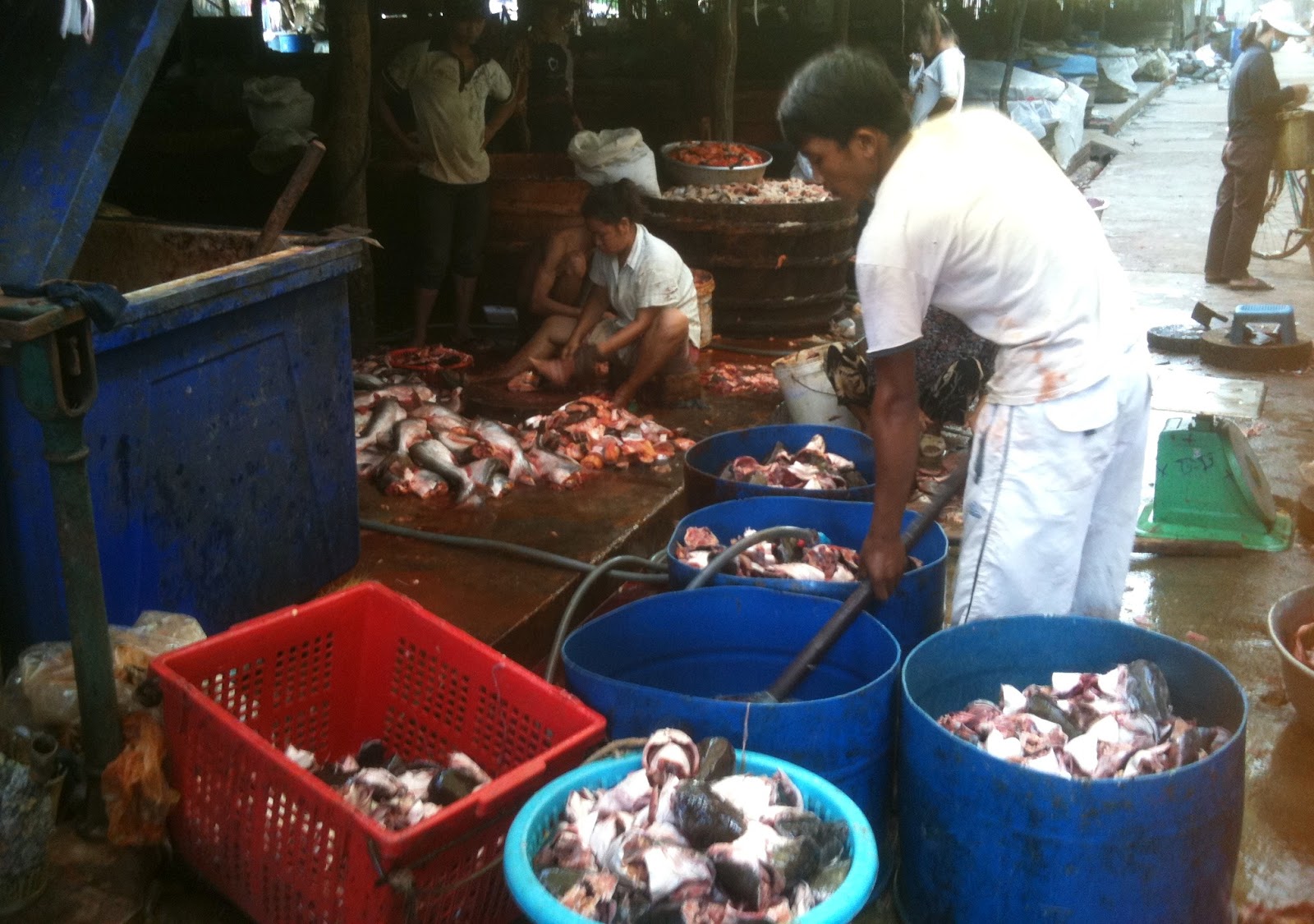
There was a huge fish processing plant hidden behind iron gates and then further on, where the boats were moored on the Sanke, a long line of huts filled with people covered in fish guts. Men were offloading fish they’d netted from the river, and the locals were sorting them into plastic barrels and crates before the real process of prahok fermentation would begin, exactly the way their ancient ancestors had done to preserve fish and guarantee a year-round supply of protein.

The fish are cleaned and then salted and mashed underfoot in barrels before being left to rot in the sun for a day - which helps kick off the fermentation process. More salt is added. Then they are weighted and left in huge barrels for months, depending on the desired taste or price, with prices rising in the rainy season when the paste becomes scarce.

River fish are put in barrels and salted...


The fish ferment and become a grey, cheese-like paste...


Prahok chopped and ready to cook...


The taste and smell varies largely from batch to batch, depending on the type of fish used, how carefully they’ve been prepped, and the time, skill and methods used to ferment them. The cheapest stuff is filled with bones, fins, and scales like the bag of prahok I’d bought from a street stall on the coast last month. It looked like it had been made from crab bait, and had a disconcerting ripeness.

In some of the other huts they were smoking and curing fish. Racks of fish no bigger than minnows were being slowly grilled over charcoal coals until deep bronze and rigid. Some of the larger fish were being turned into maam, a more expensive version of prahok. It’s salted for 24 hours, then stacked in a jar with salted rice and galangal, and stored for less time (usually a month) until it becomes sour.

It’s these fermented fish products that define traditional Khmer food and differentiate it from the strong culinary influences of China, Vietnam, Thailand, and much further back, India and Sri Lanka.

Many countries use fermented pastes and sauces, of course, to add the savoury, meaty ‘fifth taste’ of umami to food. China and Japan have soy sauce and miso made from fermented soy beans, wheat flour, water, and salt. Vietnam and Thailand have fish sauce, drained from salted and fermented anchovies, prawns or squid. Malaysia has its blocks of fish paste, or blacan, and there are many other varieties around the world.


But none of them have the cheesy punch of prahok. Most people agree it tastes of blue cheese. But it’s more the harshness and saltiness of Danish blue rather than the creamier, more refined flavour of say Roquefort or stilton. And always there on the palate and in the nose is the smack of rotten fish, as though you’ve been cutting skata with the cheese knife.

For that reason, you don’t see it on restaurant menus much, especially in places where tourists go. Sadly, many Khmers talk about how it’s now looked down on by Cambodia’s emerging middle class as a reminder of the bad old days. They say it’s the smell of poverty - a remembrance of their tough, previous lives working on the farm.

It’s certainly true of Cambodia’s highly aspirational pop videos, which always seem to feature affluent, pale-skinned Khmer couples posing around in shiny SUVs that would keep a whole village in food for a year. You never see them munching prahok at a street stall. It’s always pizza, burgers or fried chicken in soulless, chain-style restaurants.

It breaks my heart more than the appalling car crash at the end, which is how most Khmer music videos seem to end, with a girl crying hysterically, holding the lifeless body of her boyfriend in her arms, and screaming “WHY!” at the sky. Which is not the best viewing when you’re being forced to watch it on a bus clattering away on tyres with less grip than a pickled egg.

After an hour, I could take no more and cycled across the bridge to the old woman’s stall. The cats were still there, but this time there was a seat free. The ginger cat sniffed the air again and looked at me. The smell had suddenly got a lot stronger. 


:: BOOK UPDATE:

I want to apologise for the very poor delivery times of the paperback version of my new food book Down And Out In Padstow And London. For reasons that are beyond me, Amazon have had problems distributing recent batches. It’s something to do with the wrong metadata being input, whatever that means. But Completely Novel who print my book have promised they are trying to sort it out.

I don’t know how long it will continue, but I’ve been told that books ordered through Amazon will arrive soon, and they will obviously not take your money until they do post the book to your address. To help remedy this, an eBay page has been set up to sell my book. So if you want the book in the next few days, then cancel your order at Amazon and buy the book HERE... For the eBook version click HERE...


Friday, April 13, 2012

A Umami-Packed Dish That Makes Marmite Taste Like Boiled Lettuce


The smell of fermented fish and chillies is wafting from the kitchen. Prahok ling - one of the best meals I’ve come across on my journey to learn about Cambodian food, and a dish so filled with umami it makes Marmite taste like boiled lettuce - is about to be served.

I can’t say I’ve tried every meal the Kingdom has to offer, far from it, but I’ve given it my best shot. I’d always been told how I’d only find the real Cambodian dishes and the secrets of this exotic cuisine in people’s homes, or in street food stalls, and the odd restaurant, and they were right.

I ate incredible dishes like ‘sour soup cooked outside the pot’ where vegetables, bitter herbs, and chopped hard-boiled eggs are formed into balls in each soup bowl and a broth flavoured with dried fish (a stock reminiscent of Japan’s dashi) is poured over the top. A delicious bar snack of steamed ants that tasted of wild honey. A Cambodian bouillabaisse made with hundreds of tiny shrimps and fresh anchovies, and an incredibly fiery dish of chicken livers fried with morning glory.

Then there were the ones best forgotten like stewed pork intestines with pickled cabbage that reminded me of German food for some reason. Boiled duck foetuses scooped from the shell. And that wedding banquet of rat and snake meat that almost coldly furnished forth my funeral the next day.


But the dishes I like most are flavoured with prahok (pic above) - a fermented fish paste that is one of the key ingredients of traditional Cambodian cuisine. Cambodian omelette made with fried onions, prahok, and sometimes dried or smoked fish is incredible, as are the chicken, beef and fish soups it’s sometimes used in, or the dips that go with hunks of spit-roast calf, which are sadly no longer a sight on the streets of Cambodia after the government banned them, claiming the sight incited violence and offended Buddhist sensibilities.

If you can’t get hold of prahok, the recipe works pretty well with two tins of anchovies and a tin of sardines (both are rich in umami like prahok, but don’t have the cheesy flavour and notorious odour that comes from its long fermentation process). To make up for this, chop up the fish, put in a bowl, and then stir in one tablespoon of Vietnamese or Thai fish sauce, the whisky-coloured liquor drained from salted and fermented anchovies, prawns or squid. Then add one tablespoon of mashed stilton and one tablespoon of grated parmesan.

It should be an incredibly savoury and salty dish, eaten in small amounts with crudités - cucumber, onion, aubergine, snake beans, and Cambodia’s wonderful white cabbage, with lime quarters to cut the chilli and salt.

The dish is normally made by frying prahok with beaten egg, shallots, chillies, garlic, minced pork, and sometimes tamarind to make a thick dip, which I’ve also seen pressed into a terrine and served in slices. Sometimes pea aubergines are added. But they’re more common in prahok ktis, a similar fried prahok dip made with coconut.

But the version I had the other day was so unusual, containing 20 chillies and a good glug of chilli oil, that I thought I’d share it with you.

Alin, who owns a small restaurant on a near-deserted, white sand paradise that will soon have an ugly five-star resort dropped on top of it, was taught the recipe by her mother before the family moved down from their floating village near Siem Reap.

She was so proud of the prahok she still had from her last visit there, saying it was made from snakehead fish from the Tonle Sap. There she was surrounded by beautiful barracuda, red snapper and some of the best shellfish it’s possible to eat, and all she could think about was the freshwater fish from her childhood. But it’s the same with most Cambodians. They much prefer the taste of freshwater fish, and pay much higher prices for them. And after trying that dish, I don’t blame them.


She started by washing the prahok in several changes of water to remove some of the salt. She chopped it for five minutes until it was a grey paste and then put it in a bowl. Next to it were 10 large, dried red chillies she’d soaked for 20 minutes to soften them up. They were there more for the smoky flavour they’d bring to the meal rather than heat. She chopped them up until they were a vibrant red mush. Then she added 10 incendiary bird eye chillies and continued chopping.

“Very spicy,” she said proudly.

She diced four garlic cloves, two red shallots, and poured three tablespoons of vegetable oil into a frying pan. Generally Cambodians just use a smear of oil, and then keep topping up with splashes of water when ‘frying’ food. But this was an emulsified, deeply-rich dip to be eaten sparingly with raw vegetables. As rich as tapenade or brandade de morue, but completely different in taste.

She worked slowly and said little as she chopped. It was wonderful to be in the company of someone so in love with what they’re doing. She tapped away on her board. Then she poured about 50g of peanuts into a pestle and mortar and pounded them for a couple of minutes.


Then she added the garlic to the pan and it quickly became brown and nutty.


She turned down the heat, added the prahok and the chopped shallots, and stirred again. It soon became a thick, greyish sauce. She added the chopped dry and fresh chillies, stirred again, and added a teaspoon of sugar.


The kitchen was soon filled with chilli fumes. It was so bad, her husband came in with a krama wrapped round his face. Then she added the peanuts and fried them for another two minutes before adding a tablespoon of chilli oil, and two more teaspoons of sugar.


She cooked it for a few more minutes, and then told me to go and sit in the restaurant while she chopped up the crudités.


The Austrian was there. He talked more than any man I’d ever met. His victim this time was a chubby Russian. They were chatting about places they’d been, and I mentioned I was thinking of heading to Sri Lanka.

“Oh, Sri Lanka!” said the Russian. “The food is incredible, absolutely incredible!”

From the size of him, he looked like he knew what he was talking about. He left soon after saying he was off for an hour in the hammock, leaving me with the rabbiting Austrian. Even when my prahok ling arrived he wouldn’t stop. It was too good a meal to waste, so I turned my back to him and kept nodding.

MORE: Fermented Fish And A Tour Of The Market With One Of Cambodia's Top Chefs

:: My new book Down And Out In Padstow And London is available as a paperback and eBook on Amazon CLICK HERE

Tuesday, March 27, 2012

Taking Cambodia's Banned Street Food To The UK


An article I wrote for the British Street Food Awards 2012...

At the British Street Food Awards, we like to think that we know our business. Check out our knowledge of world street food HERE. But we don’t know everything. Alex Watts does. The travelling journalist, and sometime chef, writes the food blog CHEF SANDWICH – and we’re huge fans. So when he offered to write us an atmospheric piece about a side to world street food we hadn’t seen first hand, we jumped at the chance.

WALK DOWN any road in Cambodia, and you’ll see street food – sometimes an ingenious bicycle-driven cart hooked up to a car battery, sometimes a stall with a few plastic chairs to perch on.

There are old women pushing barrows of freshwater clams that are slowly ‘cooked’ on a metal tray in the morning sun for an hour or two, baguette stalls (a hangover from French imperialists) serving Cambodia’s version of the banh mi, and sometimes hawkers flogging local delicacies like fried tarantula, bugs, snakes and duck foetuses.

But the most memorable – and easily the best for my money – has to be the spit-roast cows (koo dut) you see being slowly cooked in the street next to crowds of tooting mopeds. The hunks of grilled veal are always served the same way, with a tray of crudités, salt, pepper and lime dip, and Cambodia’s fermented fish ‘cheese’ prahok.

I’m so impressed with the dish, I’ve been toying with the idea of setting up a ‘koo dut’ street food stall when I get back to the UK. I’m not sure how it would take off, and I know I’ll have more chance of getting hold of a Dodo egg in Blighty than prahok. But I reckon hunks of spit-roast calf would go down well on an English common with the sound of leather on willow and the chink of warm beer glasses.

In readiness, I’ve worked on a couple of koo dut stalls to watch how they do it – starting the day by butchering and washing the carcass, and then filling the belly with lemon grass, lime leaves and rice paddy herbs before sewing up the cavity. And then constantly feeding the coals as the beast slowly spit-roasts for hours.


Of course, I know I’ll be facing far more stringent street food regulations in the UK, and will have to fill out forms giving details of everything from my inside leg measurement to the name of the calf before the council offers me a pitch. But there’s one ludicrous law that recently came in over here that I won’t have to worry about.

The Cambodian government, in its wisdom, has banned restaurants and stalls from spit-roasting cows in public – over claims they incite violence and are bad for the image of Cambodia. It follows a meeting by the Supreme Council of the Mohanikaya Buddhist order, which decided the sight of roasting carcasses glorifies the killing of animals.

Other officials cited hygiene concerns about cooking in the street, which is ridiculous when you see the state of many indoor kitchens here, and the dozens of busy food stalls perched on every corner.

I’m delighted to say that so far the ban has been widely ignored with barbecued cows still on display in the capital Phnom Penh and in the tourist hub of Siem Reap.

But however much it is against Buddhist sensibilities, I think it’s a shame if the government does enforce the ban. It would undoubtedly lead to a lot of restaurants and stalls closing, and a lot of families being plunged on to the bread line.

The government should be showcasing these dishes, and promoting the country’s badly-marketed cuisine, rather than ordering them to be swept off the streets. Perhaps if there is a major crackdown, a koo dut stall in England wouldn’t be such a bad idea after all…

UPDATE: Sadly, the Cambodian government got tough with restaurants flouting the ban, and threatened to close them down. Now you won't see a spit-roast calf on display anywhere in Cambodia (they're being cooked in kitchens and yards at the back). The only koo dut advertising allowed is on beer signs like the one below. Mmmm beer. Now that never causes violence does it.


MORE: Ten Days In Cambodia: Street Food, Spit Roasts And Freshly Boiled Crabs

My new book on training to be a chef, including stints at Rick Stein's and the Fat Duck, is available as a paperback and eBook on Amazon CLICK HERE

"Reading this book is a serious test for any food writer. Not only has Alex Watts done what all of us say we would like to do, tested his mettle in a professional kitchen, he also writes about his experiences so well that you spend as much time being jealous of his writing skills as you do of his experiences. It's an annoyingly enjoyable read." - Simon Majumdar

Twitter Reviews:

"A rattling good read." - @chrispople

"It's a fab read. The Fat Duck chapters are class." - @Mcmoop

"If you claim to be a foodie you MUST buy this book." - @CorkGourmetGuy

"Bought your book and am hugely enjoying. Funny, engaging, interesting, lively." - @oliverthring

"A great read about the reality of working at The Fat Duck & other less famed restaurants." - @alanbertram

"Very funny, very close to the bone." - @AmeliaHanslow

"A great read and must have book for anyone in the industry." - @philwhite101

"Thoroughly enjoyed it." - @rosechadderton

"Excellent!" - @MissCay

"Just finished your book, and loved it! Thanks for ending on a happy note; it needed it after all the reality ;-)" - @voorschot

"Fab account of psycho chefs, plus work experience with Heston and Stein." - @Laurajanekemp

"Excellent read & loved the ‘scary duck’ tale! I look forward to the follow up book (no pressure ;D). Great memories of first being addressed as chef." - @granthawthorne

"Sensational account of a chef’s life, couldn't put it down. Get it from Amazon now!" - @Fishermansarms

"I'm loving your book. Very enjoyable. Some great one-liners. "His legs wobbled like a crab on stilts" had me chuckling." - @griptonfactor

"Highly recommended. A great book about changing careers for his love of cooking." @Whatsinmymouth

"Downloaded the book last Sunday and finished it the same day! Great read." - @MTomkinsonChef

"Very funny." - @SkyRuth

"Any of you who have flirted with chefdom, go and immediately download this book from Amazon - Down and Out in Padstow and London. Great read." - @el_duder

"Truly brilliant." - @kcassowary

"Just rattled through Down And Out in Padstow and London by Alex Watts in no time at all, what a great book." - @leejamesburns

"It's brilliant, a fine piece of work. If you've ever wanted to peer into a professional kitchen I can't recommend it highly enough." - @acidadam

"Fantastic read - the English Kitchen Confidential!" - @cabbagemechanic

"A great eBook to buy about serving your time (literally!) as a trainee chef." - @OkBayBach

"Great read." - @rankamateur

"Don't start reading it if you have things to do:)" - @NorthernSnippet

"Great book...couldn't put it down, read it non-stop on a train and finished it in one day." - @chunkymunki

"Jolly good read, feel free to do one more." - @esbens

There are also 12 reviews on its Amazon page.

Friday, March 16, 2012

Fermented Fish And A Tour Of The Market With One Of Cambodia's Top Chefs


This is the second part of an interview with Cambodian food expert Joannès Rivière, head chef-owner of Cuisine Wat Damnak, in Siem Reap. To read the first part, CLICK HERE...

I meet Rivière at 7.45am at the cafe next to the old market in Siem Reap as planned. But he’s not there. He’s already begun shopping for that night’s ingredients. He appears from the sweaty cauldron after a few minutes, shouting my name from across the street. You can see the stress in his eyes - he’s got to come up with six new seasonal dishes in the next nine hours.

“I had to crack on,” he explains.

I look at my Rolex and tap it a few times. I knew I should have bought the one for $15. We neck a napalm-strength espresso, and then head into the sauna-like covered market. I’m hit in the face by the smell of freshly-slaughtered pig and gasping fish. The place smells like a blood-filled swamp.


Rivière points at the different stalls as we press on. Everyone knows him. A chef from a luxury hotel walks past with a group of Asian tourists wearing masks as we’re picking through hyacinth plants for that night’s garnishes. The cooks meet like two old boxers, slapping each other on the back.

“He does tours round the market every morning for the guests. He hates it!” Rivière (pic below) laughs afterwards.


As we head to each stall, he banters away with the women in their hats and pyjamas. What impresses me most, even more than his knowledge of the local ingredients, is his Khmer. He cracks a few jokes with the women at the next stall, and then the next, and I’m left carrying the bags.

He shows me the freshwater fish and shellfish from the nearby Tonle Sap lake, pointing out the ones that are perfectly in season. There’s a splendid display of catfish, snakehead fish, Mekong langoustine (pic below), chlung, clams, and croaker fish. He describes the latter as tasting like sea bream, and says he’s putting it on that night’s menu.


“What defines Cambodian food for me is freshwater fish and the products that are used to keep them - the smoked fish, the dried fish, the fish paste,” he says.

We pass more stalls and he talks about the wide range of preserved fish Cambodia has to offer, from smoked minnows to prahok to maam to sun-dried fillets to the most pungent of all, a thick, black paste made from tiny fish and shrimps. I point to a bowl of minced, raw fish (pic below) sweating in the river-fed furnace.


“They don’t quite have the same hygiene - and with the heat!” he throws his hands up into the air. “That will probably be there all day - I wouldn’t recommend that for anyone.”

He chats away about the need to pickle, spice or brine fish and meat to stop it turning putrid in a country as hot as this. I think about how labourers building Cambodia’s 12th century holy site of Angkor Wat would have sat among the sun-baked stones, seasoning their vegetables and rice with the rich, salty, delicious taste of rotten fish.

It reminds me of the Romans, another great civilisation that had thrived on a similar fermented fish sauce to flavour each meal - and for some reason think about Keith Floyd, when he was filming at Hadrian's Wall, recreating a traditional Centurion recipe while cooking in a gale and berating the crew and assembled historians sheltering under a tarpaulin behind the camera.

Floyd is making pork stew flavoured with carrot, onion, garlic, red wine, parsley, cumin, ginger, marjoram, thyme, and dill. And then the crucial ingredient comes - an addition that plunges it back 2,000 years to when the Romans finally tired of the dreadful weather in Britain - a few glugs of Floyd’s “Centurion’s Worcestershire sauce”. It had taken him three weeks to make, he says proudly, waving the bottle at the camera. Anchovies, sprats, marjoram, red wine, and salt are boiled up and left to ferment before being strained and bottled.

The Cambodians generally just use salt and freshwater fish to make prahok, mashed under foot like the French crush grapes for wine. They leave the bloody mush to go off in the sun for a day, giving it the roof-of-the-mouth-etching taste of blue cheese, then bung in more salt and leave it to ferment for months, depending on the desired taste.

Just as the Khmers add sugar to cut the taste of prahok, the Romans added honey (they didn’t have sugar in those days). It reminded me of the first time I ordered my favourite Cambodian dish, prahok ling. It was so sweet I could hardly eat it. When I asked them to skip the sugar the next time I went in, I threw the restaurant into chaos. Even the owner emerged from her hammock near the kitchen to quiz me.

“No sugar? But it very salt!” she said.

I told her no sugar, and she cracked a joke in Khmer to the policemen playing cards in the corner. It was probably along the lines of: “What the hell does he know?”

WE BUY some pork, and then head to the chicken woman and buy a bag of wings for staff food. Then we stop at the frog woman. She digs through blooded plastic bags in the bottom of her ice box. It’s a messy task. Rivière sniffs the frogs before taking them.

“They sometimes don’t smell too good,” he whispers to me, “then I don’t buy them...”


We sit down and eat a traditional breakfast of grilled pork, rice, and pickles at a stall in the middle of the market, and he downs two iced coffees. He picks up a small bowl of sweet chilli sauce and pours it over his meal.

“When I first came to Cambodia nine years ago, I didn’t eat anything with MSG. Now I realise you can’t get away from it. Sometimes I now think I can’t taste anything without it,” he laughs. He points to an old woman drinking coffee. “She’s the best cook in Siem Reap, believe me!” he says.

I write down the name of her restaurant - Bopha Leak Khluon, tucked down an unmade road 200 yards or so from Hotel de la Paix - and go there later that day. The walls are made from green Heineken bottles. One of her specialities is prahok ling, translated on the menu as “fried rotten fish with egg and pork”. It’s the best I’ve tasted so far in Cambodia - and I’ve eaten a lot of prahok ling.

As Rivière sips away at his third iced coffee, we talk about Cambodian food again. He tells me how important it is to differentiate between traditional, ethnic Khmer dishes and Cambodian cuisine, with its heavy influences from Indian, Thai, Vietnamese, and perhaps most of all, Chinese cooking.

“People will tell you Khmer cuisine disappeared during the Khmer Rouge, but it’s actually not true. Phnom Penh cuisine from the 60s may have disappeared, but Khmer food from the countryside has always existed.

“You can still find those dishes - but people just cook them in their homes. When I was working at Hotel de la Paix people would come in and say: ‘Oh you’re rediscovering Cambodian food.’ But that’s bullshit, it’s always been here - you just have to find it and rip it off, and use it for you and claim it,” he chuckles.

We talk about the balance of salty, sour, spicy and sweet shared dishes making a whole rather than mixing the flavours in one dish - a practice popular in every cuisine that hasn’t been refined, he points out.

I ask him what he thinks every time he reads how Cambodian food is touted to be the next big thing. He agrees that it’s “definitely on the up” - but has a long way to go.

“To make a food famous is quite complicated, because people have to be familiar with it. Laos food is virtually impossible to find in France, for instance. I know one Laotian restaurant in Paris, which is excellent.

“But Laos food is very unknown, and is actually quite similar to Cambodian. People will tend to talk about it if they know about it. I’m sure it wasn’t easy for David Thompson when he started with Thai food in the 80s...”

He met the Michelin-starred chef a couple of years back, when he first visited Cambodia, and gave him a tour of the local Cambodian restaurants and street food stalls in Siem Reap.

“It was very interesting to see Cambodian cuisine with a very objective eye, not ‘I’m coming from Thailand, I’m going to compare it with Thai food’ - but more ‘is there any similarity?’”
Thompson told him that Cambodian cooking was almost the same as Thai food 20 or 30 years ago, before it became more refined, and far sweeter and spicier.

He says the biggest obstacle facing Cambodian cuisine is the lack of confidence the locals have in promoting their food, and how “some restaurants are doing a very poor job of it”.

I quiz him about Cambodia’s unofficial national dish amok, and say I still haven’t had a good one. I just hope he hasn’t got amok on that night’s menu. I’m relieved when he agrees.

“I’m still trying to figure out why amok. I think the first guy who wrote Lonely Planet must have put it in. I have no idea why it’s amok because amok is done exactly the same as it is Thailand - and it’s called the same!”


I ask him what dishes really sum up Cambodian cuisine. He thinks for a while, and then says khor trey swey kchey (pic above) - river fish braised in a mildly-spiced palm sugar sauce with grated green mango on top. I’ve had the dish a few times and it’s wonderful.

“What’s interesting about Cambodia food is it’s still quite rustic. It’s a matter of contrast - it’s not a matter of how balanced it is. You have the very sweet fish and then the very sour green mango on top with the herbs.”

I ask him for others, but he takes even longer to answer - khor trey, he adds again, prahok, maam, eels “if they’re well done”, and nom ban chok (rice noodle soup, often served with bean sprouts, sliced banana flower, herbs, and a mild, coconut curry sauce).

I mention Cambodia’s famous duck and salted lime soup traditionally served at weddings out here. The duck is deep-fried and then cooked in water flavoured with kaffir lime leaves, galangal, lemon grass, garlic, fish sauce, and its most crucial ingredient, ngam ngov (salted limes). But he says it isn’t Cambodian at all - it’s Chinese.

“Chinese-Cambodian food is as interesting as Khmer food,” he adds, “It’s the only big influence in Cambodian cuisine, if you forget the original Indian influence. You have dishes in Cambodian food that are actually very Chinese, but people will just assume they are Khmer...”

I want to question him further, but there’s no time and we’re off to the next stall. I’m handed bags of fish and meat, and a crate of eggs which are then haphazardly stacked on a waiting moped to be delivered to the restaurant.


I remind him about working in his kitchen, and he looks thoughtful for a second, and then tells me it would be better if I work there the following afternoon, given all the new dishes he’s got to create. I can see he’s going off the idea.

I walk home with my shirt stuck to my back, thinking about the 14-hour day Rivière’s got ahead of him. Cheffing is hard enough anyway, but working in this heat is unbearable.

MORE: Prahok - My Secret Addiction To Cambodia's Infamous Fermented Fish 'Cheese'

My new book on training to be a chef, including stints at Rick Stein's and the Fat Duck, is available as a paperback and eBook on Amazon CLICK HERE

"Reading this book is a serious test for any food writer. Not only has Alex Watts done what all of us say we would like to do, tested his mettle in a professional kitchen, he also writes about his experiences so well that you spend as much time being jealous of his writing skills as you do of his experiences. It's an annoyingly enjoyable read." - Simon Majumdar

Twitter Reviews:

"A rattling good read." - @chrispople

"It's a fab read. The Fat Duck chapters are class." - @Mcmoop

"If you claim to be a foodie you MUST buy this book." - @CorkGourmetGuy

"Bought your book and am hugely enjoying. Funny, engaging, interesting, lively." - @oliverthring

"A great read about the reality of working at The Fat Duck & other less famed restaurants." - @alanbertram

"Very funny, very close to the bone." - @AmeliaHanslow

"A great read and must have book for anyone in the industry." - @philwhite101

"Thoroughly enjoyed it." - @rosechadderton

"Excellent!" - @MissCay

"Just finished your book, and loved it! Thanks for ending on a happy note; it needed it after all the reality ;-)" - @voorschot

"Fab account of psycho chefs, plus work experience with Heston and Stein." - @Laurajanekemp

"Excellent read & loved the ‘scary duck’ tale! I look forward to the follow up book (no pressure ;D). Great memories of first being addressed as chef." - @granthawthorne

"Sensational account of a chef’s life, couldn't put it down. Get it from Amazon now!" - @Fishermansarms

"I'm loving your book. Very enjoyable. Some great one-liners. "His legs wobbled like a crab on stilts" had me chuckling." - @griptonfactor

"Highly recommended. A great book about changing careers for his love of cooking." @Whatsinmymouth

"Downloaded the book last Sunday and finished it the same day! Great read." - @MTomkinsonChef

"Very funny." - @SkyRuth

"Any of you who have flirted with chefdom, go and immediately download this book from Amazon - Down and Out in Padstow and London. Great read." - @el_duder

"Truly brilliant." - @kcassowary

"Just rattled through Down And Out in Padstow and London by Alex Watts in no time at all, what a great book." - @leejamesburns

"It's brilliant, a fine piece of work. If you've ever wanted to peer into a professional kitchen I can't recommend it highly enough." - @acidadam

"Fantastic read - the English Kitchen Confidential!" - @cabbagemechanic

"A great eBook to buy about serving your time (literally!) as a trainee chef." - @OkBayBach

"Great read." - @rankamateur

"Don't start reading it if you have things to do:)" - @NorthernSnippet

"Great book...couldn't put it down, read it non-stop on a train and finished it in one day." - @chunkymunki

"Jolly good read, feel free to do one more." - @esbens

There are also 12 reviews on its Amazon page.