Showing posts with label Siem Reap. Show all posts

Friday, March 16, 2012

Fermented Fish And A Tour Of The Market With One Of Cambodia's Top Chefs


This is the second part of an interview with Cambodian food expert Joannès Rivière, head chef-owner of Cuisine Wat Damnak, in Siem Reap. To read the first part, CLICK HERE...

I meet Rivière at 7.45am at the cafe next to the old market in Siem Reap as planned. But he’s not there. He’s already begun shopping for that night’s ingredients. He appears from the sweaty cauldron after a few minutes, shouting my name from across the street. You can see the stress in his eyes - he’s got to come up with six new seasonal dishes in the next nine hours.

“I had to crack on,” he explains.

I look at my Rolex and tap it a few times. I knew I should have bought the one for $15. We neck a napalm-strength espresso, and then head into the sauna-like covered market. I’m hit in the face by the smell of freshly-slaughtered pig and gasping fish. The place smells like a blood-filled swamp.


Rivière points at the different stalls as we press on. Everyone knows him. A chef from a luxury hotel walks past with a group of Asian tourists wearing masks as we’re picking through hyacinth plants for that night’s garnishes. The cooks meet like two old boxers, slapping each other on the back.

“He does tours round the market every morning for the guests. He hates it!” Rivière (pic below) laughs afterwards.


As we head to each stall, he banters away with the women in their hats and pyjamas. What impresses me most, even more than his knowledge of the local ingredients, is his Khmer. He cracks a few jokes with the women at the next stall, and then the next, and I’m left carrying the bags.

He shows me the freshwater fish and shellfish from the nearby Tonle Sap lake, pointing out the ones that are perfectly in season. There’s a splendid display of catfish, snakehead fish, Mekong langoustine (pic below), chlung, clams, and croaker fish. He describes the latter as tasting like sea bream, and says he’s putting it on that night’s menu.


“What defines Cambodian food for me is freshwater fish and the products that are used to keep them - the smoked fish, the dried fish, the fish paste,” he says.

We pass more stalls and he talks about the wide range of preserved fish Cambodia has to offer, from smoked minnows to prahok to maam to sun-dried fillets to the most pungent of all, a thick, black paste made from tiny fish and shrimps. I point to a bowl of minced, raw fish (pic below) sweating in the river-fed furnace.


“They don’t quite have the same hygiene - and with the heat!” he throws his hands up into the air. “That will probably be there all day - I wouldn’t recommend that for anyone.”

He chats away about the need to pickle, spice or brine fish and meat to stop it turning putrid in a country as hot as this. I think about how labourers building Cambodia’s 12th century holy site of Angkor Wat would have sat among the sun-baked stones, seasoning their vegetables and rice with the rich, salty, delicious taste of rotten fish.

It reminds me of the Romans, another great civilisation that had thrived on a similar fermented fish sauce to flavour each meal - and for some reason think about Keith Floyd, when he was filming at Hadrian's Wall, recreating a traditional Centurion recipe while cooking in a gale and berating the crew and assembled historians sheltering under a tarpaulin behind the camera.

Floyd is making pork stew flavoured with carrot, onion, garlic, red wine, parsley, cumin, ginger, marjoram, thyme, and dill. And then the crucial ingredient comes - an addition that plunges it back 2,000 years to when the Romans finally tired of the dreadful weather in Britain - a few glugs of Floyd’s “Centurion’s Worcestershire sauce”. It had taken him three weeks to make, he says proudly, waving the bottle at the camera. Anchovies, sprats, marjoram, red wine, and salt are boiled up and left to ferment before being strained and bottled.

The Cambodians generally just use salt and freshwater fish to make prahok, mashed under foot like the French crush grapes for wine. They leave the bloody mush to go off in the sun for a day, giving it the roof-of-the-mouth-etching taste of blue cheese, then bung in more salt and leave it to ferment for months, depending on the desired taste.

Just as the Khmers add sugar to cut the taste of prahok, the Romans added honey (they didn’t have sugar in those days). It reminded me of the first time I ordered my favourite Cambodian dish, prahok ling. It was so sweet I could hardly eat it. When I asked them to skip the sugar the next time I went in, I threw the restaurant into chaos. Even the owner emerged from her hammock near the kitchen to quiz me.

“No sugar? But it very salt!” she said.

I told her no sugar, and she cracked a joke in Khmer to the policemen playing cards in the corner. It was probably along the lines of: “What the hell does he know?”

WE BUY some pork, and then head to the chicken woman and buy a bag of wings for staff food. Then we stop at the frog woman. She digs through blooded plastic bags in the bottom of her ice box. It’s a messy task. Rivière sniffs the frogs before taking them.

“They sometimes don’t smell too good,” he whispers to me, “then I don’t buy them...”


We sit down and eat a traditional breakfast of grilled pork, rice, and pickles at a stall in the middle of the market, and he downs two iced coffees. He picks up a small bowl of sweet chilli sauce and pours it over his meal.

“When I first came to Cambodia nine years ago, I didn’t eat anything with MSG. Now I realise you can’t get away from it. Sometimes I now think I can’t taste anything without it,” he laughs. He points to an old woman drinking coffee. “She’s the best cook in Siem Reap, believe me!” he says.

I write down the name of her restaurant - Bopha Leak Khluon, tucked down an unmade road 200 yards or so from Hotel de la Paix - and go there later that day. The walls are made from green Heineken bottles. One of her specialities is prahok ling, translated on the menu as “fried rotten fish with egg and pork”. It’s the best I’ve tasted so far in Cambodia - and I’ve eaten a lot of prahok ling.

As Rivière sips away at his third iced coffee, we talk about Cambodian food again. He tells me how important it is to differentiate between traditional, ethnic Khmer dishes and Cambodian cuisine, with its heavy influences from Indian, Thai, Vietnamese, and perhaps most of all, Chinese cooking.

“People will tell you Khmer cuisine disappeared during the Khmer Rouge, but it’s actually not true. Phnom Penh cuisine from the 60s may have disappeared, but Khmer food from the countryside has always existed.

“You can still find those dishes - but people just cook them in their homes. When I was working at Hotel de la Paix people would come in and say: ‘Oh you’re rediscovering Cambodian food.’ But that’s bullshit, it’s always been here - you just have to find it and rip it off, and use it for you and claim it,” he chuckles.

We talk about the balance of salty, sour, spicy and sweet shared dishes making a whole rather than mixing the flavours in one dish - a practice popular in every cuisine that hasn’t been refined, he points out.

I ask him what he thinks every time he reads how Cambodian food is touted to be the next big thing. He agrees that it’s “definitely on the up” - but has a long way to go.

“To make a food famous is quite complicated, because people have to be familiar with it. Laos food is virtually impossible to find in France, for instance. I know one Laotian restaurant in Paris, which is excellent.

“But Laos food is very unknown, and is actually quite similar to Cambodian. People will tend to talk about it if they know about it. I’m sure it wasn’t easy for David Thompson when he started with Thai food in the 80s...”

He met the Michelin-starred chef a couple of years back, when he first visited Cambodia, and gave him a tour of the local Cambodian restaurants and street food stalls in Siem Reap.

“It was very interesting to see Cambodian cuisine with a very objective eye, not ‘I’m coming from Thailand, I’m going to compare it with Thai food’ - but more ‘is there any similarity?’”
Thompson told him that Cambodian cooking was almost the same as Thai food 20 or 30 years ago, before it became more refined, and far sweeter and spicier.

He says the biggest obstacle facing Cambodian cuisine is the lack of confidence the locals have in promoting their food, and how “some restaurants are doing a very poor job of it”.

I quiz him about Cambodia’s unofficial national dish amok, and say I still haven’t had a good one. I just hope he hasn’t got amok on that night’s menu. I’m relieved when he agrees.

“I’m still trying to figure out why amok. I think the first guy who wrote Lonely Planet must have put it in. I have no idea why it’s amok because amok is done exactly the same as it is Thailand - and it’s called the same!”


I ask him what dishes really sum up Cambodian cuisine. He thinks for a while, and then says khor trey swey kchey (pic above) - river fish braised in a mildly-spiced palm sugar sauce with grated green mango on top. I’ve had the dish a few times and it’s wonderful.

“What’s interesting about Cambodia food is it’s still quite rustic. It’s a matter of contrast - it’s not a matter of how balanced it is. You have the very sweet fish and then the very sour green mango on top with the herbs.”

I ask him for others, but he takes even longer to answer - khor trey, he adds again, prahok, maam, eels “if they’re well done”, and nom ban chok (rice noodle soup, often served with bean sprouts, sliced banana flower, herbs, and a mild, coconut curry sauce).

I mention Cambodia’s famous duck and salted lime soup traditionally served at weddings out here. The duck is deep-fried and then cooked in water flavoured with kaffir lime leaves, galangal, lemon grass, garlic, fish sauce, and its most crucial ingredient, ngam ngov (salted limes). But he says it isn’t Cambodian at all - it’s Chinese.

“Chinese-Cambodian food is as interesting as Khmer food,” he adds, “It’s the only big influence in Cambodian cuisine, if you forget the original Indian influence. You have dishes in Cambodian food that are actually very Chinese, but people will just assume they are Khmer...”

I want to question him further, but there’s no time and we’re off to the next stall. I’m handed bags of fish and meat, and a crate of eggs which are then haphazardly stacked on a waiting moped to be delivered to the restaurant.


I remind him about working in his kitchen, and he looks thoughtful for a second, and then tells me it would be better if I work there the following afternoon, given all the new dishes he’s got to create. I can see he’s going off the idea.

I walk home with my shirt stuck to my back, thinking about the 14-hour day Rivière’s got ahead of him. Cheffing is hard enough anyway, but working in this heat is unbearable.

MORE: Prahok - My Secret Addiction To Cambodia's Infamous Fermented Fish 'Cheese'

My new book on training to be a chef, including stints at Rick Stein's and the Fat Duck, is available as a paperback and eBook on Amazon CLICK HERE

"Reading this book is a serious test for any food writer. Not only has Alex Watts done what all of us say we would like to do, tested his mettle in a professional kitchen, he also writes about his experiences so well that you spend as much time being jealous of his writing skills as you do of his experiences. It's an annoyingly enjoyable read." - Simon Majumdar

Twitter Reviews:

"A rattling good read." - @chrispople

"It's a fab read. The Fat Duck chapters are class." - @Mcmoop

"If you claim to be a foodie you MUST buy this book." - @CorkGourmetGuy

"Bought your book and am hugely enjoying. Funny, engaging, interesting, lively." - @oliverthring

"A great read about the reality of working at The Fat Duck & other less famed restaurants." - @alanbertram

"Very funny, very close to the bone." - @AmeliaHanslow

"A great read and must have book for anyone in the industry." - @philwhite101

"Thoroughly enjoyed it." - @rosechadderton

"Excellent!" - @MissCay

"Just finished your book, and loved it! Thanks for ending on a happy note; it needed it after all the reality ;-)" - @voorschot

"Fab account of psycho chefs, plus work experience with Heston and Stein." - @Laurajanekemp

"Excellent read & loved the ‘scary duck’ tale! I look forward to the follow up book (no pressure ;D). Great memories of first being addressed as chef." - @granthawthorne

"Sensational account of a chef’s life, couldn't put it down. Get it from Amazon now!" - @Fishermansarms

"I'm loving your book. Very enjoyable. Some great one-liners. "His legs wobbled like a crab on stilts" had me chuckling." - @griptonfactor

"Highly recommended. A great book about changing careers for his love of cooking." @Whatsinmymouth

"Downloaded the book last Sunday and finished it the same day! Great read." - @MTomkinsonChef

"Very funny." - @SkyRuth

"Any of you who have flirted with chefdom, go and immediately download this book from Amazon - Down and Out in Padstow and London. Great read." - @el_duder

"Truly brilliant." - @kcassowary

"Just rattled through Down And Out in Padstow and London by Alex Watts in no time at all, what a great book." - @leejamesburns

"It's brilliant, a fine piece of work. If you've ever wanted to peer into a professional kitchen I can't recommend it highly enough." - @acidadam

"Fantastic read - the English Kitchen Confidential!" - @cabbagemechanic

"A great eBook to buy about serving your time (literally!) as a trainee chef." - @OkBayBach

"Great read." - @rankamateur

"Don't start reading it if you have things to do:)" - @NorthernSnippet

"Great book...couldn't put it down, read it non-stop on a train and finished it in one day." - @chunkymunki

"Jolly good read, feel free to do one more." - @esbens

There are also 12 reviews on its Amazon page.

When Will Angkor Wat Be Sold To China?


A column I wrote for Khmer 440...

I was quite surprised by the fuss this week over the announcement that a full-scale replica of the world-famous temple of Angkor Wat is to built thousands of miles away on the banks of the Ganges in India.

The trust behind the $18m project says the new temple, some 25 miles outside the Bihar state capital of Patna, in east India, will take 10 years to build, be even bigger than the original, and standing at 222ft will result in the world’s tallest Hindu temple.

Cambodian officials – clearly worried it might divert confused holidaymakers from the country’s big money-spinner near Siem Reap – came out in force to slam the venture. They branded it a “fake” and said it was an outrage that the temple would be even bigger than the real thing.

Continue reading...

My new book on training to be a chef, including stints at Rick Stein's and the Fat Duck, is available as a paperback and eBook on Amazon CLICK HERE

"Reading this book is a serious test for any food writer. Not only has Alex Watts done what all of us say we would like to do, tested his mettle in a professional kitchen, he also writes about his experiences so well that you spend as much time being jealous of his writing skills as you do of his experiences. It's an annoyingly enjoyable read." - Simon Majumdar

Twitter Reviews:

"A rattling good read." - @chrispople

"It's a fab read. The Fat Duck chapters are class." - @Mcmoop

"If you claim to be a foodie you MUST buy this book." - @CorkGourmetGuy

"Bought your book and am hugely enjoying. Funny, engaging, interesting, lively." - @oliverthring

"A great read about the reality of working at The Fat Duck & other less famed restaurants." - @alanbertram

"Very funny, very close to the bone." - @AmeliaHanslow

"A great read and must have book for anyone in the industry." - @philwhite101

"Thoroughly enjoyed it." - @rosechadderton

"Excellent!" - @MissCay

"Just finished your book, and loved it! Thanks for ending on a happy note; it needed it after all the reality ;-)" - @voorschot

"Fab account of psycho chefs, plus work experience with Heston and Stein." - @Laurajanekemp

"Excellent read & loved the ‘scary duck’ tale! I look forward to the follow up book (no pressure ;D). Great memories of first being addressed as chef." - @granthawthorne

"Sensational account of a chef’s life, couldn't put it down. Get it from Amazon now!" - @Fishermansarms

"I'm loving your book. Very enjoyable. Some great one-liners. "His legs wobbled like a crab on stilts" had me chuckling." - @griptonfactor

"Highly recommended. A great book about changing careers for his love of cooking." @Whatsinmymouth

"Downloaded the book last Sunday and finished it the same day! Great read." - @MTomkinsonChef

"Very funny." - @SkyRuth

"Any of you who have flirted with chefdom, go and immediately download this book from Amazon - Down and Out in Padstow and London. Great read." - @el_duder

"Truly brilliant." - @kcassowary

"Just rattled through Down And Out in Padstow and London by Alex Watts in no time at all, what a great book." - @leejamesburns

"It's brilliant, a fine piece of work. If you've ever wanted to peer into a professional kitchen I can't recommend it highly enough." - @acidadam

"Fantastic read - the English Kitchen Confidential!" - @cabbagemechanic

"A great eBook to buy about serving your time (literally!) as a trainee chef." - @OkBayBach

"Great read." - @rankamateur

"Don't start reading it if you have things to do:)" - @NorthernSnippet

"Great book...couldn't put it down, read it non-stop on a train and finished it in one day." - @chunkymunki

"Jolly good read, feel free to do one more." - @esbens

There are also 12 reviews on its Amazon page.

Tuks Tuks And Learning To Bite Your Tongue


A piece I wrote for Khmer 440...

I’ve got a Dutch expat friend who has a rather novel idea for dealing with what he calls the “scourge of tuk tuks in Cambodia”.

“They should do what they do in Tunisia!” he says. “Ban them from even talking to the tourists – they can only speak to you if you speak to them first. It’s brilliant!”

It seems pretty extreme to me, even by Muslim country standards. But you can’t help agreeing with the sentiment to some extent. Talk to most expats or tourists, and they’ll say that one of the main detractions of this beautiful country is the continual gauntlet of pestering tuk tuk drivers trying to make a fast buck...

Continue reading...

My new book on training to be a chef, including stints at Rick Stein's and the Fat Duck, is available as a paperback and eBook on Amazon CLICK HERE

"Reading this book is a serious test for any food writer. Not only has Alex Watts done what all of us say we would like to do, tested his mettle in a professional kitchen, he also writes about his experiences so well that you spend as much time being jealous of his writing skills as you do of his experiences. It's an annoyingly enjoyable read." - Simon Majumdar

Twitter Reviews:

"A rattling good read." - @chrispople

"It's a fab read. The Fat Duck chapters are class." - @Mcmoop

"If you claim to be a foodie you MUST buy this book." - @CorkGourmetGuy

"Bought your book and am hugely enjoying. Funny, engaging, interesting, lively." - @oliverthring

"A great read about the reality of working at The Fat Duck & other less famed restaurants." - @alanbertram

"Very funny, very close to the bone." - @AmeliaHanslow

"A great read and must have book for anyone in the industry." - @philwhite101

"Thoroughly enjoyed it." - @rosechadderton

"Excellent!" - @MissCay

"Just finished your book, and loved it! Thanks for ending on a happy note; it needed it after all the reality ;-)" - @voorschot

"Fab account of psycho chefs, plus work experience with Heston and Stein." - @Laurajanekemp

"Excellent read & loved the ‘scary duck’ tale! I look forward to the follow up book (no pressure ;D). Great memories of first being addressed as chef." - @granthawthorne

"Sensational account of a chef’s life, couldn't put it down. Get it from Amazon now!" - @Fishermansarms

"I'm loving your book. Very enjoyable. Some great one-liners. "His legs wobbled like a crab on stilts" had me chuckling." - @griptonfactor

"Highly recommended. A great book about changing careers for his love of cooking." @Whatsinmymouth

"Downloaded the book last Sunday and finished it the same day! Great read." - @MTomkinsonChef

"Very funny." - @SkyRuth

"Any of you who have flirted with chefdom, go and immediately download this book from Amazon - Down and Out in Padstow and London. Great read." - @el_duder

"Truly brilliant." - @kcassowary

"Just rattled through Down And Out in Padstow and London by Alex Watts in no time at all, what a great book." - @leejamesburns

"It's brilliant, a fine piece of work. If you've ever wanted to peer into a professional kitchen I can't recommend it highly enough." - @acidadam

"Fantastic read - the English Kitchen Confidential!" - @cabbagemechanic

"A great eBook to buy about serving your time (literally!) as a trainee chef." - @OkBayBach

"Great read." - @rankamateur

"Don't start reading it if you have things to do:)" - @NorthernSnippet

"Great book...couldn't put it down, read it non-stop on a train and finished it in one day." - @chunkymunki

"Jolly good read, feel free to do one more." - @esbens

There are also 12 reviews on its Amazon page.

Thursday, February 16, 2012

Elton John To Play Gig At Angkor Wat


Sir Elton John is set to play a concert for thousands of people at the world-famous temples of Angkor Wat.

The singer/songwriter will be one of the biggest international stars ever to play in Cambodia when he performs at the ancient jungle complex outside the tourist hub of Siem Reap at the end of this year.

His tour reconnaissance team have already visited the northern city and the nearby UNESCO world heritage site to do the logistics and check out the area in preparation for the big event.

The musician will also visit projects in the country helped by the Elton John AIDS Foundation, which he set up in 1992. It is understood the gig will raise money for the charity.

Sir Elton’s publicist Gary Farrow refused to give any details of the concert.

“(It’s) not been announced yet, Elton will not be doing any media at present,” he told me.

A source working for the lighting team that have been approached to put on the show said: “The only thing we’ve been told at the moment is the concert is going to be at Angkor Wat at the end of this year.

“We’ve been told it will probably be in November because Elton will already be in Asia that month for the last gig of his world tour, at the Mata Elang International Stadium in Jakarta, Indonesia, on November 17.”

He said it is expected there will be as many as 50,000 people at the Cambodia gig.


The Sokha Angkor Resort, a luxurious hotel in Siem Reap, said Sir Elton’s staff had booked the 64-year-old into the venue for the concert - but the booking had not yet been confirmed.

A spokeswoman said: “The singer Elton John planned to stay in Sokha Angkor Resort during the concert at Angkor Temple at the end of this year.

“But until now we have not received any confirmation from him.”

In December 2008, Placebo became the first rock band to play at Angkor Wat.

The trio used their semi-acoustic show - featuring US band The Click Five and a host of other international and Cambodian stars - to speak out against human trafficking in the country.

Before that, the last international artist to perform at Angkor Wat was tenor Jose Carreras who sang for a charity gala dinner there in 2002.

Sir Elton is also due to perform at the Queen’s Diamond Jubilee concert in the UK in the summer.


My new book on training to be a chef, including stints at Rick Stein's and the Fat Duck, is available on Amazon CLICK HERE

"Reading this book is a serious test for any food writer. Not only has Alex Watts done what all of us say we would like to do, tested his mettle in a professional kitchen, he also writes about his experiences so well that you spend as much time being jealous of his writing skills as you do of his experiences. It's an annoyingly enjoyable read." - Simon Majumdar

Twitter Reviews:

"A rattling good read." - @chrispople

"It's a fab read. The Fat Duck chapters are class." - @Mcmoop

"If you claim to be a foodie you MUST buy this book." - @CorkGourmetGuy

"Bought your book and am hugely enjoying. Funny, engaging, interesting, lively." - @oliverthring

"A great read about the reality of working at The Fat Duck & other less famed restaurants." - @alanbertram

"Very funny, very close to the bone." - @AmeliaHanslow

"A great read and must have book for anyone in the industry." - @philwhite101

"Thoroughly enjoyed it." - @rosechadderton

"Excellent!" - @MissCay

"Just finished your book, and loved it! Thanks for ending on a happy note; it needed it after all the reality ;-)" - @voorschot

"Fab account of psycho chefs, plus work experience with Heston and Stein." - @Laurajanekemp

"Excellent read & loved the ‘scary duck’ tale! I look forward to the follow up book (no pressure ;D). Great memories of first being addressed as chef." - @granthawthorne

"Sensational account of a chef’s life, couldn't put it down. Get it from Amazon now!" - @Fishermansarms

"I'm loving your book. Very enjoyable. Some great one-liners. "His legs wobbled like a crab on stilts" had me chuckling." - @griptonfactor

"Highly recommended. A great book about changing careers for his love of cooking." @Whatsinmymouth

"Downloaded the book last Sunday and finished it the same day! Great read." - @MTomkinsonChef

"Very funny." - @SkyRuth

"Any of you who have flirted with chefdom, go and immediately download this book from Amazon - Down and Out in Padstow and London. Great read." - @el_duder

"Truly brilliant." - @kcassowary

"Just rattled through Down And Out in Padstow and London by Alex Watts in no time at all, what a great book." - @leejamesburns

"It's brilliant, a fine piece of work. If you've ever wanted to peer into a professional kitchen I can't recommend it highly enough." - @acidadam

"Fantastic read - the English Kitchen Confidential!" - @cabbagemechanic

"A great eBook to buy about serving your time (literally!) as a trainee chef." - @OkBayBach

"Great read." - @rankamateur

"Don't start reading it if you have things to do:)" - @NorthernSnippet

"Great book...couldn't put it down, read it non-stop on a train and finished it in one day." - @chunkymunki

"Jolly good read, feel free to do one more." - @esbens

There are also 12 reviews on its Amazon page.

Haven't got a Kindle? You can download a free Kindle reader app to read it on your computer. CLICK HERE.

Tuesday, February 07, 2012

Cambodian Food: The Chef Hailed As A Genius By Raymond Blanc


My nine-month quest to learn how to cook Cambodian food hasn’t been an easy one. There are only a few decent cookbooks on the subject, and even they’re filled with contradictions, making it even harder to get to the bottom of what is undoubtedly one of the world’s most overlooked cuisines.

You might have thought I’d lost a bet when I set out to do this, especially as I can only speak a few words of Khmer, or at least ones that are understood. But I really wanted to go somewhere that hasn’t been done to death. I’ve always loved Indian food, for instance, and haven’t been helped by the fact that there are a few very good Indian restaurants out here, when I should have been researching the local delicacies, but the world hardly needs another book or blog on Indian food.

But saying that, given that Cambodian cuisine was heavily influenced by the cooking of early Indian traders, and then much later by Cham Muslim, Vietnamese, and Chinese immigrants and invaders, and then French imperialists, whose only legacy in this beautiful country seems to be the humble baguette, it’s impossible to know where one food starts and another ends.

Take ‘loc lac’ for instance (beef steak stir-fried in oyster sauce and ketchup). It’s easily the second most famous Cambodian dish after the repulsive unofficial national dish of amok. It’s on every menu, even in places that do actually serve proper traditional dishes. But it’s undoubtedly Vietnamese - even the name is Vietnamese.

And calling it ‘English loc lac’ with the courtesy of a fried egg on top is just ridiculous - and shows just how unconfident Cambodians are about their food, and how reluctantly they reveal the real, pongy, delicious stuff that they hide near the ruins at Angkor Wat.

Talk to one chef, and they’ll say one thing, talk to another and they’ll say something else. Some will point out how the Khmer Empire ruled Thailand for hundreds of years, and gave its food as much as it took, and that tom yam soup is actually Cambodian. While others claim amok is a Thai dish.

No-one seems to be in agreement about anything. And it isn’t helped by the fact that it’s virtually impossible to find traditional ethnic Khmer food in Cambodia, and even when you do, it’s stuffed full of MSG and drenched in horrible bottled sauces.

You can still find it in the countryside, passed from mother to daughter in homes and a few restaurants and street stalls, as I’ve written about in the past. But I knew my quest wouldn’t be complete without visiting Joannès Rivière (pic above) - a chef widely seen as one of the world’s leading experts on Cambodian cuisine.

The Frenchman, who worked as a food consultant for Rick Stein when he visited the country for one of his programmes, has been shining the path in the Cambodian culinary capital of Siem Reap for the past nine years. Chefs and food writers kept telling me that what he doesn’t know about Cambodian food can be written on a 100 riel note.

I was convinced Rivière was the man to talk to, even if he was only going to dispel a few of my theories, and even more so when celebrity chef Raymond Blanc heaped huge praise on him last month during a visit to Cuisine Wat Damnak.

“Oh mon Dieu, this man can cook, he is blessed!” Blanc wrote on his blog after trying his Cambodian tasting menu.


The menu certainly sounded interesting - an amuse bouche of green mango salad; fresh rice flake pancake with prawn, smoked fish and aubergine puree; pan-fried chlang (an eel-like fish from the nearby Tonle Sap lake - pic above) with crisp vegetables and hyacinth blossom; quail curry with pumpkin and long beans; and a sticky rice crème brûlée (pic below).


“Those moments are rare when you know that you are in the presence of a very gifted craftsman,” added Blanc. “Remember this name: Joannès Rivière.”

That was it - I had to meet the man. I caught a bus from Phnom Penh to Siem Reap, and was about to give the chef a call when I got embroiled in a couple of news stories. Two weeks later, I rang and he told me to come round the next day.


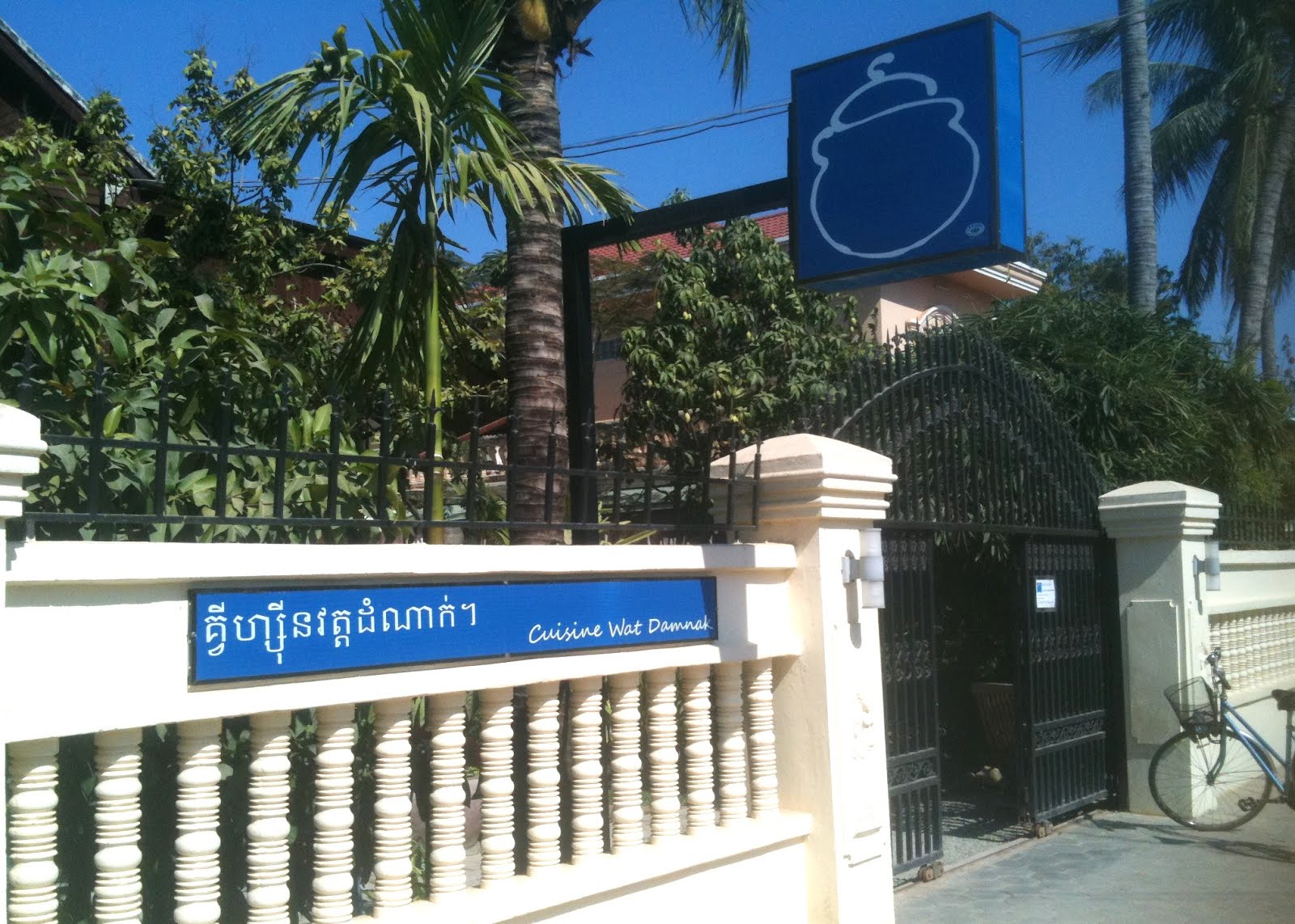
I walked along the dusty, crater-filled side streets near Wat Damnak temple, a mile or so from town, and then spotted the restaurant’s blue logo. The place had been converted from a traditional Khmer house, with a large kitchen extension at the back, and was set in a beautiful garden.

Rivière emerged from the kitchen with fat beads of sweat rolling down his forehead. He gestured me to a seat flanked by herb pots and we shared two bottles of ice cold water as the midday sun beat down.

He was good company, and very self-effacing given his credentials. You only had to look at him to see he had cooking and restaurants in his blood. He grew up working in his family’s small restaurant in Roanne, in the Loire region of France, and then went to chef school for three years before working as a pastry chef in Nantucket and Philadelphia.

He then decided he needed a change of scene and moved to Cambodia, working as a volunteer for two years teaching impoverished kids cooking and hospitality skills at the French NGO-run Sala Bai Hotel School in Siem Reap.

But savings don’t last forever, however much Buddha’s on your side, and he spent the next five years as executive chef of one of the northern city’s most prestigious venues, Hotel de la Paix, launching its renowned Cambodian degustation menu. In April last year, during Cambodia’s hottest month, and at the beginning of the low season, he and his wife Carole opened Cuisine Wat Damnak “with the aim of serving delicious and imaginative Cambodian food to locals, expats and travellers alike”. They also had a baby.

“It wasn’t a very clever idea,” chuckles Rivière, rubbing his eyes. “I wouldn’t recommend to have a baby and open a restaurant at the same time. It’s extremely tiring! You finish work at midnight and then you have to wake up at 6am, and it’s like this every single day!”

It wasn’t the most auspicious start. Business was fairly slow, and then he was hit by last year’s severe flooding and had to close for two months. But the word slowly got round as foodie tourists and expats and rich Khmers from Phnom Penh flocked to see a Frenchman showcasing traditional Cambodian recipes using seasonal fish, fruit and vegetables that are nearly impossible to source.

“I wanted to open a restaurant like you would in France or England by focusing on the products, which is actually very rarely the case in Cambodia. So I base all the recipes on that. If I find a good fish then we change the menu, and put the fish on the menu,” he says.


Rivière built up a network of local suppliers, getting freshwater fish from the Tonle Sap and pigs from farms near the world-famous temples of Angkor Wat. “The two good meats in Cambodia are fish and pork,” he explains. “If you can get Cambodian pork - because 70% of the pork here is imported from Vietnam, and is industrially farmed.”

The beautifully-white local pig meat is showcased in dishes like braised pork shank with star anis, caramelised palm sugar, fresh bamboo shoots, and crispy trotter. But it’s the freshwater fish he’s most proud of - a food that he says truly defines Cambodian cuisine.

“There are very, very good freshwater fish here. The Tonle Sap is actually the second biggest source of freshwater fish in the world after the Amazon, and because the ecosystem is so unique there is a variety of fish of all types.”


There are two fish on that day. Kay, which is originally from the Danube, but was introduced to Cambodia to help boost fish stocks. “They’re very, very bad in Europe - they taste like shit. But here they’re very good. They’re one of the best fish from the lake,” he says. It’s served as a fillet with tamarind reduction and pounded ambarella (golden apple).

The other is sanday (butter catfish), a big, torpedo-shaped predator with a large mouth and small tail that migrates between the Mekong and Tonle Sap. He serves that in a yellow curry sauce with green jackfruit.

Both are highly prized by Cambodians, and fetch high prices at the market, where Rivière, 32, follows the French tradition of shopping every morning for that night’s menu. With some foods only available for a month or two every year, he creates a new menu every week. But he’s given up describing his food as “local and seasonal”, cringing at the Noma-fuelled cliché it’s become.

“Everyone says that now,” he chuckles. “Now we say we choose premium products that happen to be seasonal...”

His food will dash any preconceptions about Cambodian food - or at least what most people think is Cambodian food - being bland and uninteresting. It’s piquantly flavoured with herbs, fish paste, fish sauce, and fermented soy beans. He’s a big fan of bold flavours like Cambodia’s famous fish ‘cheese’ prahok, and its more expensive sister maam, which is milder and more refined, if you can describe rotten fish that way, because it’s made using a different fermentation process.


He runs off to the kitchen and brings back a Tupperware box full of maam (pic above), which he will bake that night with minced pork and egg, and serve with herbs, flowers and local crudités.
“I always get it from the same supplier. She makes it for me without colour or MSG. The fish is salted for 24 hours then stacked in a jar with salted rice and galangal, and stored for one month until it becomes sour,” he says. “I don’t invent anything, I just use local products, and use quite traditional combinations, and then the technique and the presentation are definitely French.”


Another thing that differentiates his food is coriander. He doesn’t use it. It’s hard to find, because like carrots, potatoes, and onions, it doesn’t grow well in Cambodia. Instead, most restaurants use culantro, or lawn parsley, a coriander-tasting, jagged-toothed herb originally from the Caribbean (pic above). But he doesn’t use that either because he says it was brought here by Chinese immigrants, and you generally don’t find it in traditional Cambodian dishes.

Confusingly though, he does use ‘local thyme’ (chir slokkrahs, or pig’s ear - pic below), even though it’s another herb from the Caribbean. It’s a common fragrance often used in traditional Cambodian beef and tripe recipes, he explains. I don’t push the point any further.


He shows me the kitchen, pointing out the foot-high flood mark on the wooden door frame. It’s a lovely, airy space built on to the back of the house. When I mention how much it must have cost him, he just shrugs: “I have to spend 14 hours a day in here, so I want it to be a nice place.”


He leads me into a side chamber where a girl is prepping frogs for his pan-fried frog meat on a dry Vietnamese soup dish. Hang on - Vietnamese? I’m confused already. They have a short conversation in Khmer. From what I can tell she’s not too happy because the frogs aren’t as big as the last batch.


He leads me back into the main kitchen and proudly shows me the chicken stock simmering on the stove (pics below and above). He starts off by frying prahok paste, and then adds water, barbecued chicken, plenty of lemon grass stalks, lime leaves, and several heads of garlic, which will be carefully peeled and used as a garnish. The sour soup is then served with straw mushrooms, potulac, holy basil, and local thyme on the $17 five-course tasting menu.


Next to it is a tray of aubergines grilled to black. They’ll be made into a paste with ground smoked fish (pic below) to go with the fresh rice flake pancake. In the fridge is a bowl of chocolate and holy basil ganache, which is served on the second tasting menu, a six-courser for $24, with rice praline and salted caramel sheet.


I can tell from his passion, the presentation of the dishes, the quality of his ingredients, and the incredible smells why Blanc was so impressed - the fellow Frenchman describing his food as having “supreme command in the spicing, warm in the mouth, long flavours so perfect, complex but no sophistication: simply delicious.”

I ask him about the TV chef’s visit, but Rivière just shrugs.

“I knew his name but I wasn’t very familiar with his restaurant or anything. The chef from La Residence called me and said I want to book a table for Raymond Blanc - and I was fully booked. And he said ‘Oh come on, it’s Raymond Blanc!’ So we found him a table at the back in a dark corner of the terrace so he wouldn’t see too much,” he laughs.

Afterwards, Blanc asked for a tour of the kitchen and shook hands with the staff. He was intrigued by one of the dishes - ‘soup outside the pot’ - a vibrant, green dish of raw herbs and vegetables which at the last minute has broth made from dried fish and spices poured over it.

“He said I’ve never had such a thing before, this is genius! But it’s not something I invented, it’s very, very, traditional. Cambodians will put grated boiled eggs in it to thicken it up, but we don’t because it looks quite ugly...”

I ask whether it’s possible that Cambodia might be on its way to its first big restaurant award, given Blanc’s hyperbole, and the painfully-trendy vogue for locally-picked weeds, but Rivière just laughs in his usual modest manner.

“It’s not me who’d going to decide that,” he says.

Then I ask if I can do a day in his kitchen as part of the interview. He looks less surprised than reluctant. Then he suggests I meet him at the market at 7.45 on Wednesday morning and we take it from there...


MORE: In Defence Of Cambodian Cooking

My new book on training to be a chef, including stints at Rick Stein's and the Fat Duck, is available on Amazon CLICK HERE

"Reading this book is a serious test for any food writer. Not only has Alex Watts done what all of us say we would like to do, tested his mettle in a professional kitchen, he also writes about his experiences so well that you spend as much time being jealous of his writing skills as you do of his experiences. It's an annoyingly enjoyable read." - Simon Majumdar

Twitter Reviews:

"A rattling good read." - @chrispople

"It's a fab read. The Fat Duck chapters are class." - @Mcmoop

"If you claim to be a foodie you MUST buy this book." - @CorkGourmetGuy

"Bought your book and am hugely enjoying. Funny, engaging, interesting, lively." - @oliverthring

"A great read about the reality of working at The Fat Duck & other less famed restaurants." - @alanbertram

"Very funny, very close to the bone." - @AmeliaHanslow

"A great read and must have book for anyone in the industry." - @philwhite101

"Thoroughly enjoyed it." - @rosechadderton

"Excellent!" - @MissCay

"Just finished your book, and loved it! Thanks for ending on a happy note; it needed it after all the reality ;-)" - @voorschot

"Fab account of psycho chefs, plus work experience with Heston and Stein." - @Laurajanekemp

"Excellent read & loved the ‘scary duck’ tale! I look forward to the follow up book (no pressure ;D). Great memories of first being addressed as chef." - @granthawthorne

"Sensational account of a chef’s life, couldn't put it down. Get it from Amazon now!" - @Fishermansarms

"I'm loving your book. Very enjoyable. Some great one-liners. "His legs wobbled like a crab on stilts" had me chuckling." - @griptonfactor

"Highly recommended. A great book about changing careers for his love of cooking." @Whatsinmymouth

"Downloaded the book last Sunday and finished it the same day! Great read." - @MTomkinsonChef

"Very funny." - @SkyRuth

"Any of you who have flirted with chefdom, go and immediately download this book from Amazon - Down and Out in Padstow and London. Great read." - @el_duder

"Truly brilliant." - @kcassowary

"Just rattled through Down And Out in Padstow and London by Alex Watts in no time at all, what a great book." - @leejamesburns

"It's brilliant, a fine piece of work. If you've ever wanted to peer into a professional kitchen I can't recommend it highly enough." - @acidadam

"Fantastic read - the English Kitchen Confidential!" - @cabbagemechanic

"A great eBook to buy about serving your time (literally!) as a trainee chef." - @OkBayBach

"Great read." - @rankamateur

"Don't start reading it if you have things to do:)" - @NorthernSnippet

"Great book...couldn't put it down, read it non-stop on a train and finished it in one day." - @chunkymunki

"Jolly good read, feel free to do one more." - @esbens

There are also 12 reviews on its Amazon page.

Haven't got a Kindle? You can download a free Kindle reader app to read it on your computer. CLICK HERE.

Tuesday, August 16, 2011

An Existence Of Mud, Fish & Lake Water


I continued my journey through the floating villages on Tonle Sap, and the tin shacks and wooden houses became even more ramshackle, until there were families of 14 living in single room shelters with reed-stitched roofs. The people looked happy, but the poverty was appalling.

Children were playing in the mud, and everywhere I went there were choruses of “allo!” It was obvious they got few foreign visitors. Most of the tourists they see are the boat loads of holidaymakers who float past on organised tours of SE Asia's largest freshwater lake, which during the monsoon swells up to cover a fifth of the country.


It’s an existence of mud, fish and lake water. I passed a yard making boats, and the smell of the wood oils enveloped the air with a fresh, musky, aftershave smell that for a few seconds overpowered the relentless stench of fish rotting away in tubs to make prahoc (a delicious fermented fish condiment that has a peculiar taste of Roquefort, and is often cooked in omelettes, and served with beef lok lak).


It's a tough life - the dreadful poverty means the average age expectancy is just 54, 50% of children are malnourished, and 12% die before the age of five, according to the NGOs that raise cash for the villagers.

Some of the wooden shacks were bought for families by foreign visitors, and have their names plastered on boards outside like 'for sale' signs.


The whole economy is based on fish. And I'm glad the Cambodian government has finally announced action to restore fish stocks in Tonle Sap, also known as the Great Lake, by removing the commercial licences of fishermen who had been pouring toxic chemicals into the water to drive fish towards their nets.

The 35 lot-holders, who had been paying the government a total of $2m a year for the privilege of overfishing and poisoning the lake, will not be able to operate for at least three years to allow fish stocks to recover.

Locals will still be able to fish the lake to feed their families, however - which is lucky considering there is very little else for them to eat.


On the dusty road back to Siem Reap, a tuk tuk full of lycra-clad Russians clutching beer bottles ambled past and then stopped suddenly in front of me.

They got out and disappeared down a slope to a lotus flower farm with a 1,000 riel ($0.25) honesty box outside for visitors. They started clambering around in the middle of the flowers, taking pictures of each other.


I watched for a bit wondering whether the entrance fee would pay for the damage to the plants, and then there was lightning over the hill and soon the full strength of a monsoon.

I was drenched in seconds. The potholes and craters quickly filled with muddy, red water and it was impossible to know which would lead down into a crunching chasm, and which was older and filled with stones.

I stopped outside one of the hammock bars lining the road. An old woman welcomed me in and sat me down with a bucket of ice cold beers and a bucket of ice.

I drank the Anchors in quick succession, staring out at the lush green rice fields that would soon become a lake again. I could have been in Wales, except the rain was stronger, the heat left breath trails in the air, and there wasn’t a curried chip or a track-suit in sight.


The rain gathered strength, and poured through every hole in the roof. They moved me to a room at the back with a sturdier roof made of rusty corrugated iron, and I drank a few more beers as I waited for my Cambodian sour rice chicken soup. A steaming bowl big enough to feed a brigade of hungry soldiers arrived. There was so much there, I shared it with the family.

The chicken was the gloopy, gelatinous parts of the bird – feet and wing tips mainly – as well as offal and gizzards, and with the sourness of the tamarind, flavoured the stock brilliantly.

It came with bean sprouts, chopped spring onions greens, and a bowl of Kampot pepper. Every time the liquid level fell below five gallons, the old woman would return with a cauldron of bubbling chicken stock to top it up.

It was absolutely divine, and continues to be one of my favourite Khmer dishes. More commonly, it is flavoured with dried shrimps, sliced shiitake and straw mushrooms, chopped thorny coriander, spring onion greens, slices of onion, plenty of black pepper, and julienne strips of fresh ginger draped over the top (pic below).


The prawns add wonderful bursts of fishy flavour, and it’s so thick, it has all the smack of a good Mulligatawny. It really is a spectacular meal in a soup.

I sat in my hammock and gazed out at the paddy fields that now resembled a patched quilt with squares of brown in the afternoon haze. I looked down at the water-filled trench below and the goat and her mewing kid. The top of a reed fish trap was poking out from the water. There was movement inside and I could see a snake’s head squeezing out through the bars.

It tried one side and then the other, each time looking for a bigger gap. Finally it pushed half its body through and dangled unsteadily in mid-air. I felt slightly guilty, but did it anyway. I walked out to the front of the restaurant to tell the family they were about to lose a snake.

They had no idea what I was talking about so I got them to follow me. They squinted for a bit as I pointed. The snake had gone still all of a sudden and you could hardly tell it was there. Then it gave a final lunge and vanished into the brown water. I gestured again, but the woman just shrugged.


“You want me go and get and cook for you?” she asked.

“No, no, I not like,” I said.

They wandered back to their hammocks, and then the woman returned with a stick in her hand. Her silhouette got closer. When she was a few feet away, the stick bent upwards and I realised it was a snake.

“I cook for you?” she said.

“No, no,” I said, panicking, and wondering how I could jump out of the hammock without falling over the low banister into the snake-filled trench 20ft below.

She grinned, and I thought she was going to throw it at me. But she walked off and chucked the serpent back into a large, foul-smelling vase to rejoin its friends and live for a few more hours. I staggered to my feet, paid the bill, and got back on my bike to brave the rain.

:: Map Of Siem Reap And Tonle Sap...


View Larger Map

Monday, August 15, 2011

A Novel Way Of Catching Crickets


Cambodia is a hard place to work in as a journalist, but it’s still depressing to see the lack of news coming out of the country. Publications that take a critical stance are quickly brought to heel, or have their licences taken away by the Information Ministry.

For a country so rife with corruption, and so full of human rights abuses, it’s a crying shame there’s not more printed about the place. Much of it has to do with the media’s ever-growing obsession with celebrities and soft news.

It hammered it home the other day when I typed “Cambodia” in a Google news search, and most of the stories that came up were about how Angelina Jolie’s kids love eating crickets and munch them “like Doritos” - as she revealed in an interview during a visit to Siem Reap Province to plug a £7,000 handbag for Louis Vuitton.


Light-hearted yarns about child labour, mass faintings in sweat shops knocking out goods for the likes of Tesco and Marks & Spencer, and foreign conglomerates driving out impoverished villagers from their homes to make way for rubber plantations and shopping malls, don’t stand much of a chance against what a celebrity’s adopted brood like to scoff while playing video games.

But in the unlikely event that Jolie or her kids ever find themselves on skid row, they could always try this novel way of catching crickets I came across on a tour of the third world floating villages lining the massive Tonle Sap lake, just south of Siem Reap and the ancient, fabled city of Angkor Wat.


It really is shocking the extremes of wealth in Cambodia, where there's little or no state help. Siem Reap is so developed, with its $800 a night suites and world class golf courses, and yet an hour's bike ride away there are villagers earning $500 a year.

When the lake is down, as it is now, they pretty much survive on snakehead fish, which are ugly looking things with dark reptilian eyes that glint angrily as they are pulled from nets, and are about the only fish that can survive the dry season buried in muddy puddles, pretty much like the people who live on them.


One side of the road was lined with plastic bowls with what looked like giant hankies hanging over them. I’d seen them many times, but still couldn’t figure out what they were for.

I’d seen calves and chickens drinking from them, and initially thought they were just water tubs, but why so many? And what about the netting and the electrical cables and fluorescent bulbs dodgily hooked up to the overhanging power lines?

A dead frog was floating in one. Was it a frog trap? That didn’t explain the electrics. Or did it?


A group of young Khmer men emerged from a karaoke bar. They were working for an English school and offered me a job on the spot after discovering I was British – which perhaps sheds some light on why people complain about there being so many village idiots teaching English out here.

It turned out the splat-smeared netting was to catch flying crickets, so they plunged down and drowned in the slimy green ooze. I looked closer as one of the bolder Khmers began fiddling with the fizzing electrics to demonstrate how it worked.


A cable ran from the overhead power line to a plastic water bottle with two connections, providing some sort of switch so the bulb dangling perilously over the water could be switched on at night to attract more insects.

The crickets are then collected in the morning and fried for breakfast, or sold to street vendors who cook them up for the thousands of tuk tuk drivers clapping their hands at tourists in the centre of Siem Reap.


:: Five Ways To Cook A Cricket

The locals are also big fans of deep-fried spiders, but I have no idea how they catch them...


As I was cycling up to one of the poorest villages, several policemen lounging in hammocks by the side of the track called me over and told me I had to pay $2 to go in.

I was directed back to the ticket office at Chong Kneas, where tourists are charged a hefty $20 to go on a short boat tour of the floating villages and schools.

At first, the touts denied it was possible to buy a ticket for the village and kept pointing at the boat, and then they said it was $4, and finally agreed it was $2.

It wasn’t the money that bothered me - it was knowing that hardly any of it would get to those cricket-loving villagers trying to scrape a living in the mud.

:: Map Of Siem Reap And Tonle Sap...


View Larger Map