Showing posts with label fermented fish. Show all posts

Tuesday, May 15, 2012

Phsar Prahok: One Of The Smelliest Places In The World


I was in an area where no-one speaks any English, and I’d got lost trying to find what I’d been told was one of the smelliest places in the world - Cambodia’s prahok-making hub, Phsar Prahok (fish paste market), on the banks of the Sanke river near Battambang, where hundreds of tons of freshwater fish are bought and sold each year.

How anyone would ever know it was one of the smelliest places in the world, I have no idea, and I’ve been to a few. But mention the name and even Cambodians hold their nose. I kept cycling up and down a mud track lined with stalls, and stopped to ask people for directions. But no-one knew what I was going on about.

The smell of rotten fish was definitely getting stronger though. There was just a gentle breeze in the hot midday sun, but sometimes with the wind on my face as I cycled, there was the distant whiff of Cambodia’s infamously smelly fermented fish paste.

I kept cycling, and then stopped to ask an old woman for directions. She was selling fresh spring rolls at the side of the road. She had five chairs outside her stall, and her cats took up two of them. I didn’t want to push them off. They looked vicious. The sort of cats used to keep snakes away.

I thought about dark, hooded encounters with monocled cobras hissing like garage tyre inflators. One of the cats yawned at me and stretched out its claws. It licked its lips, and we both looked round in the same direction. The wind had definitely changed. The smell of rotten fish was coming from somewhere behind those trees to the north-east.

I asked the woman again and she kept shaking her head when I said Phsar Prahok. Then she asked if I could speak French. She started to babble and slowly a few words came to me, and before I knew it she was shouting Phsar Prahok exactly the way I’d said it to her, and I’d gone through a number of possibilities.

She slapped me on the chest, as if to say ‘why didn’t you say so all along’, and then pointed to where the ginger cat was drooling. A mile later, the stench of fermented fish was breathtaking. It smelled worse than the crocodile farm I’d been forced to spend two days in for a story about whooping tourists hurling live chickens and ducks into crocodile pens.

It’s so strong if you get some on your hands while dipping chunks of barbecued veal and raw vegetables in prahok sauce, you soon know about it. Even bleach doesn’t get rid of the smell. Or as someone once said: “To describe prahok as pungent is being too charitable. It smells like it should be buried with corn seed.”

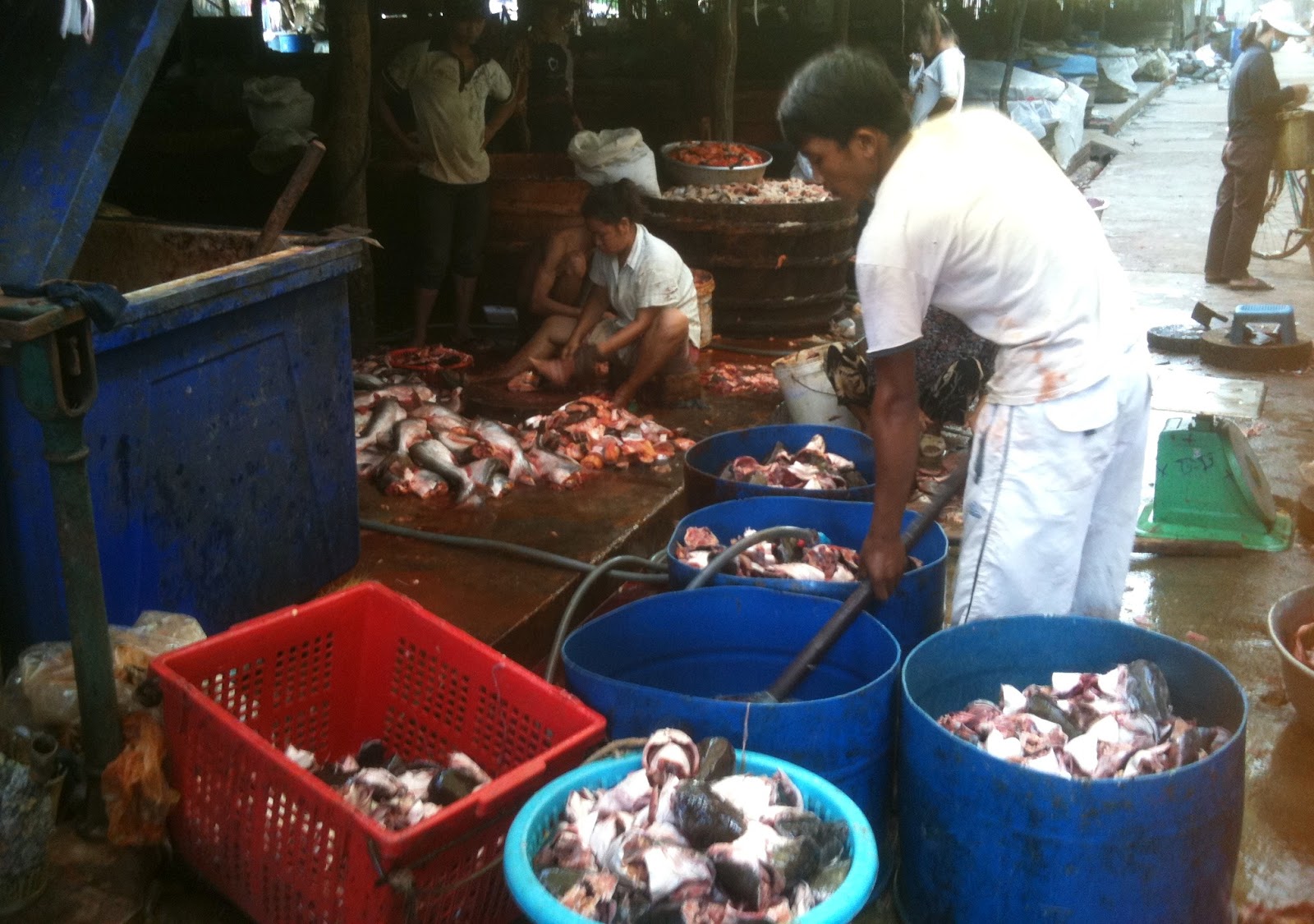
There was a huge fish processing plant hidden behind iron gates and then further on, where the boats were moored on the Sanke, a long line of huts filled with people covered in fish guts. Men were offloading fish they’d netted from the river, and the locals were sorting them into plastic barrels and crates before the real process of prahok fermentation would begin, exactly the way their ancient ancestors had done to preserve fish and guarantee a year-round supply of protein.

The fish are cleaned and then salted and mashed underfoot in barrels before being left to rot in the sun for a day - which helps kick off the fermentation process. More salt is added. Then they are weighted and left in huge barrels for months, depending on the desired taste or price, with prices rising in the rainy season when the paste becomes scarce.

River fish are put in barrels and salted...


The fish ferment and become a grey, cheese-like paste...


Prahok chopped and ready to cook...


The taste and smell varies largely from batch to batch, depending on the type of fish used, how carefully they’ve been prepped, and the time, skill and methods used to ferment them. The cheapest stuff is filled with bones, fins, and scales like the bag of prahok I’d bought from a street stall on the coast last month. It looked like it had been made from crab bait, and had a disconcerting ripeness.

In some of the other huts they were smoking and curing fish. Racks of fish no bigger than minnows were being slowly grilled over charcoal coals until deep bronze and rigid. Some of the larger fish were being turned into maam, a more expensive version of prahok. It’s salted for 24 hours, then stacked in a jar with salted rice and galangal, and stored for less time (usually a month) until it becomes sour.

It’s these fermented fish products that define traditional Khmer food and differentiate it from the strong culinary influences of China, Vietnam, Thailand, and much further back, India and Sri Lanka.

Many countries use fermented pastes and sauces, of course, to add the savoury, meaty ‘fifth taste’ of umami to food. China and Japan have soy sauce and miso made from fermented soy beans, wheat flour, water, and salt. Vietnam and Thailand have fish sauce, drained from salted and fermented anchovies, prawns or squid. Malaysia has its blocks of fish paste, or blacan, and there are many other varieties around the world.


But none of them have the cheesy punch of prahok. Most people agree it tastes of blue cheese. But it’s more the harshness and saltiness of Danish blue rather than the creamier, more refined flavour of say Roquefort or stilton. And always there on the palate and in the nose is the smack of rotten fish, as though you’ve been cutting skata with the cheese knife.

For that reason, you don’t see it on restaurant menus much, especially in places where tourists go. Sadly, many Khmers talk about how it’s now looked down on by Cambodia’s emerging middle class as a reminder of the bad old days. They say it’s the smell of poverty - a remembrance of their tough, previous lives working on the farm.

It’s certainly true of Cambodia’s highly aspirational pop videos, which always seem to feature affluent, pale-skinned Khmer couples posing around in shiny SUVs that would keep a whole village in food for a year. You never see them munching prahok at a street stall. It’s always pizza, burgers or fried chicken in soulless, chain-style restaurants.

It breaks my heart more than the appalling car crash at the end, which is how most Khmer music videos seem to end, with a girl crying hysterically, holding the lifeless body of her boyfriend in her arms, and screaming “WHY!” at the sky. Which is not the best viewing when you’re being forced to watch it on a bus clattering away on tyres with less grip than a pickled egg.

After an hour, I could take no more and cycled across the bridge to the old woman’s stall. The cats were still there, but this time there was a seat free. The ginger cat sniffed the air again and looked at me. The smell had suddenly got a lot stronger. 


:: BOOK UPDATE:

I want to apologise for the very poor delivery times of the paperback version of my new food book Down And Out In Padstow And London. For reasons that are beyond me, Amazon have had problems distributing recent batches. It’s something to do with the wrong metadata being input, whatever that means. But Completely Novel who print my book have promised they are trying to sort it out.

I don’t know how long it will continue, but I’ve been told that books ordered through Amazon will arrive soon, and they will obviously not take your money until they do post the book to your address. To help remedy this, an eBay page has been set up to sell my book. So if you want the book in the next few days, then cancel your order at Amazon and buy the book HERE... For the eBook version click HERE...


Friday, March 16, 2012

Fermented Fish And A Tour Of The Market With One Of Cambodia's Top Chefs


This is the second part of an interview with Cambodian food expert Joannès Rivière, head chef-owner of Cuisine Wat Damnak, in Siem Reap. To read the first part, CLICK HERE...

I meet Rivière at 7.45am at the cafe next to the old market in Siem Reap as planned. But he’s not there. He’s already begun shopping for that night’s ingredients. He appears from the sweaty cauldron after a few minutes, shouting my name from across the street. You can see the stress in his eyes - he’s got to come up with six new seasonal dishes in the next nine hours.

“I had to crack on,” he explains.

I look at my Rolex and tap it a few times. I knew I should have bought the one for $15. We neck a napalm-strength espresso, and then head into the sauna-like covered market. I’m hit in the face by the smell of freshly-slaughtered pig and gasping fish. The place smells like a blood-filled swamp.


Rivière points at the different stalls as we press on. Everyone knows him. A chef from a luxury hotel walks past with a group of Asian tourists wearing masks as we’re picking through hyacinth plants for that night’s garnishes. The cooks meet like two old boxers, slapping each other on the back.

“He does tours round the market every morning for the guests. He hates it!” Rivière (pic below) laughs afterwards.


As we head to each stall, he banters away with the women in their hats and pyjamas. What impresses me most, even more than his knowledge of the local ingredients, is his Khmer. He cracks a few jokes with the women at the next stall, and then the next, and I’m left carrying the bags.

He shows me the freshwater fish and shellfish from the nearby Tonle Sap lake, pointing out the ones that are perfectly in season. There’s a splendid display of catfish, snakehead fish, Mekong langoustine (pic below), chlung, clams, and croaker fish. He describes the latter as tasting like sea bream, and says he’s putting it on that night’s menu.


“What defines Cambodian food for me is freshwater fish and the products that are used to keep them - the smoked fish, the dried fish, the fish paste,” he says.

We pass more stalls and he talks about the wide range of preserved fish Cambodia has to offer, from smoked minnows to prahok to maam to sun-dried fillets to the most pungent of all, a thick, black paste made from tiny fish and shrimps. I point to a bowl of minced, raw fish (pic below) sweating in the river-fed furnace.


“They don’t quite have the same hygiene - and with the heat!” he throws his hands up into the air. “That will probably be there all day - I wouldn’t recommend that for anyone.”

He chats away about the need to pickle, spice or brine fish and meat to stop it turning putrid in a country as hot as this. I think about how labourers building Cambodia’s 12th century holy site of Angkor Wat would have sat among the sun-baked stones, seasoning their vegetables and rice with the rich, salty, delicious taste of rotten fish.

It reminds me of the Romans, another great civilisation that had thrived on a similar fermented fish sauce to flavour each meal - and for some reason think about Keith Floyd, when he was filming at Hadrian's Wall, recreating a traditional Centurion recipe while cooking in a gale and berating the crew and assembled historians sheltering under a tarpaulin behind the camera.

Floyd is making pork stew flavoured with carrot, onion, garlic, red wine, parsley, cumin, ginger, marjoram, thyme, and dill. And then the crucial ingredient comes - an addition that plunges it back 2,000 years to when the Romans finally tired of the dreadful weather in Britain - a few glugs of Floyd’s “Centurion’s Worcestershire sauce”. It had taken him three weeks to make, he says proudly, waving the bottle at the camera. Anchovies, sprats, marjoram, red wine, and salt are boiled up and left to ferment before being strained and bottled.

The Cambodians generally just use salt and freshwater fish to make prahok, mashed under foot like the French crush grapes for wine. They leave the bloody mush to go off in the sun for a day, giving it the roof-of-the-mouth-etching taste of blue cheese, then bung in more salt and leave it to ferment for months, depending on the desired taste.

Just as the Khmers add sugar to cut the taste of prahok, the Romans added honey (they didn’t have sugar in those days). It reminded me of the first time I ordered my favourite Cambodian dish, prahok ling. It was so sweet I could hardly eat it. When I asked them to skip the sugar the next time I went in, I threw the restaurant into chaos. Even the owner emerged from her hammock near the kitchen to quiz me.

“No sugar? But it very salt!” she said.

I told her no sugar, and she cracked a joke in Khmer to the policemen playing cards in the corner. It was probably along the lines of: “What the hell does he know?”

WE BUY some pork, and then head to the chicken woman and buy a bag of wings for staff food. Then we stop at the frog woman. She digs through blooded plastic bags in the bottom of her ice box. It’s a messy task. Rivière sniffs the frogs before taking them.

“They sometimes don’t smell too good,” he whispers to me, “then I don’t buy them...”


We sit down and eat a traditional breakfast of grilled pork, rice, and pickles at a stall in the middle of the market, and he downs two iced coffees. He picks up a small bowl of sweet chilli sauce and pours it over his meal.

“When I first came to Cambodia nine years ago, I didn’t eat anything with MSG. Now I realise you can’t get away from it. Sometimes I now think I can’t taste anything without it,” he laughs. He points to an old woman drinking coffee. “She’s the best cook in Siem Reap, believe me!” he says.

I write down the name of her restaurant - Bopha Leak Khluon, tucked down an unmade road 200 yards or so from Hotel de la Paix - and go there later that day. The walls are made from green Heineken bottles. One of her specialities is prahok ling, translated on the menu as “fried rotten fish with egg and pork”. It’s the best I’ve tasted so far in Cambodia - and I’ve eaten a lot of prahok ling.

As Rivière sips away at his third iced coffee, we talk about Cambodian food again. He tells me how important it is to differentiate between traditional, ethnic Khmer dishes and Cambodian cuisine, with its heavy influences from Indian, Thai, Vietnamese, and perhaps most of all, Chinese cooking.

“People will tell you Khmer cuisine disappeared during the Khmer Rouge, but it’s actually not true. Phnom Penh cuisine from the 60s may have disappeared, but Khmer food from the countryside has always existed.

“You can still find those dishes - but people just cook them in their homes. When I was working at Hotel de la Paix people would come in and say: ‘Oh you’re rediscovering Cambodian food.’ But that’s bullshit, it’s always been here - you just have to find it and rip it off, and use it for you and claim it,” he chuckles.

We talk about the balance of salty, sour, spicy and sweet shared dishes making a whole rather than mixing the flavours in one dish - a practice popular in every cuisine that hasn’t been refined, he points out.

I ask him what he thinks every time he reads how Cambodian food is touted to be the next big thing. He agrees that it’s “definitely on the up” - but has a long way to go.

“To make a food famous is quite complicated, because people have to be familiar with it. Laos food is virtually impossible to find in France, for instance. I know one Laotian restaurant in Paris, which is excellent.

“But Laos food is very unknown, and is actually quite similar to Cambodian. People will tend to talk about it if they know about it. I’m sure it wasn’t easy for David Thompson when he started with Thai food in the 80s...”

He met the Michelin-starred chef a couple of years back, when he first visited Cambodia, and gave him a tour of the local Cambodian restaurants and street food stalls in Siem Reap.

“It was very interesting to see Cambodian cuisine with a very objective eye, not ‘I’m coming from Thailand, I’m going to compare it with Thai food’ - but more ‘is there any similarity?’”
Thompson told him that Cambodian cooking was almost the same as Thai food 20 or 30 years ago, before it became more refined, and far sweeter and spicier.

He says the biggest obstacle facing Cambodian cuisine is the lack of confidence the locals have in promoting their food, and how “some restaurants are doing a very poor job of it”.

I quiz him about Cambodia’s unofficial national dish amok, and say I still haven’t had a good one. I just hope he hasn’t got amok on that night’s menu. I’m relieved when he agrees.

“I’m still trying to figure out why amok. I think the first guy who wrote Lonely Planet must have put it in. I have no idea why it’s amok because amok is done exactly the same as it is Thailand - and it’s called the same!”


I ask him what dishes really sum up Cambodian cuisine. He thinks for a while, and then says khor trey swey kchey (pic above) - river fish braised in a mildly-spiced palm sugar sauce with grated green mango on top. I’ve had the dish a few times and it’s wonderful.

“What’s interesting about Cambodia food is it’s still quite rustic. It’s a matter of contrast - it’s not a matter of how balanced it is. You have the very sweet fish and then the very sour green mango on top with the herbs.”

I ask him for others, but he takes even longer to answer - khor trey, he adds again, prahok, maam, eels “if they’re well done”, and nom ban chok (rice noodle soup, often served with bean sprouts, sliced banana flower, herbs, and a mild, coconut curry sauce).

I mention Cambodia’s famous duck and salted lime soup traditionally served at weddings out here. The duck is deep-fried and then cooked in water flavoured with kaffir lime leaves, galangal, lemon grass, garlic, fish sauce, and its most crucial ingredient, ngam ngov (salted limes). But he says it isn’t Cambodian at all - it’s Chinese.

“Chinese-Cambodian food is as interesting as Khmer food,” he adds, “It’s the only big influence in Cambodian cuisine, if you forget the original Indian influence. You have dishes in Cambodian food that are actually very Chinese, but people will just assume they are Khmer...”

I want to question him further, but there’s no time and we’re off to the next stall. I’m handed bags of fish and meat, and a crate of eggs which are then haphazardly stacked on a waiting moped to be delivered to the restaurant.


I remind him about working in his kitchen, and he looks thoughtful for a second, and then tells me it would be better if I work there the following afternoon, given all the new dishes he’s got to create. I can see he’s going off the idea.

I walk home with my shirt stuck to my back, thinking about the 14-hour day Rivière’s got ahead of him. Cheffing is hard enough anyway, but working in this heat is unbearable.

MORE: Prahok - My Secret Addiction To Cambodia's Infamous Fermented Fish 'Cheese'

My new book on training to be a chef, including stints at Rick Stein's and the Fat Duck, is available as a paperback and eBook on Amazon CLICK HERE

"Reading this book is a serious test for any food writer. Not only has Alex Watts done what all of us say we would like to do, tested his mettle in a professional kitchen, he also writes about his experiences so well that you spend as much time being jealous of his writing skills as you do of his experiences. It's an annoyingly enjoyable read." - Simon Majumdar

Twitter Reviews:

"A rattling good read." - @chrispople

"It's a fab read. The Fat Duck chapters are class." - @Mcmoop

"If you claim to be a foodie you MUST buy this book." - @CorkGourmetGuy

"Bought your book and am hugely enjoying. Funny, engaging, interesting, lively." - @oliverthring

"A great read about the reality of working at The Fat Duck & other less famed restaurants." - @alanbertram

"Very funny, very close to the bone." - @AmeliaHanslow

"A great read and must have book for anyone in the industry." - @philwhite101

"Thoroughly enjoyed it." - @rosechadderton

"Excellent!" - @MissCay

"Just finished your book, and loved it! Thanks for ending on a happy note; it needed it after all the reality ;-)" - @voorschot

"Fab account of psycho chefs, plus work experience with Heston and Stein." - @Laurajanekemp

"Excellent read & loved the ‘scary duck’ tale! I look forward to the follow up book (no pressure ;D). Great memories of first being addressed as chef." - @granthawthorne

"Sensational account of a chef’s life, couldn't put it down. Get it from Amazon now!" - @Fishermansarms

"I'm loving your book. Very enjoyable. Some great one-liners. "His legs wobbled like a crab on stilts" had me chuckling." - @griptonfactor

"Highly recommended. A great book about changing careers for his love of cooking." @Whatsinmymouth

"Downloaded the book last Sunday and finished it the same day! Great read." - @MTomkinsonChef

"Very funny." - @SkyRuth

"Any of you who have flirted with chefdom, go and immediately download this book from Amazon - Down and Out in Padstow and London. Great read." - @el_duder

"Truly brilliant." - @kcassowary

"Just rattled through Down And Out in Padstow and London by Alex Watts in no time at all, what a great book." - @leejamesburns

"It's brilliant, a fine piece of work. If you've ever wanted to peer into a professional kitchen I can't recommend it highly enough." - @acidadam

"Fantastic read - the English Kitchen Confidential!" - @cabbagemechanic

"A great eBook to buy about serving your time (literally!) as a trainee chef." - @OkBayBach

"Great read." - @rankamateur

"Don't start reading it if you have things to do:)" - @NorthernSnippet

"Great book...couldn't put it down, read it non-stop on a train and finished it in one day." - @chunkymunki

"Jolly good read, feel free to do one more." - @esbens

There are also 12 reviews on its Amazon page.