Showing posts with label Battambang. Show all posts

Tuesday, May 15, 2012

Phsar Prahok: One Of The Smelliest Places In The World


I was in an area where no-one speaks any English, and I’d got lost trying to find what I’d been told was one of the smelliest places in the world - Cambodia’s prahok-making hub, Phsar Prahok (fish paste market), on the banks of the Sanke river near Battambang, where hundreds of tons of freshwater fish are bought and sold each year.

How anyone would ever know it was one of the smelliest places in the world, I have no idea, and I’ve been to a few. But mention the name and even Cambodians hold their nose. I kept cycling up and down a mud track lined with stalls, and stopped to ask people for directions. But no-one knew what I was going on about.

The smell of rotten fish was definitely getting stronger though. There was just a gentle breeze in the hot midday sun, but sometimes with the wind on my face as I cycled, there was the distant whiff of Cambodia’s infamously smelly fermented fish paste.

I kept cycling, and then stopped to ask an old woman for directions. She was selling fresh spring rolls at the side of the road. She had five chairs outside her stall, and her cats took up two of them. I didn’t want to push them off. They looked vicious. The sort of cats used to keep snakes away.

I thought about dark, hooded encounters with monocled cobras hissing like garage tyre inflators. One of the cats yawned at me and stretched out its claws. It licked its lips, and we both looked round in the same direction. The wind had definitely changed. The smell of rotten fish was coming from somewhere behind those trees to the north-east.

I asked the woman again and she kept shaking her head when I said Phsar Prahok. Then she asked if I could speak French. She started to babble and slowly a few words came to me, and before I knew it she was shouting Phsar Prahok exactly the way I’d said it to her, and I’d gone through a number of possibilities.

She slapped me on the chest, as if to say ‘why didn’t you say so all along’, and then pointed to where the ginger cat was drooling. A mile later, the stench of fermented fish was breathtaking. It smelled worse than the crocodile farm I’d been forced to spend two days in for a story about whooping tourists hurling live chickens and ducks into crocodile pens.

It’s so strong if you get some on your hands while dipping chunks of barbecued veal and raw vegetables in prahok sauce, you soon know about it. Even bleach doesn’t get rid of the smell. Or as someone once said: “To describe prahok as pungent is being too charitable. It smells like it should be buried with corn seed.”

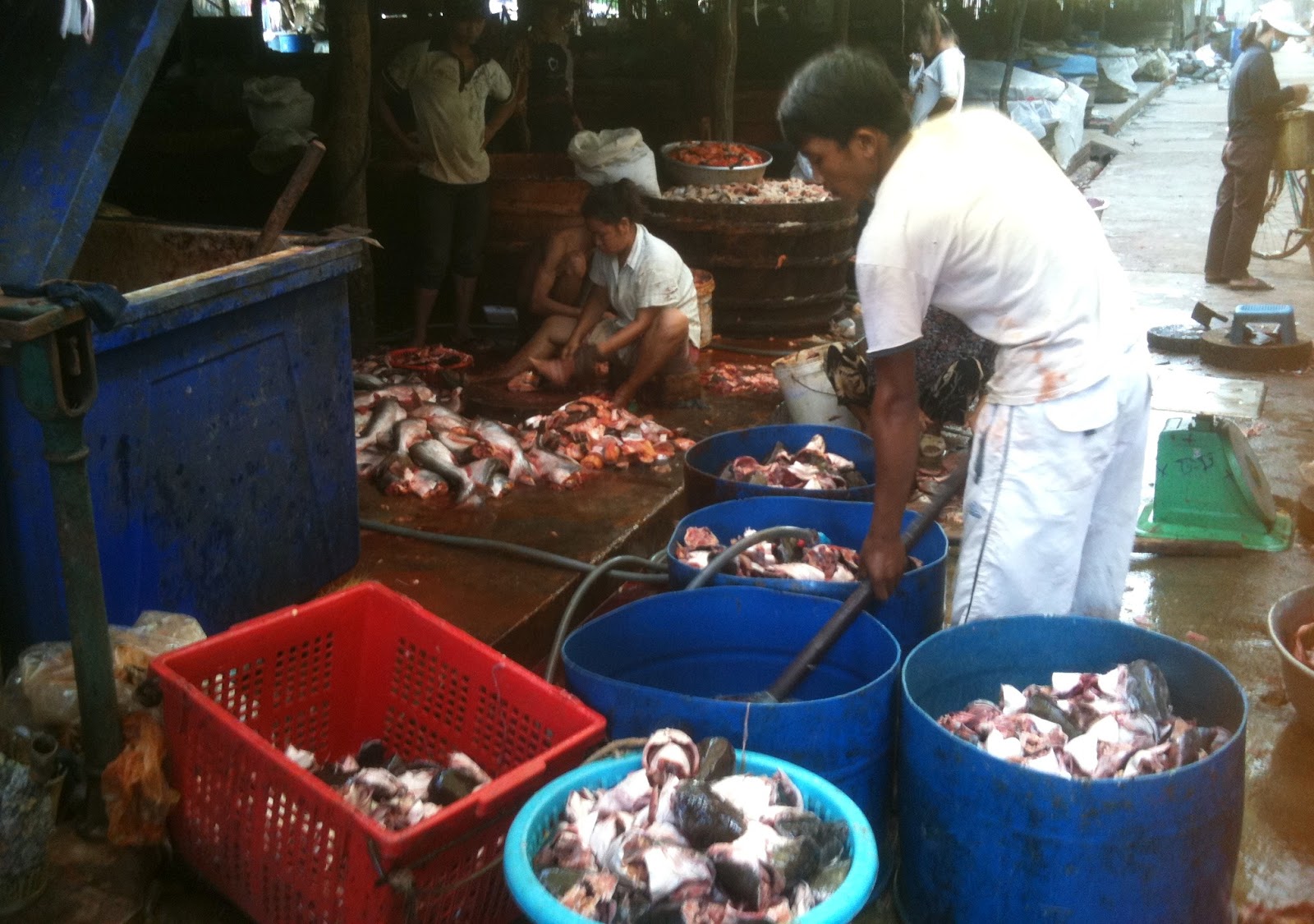
There was a huge fish processing plant hidden behind iron gates and then further on, where the boats were moored on the Sanke, a long line of huts filled with people covered in fish guts. Men were offloading fish they’d netted from the river, and the locals were sorting them into plastic barrels and crates before the real process of prahok fermentation would begin, exactly the way their ancient ancestors had done to preserve fish and guarantee a year-round supply of protein.

The fish are cleaned and then salted and mashed underfoot in barrels before being left to rot in the sun for a day - which helps kick off the fermentation process. More salt is added. Then they are weighted and left in huge barrels for months, depending on the desired taste or price, with prices rising in the rainy season when the paste becomes scarce.

River fish are put in barrels and salted...


The fish ferment and become a grey, cheese-like paste...


Prahok chopped and ready to cook...


The taste and smell varies largely from batch to batch, depending on the type of fish used, how carefully they’ve been prepped, and the time, skill and methods used to ferment them. The cheapest stuff is filled with bones, fins, and scales like the bag of prahok I’d bought from a street stall on the coast last month. It looked like it had been made from crab bait, and had a disconcerting ripeness.

In some of the other huts they were smoking and curing fish. Racks of fish no bigger than minnows were being slowly grilled over charcoal coals until deep bronze and rigid. Some of the larger fish were being turned into maam, a more expensive version of prahok. It’s salted for 24 hours, then stacked in a jar with salted rice and galangal, and stored for less time (usually a month) until it becomes sour.

It’s these fermented fish products that define traditional Khmer food and differentiate it from the strong culinary influences of China, Vietnam, Thailand, and much further back, India and Sri Lanka.

Many countries use fermented pastes and sauces, of course, to add the savoury, meaty ‘fifth taste’ of umami to food. China and Japan have soy sauce and miso made from fermented soy beans, wheat flour, water, and salt. Vietnam and Thailand have fish sauce, drained from salted and fermented anchovies, prawns or squid. Malaysia has its blocks of fish paste, or blacan, and there are many other varieties around the world.


But none of them have the cheesy punch of prahok. Most people agree it tastes of blue cheese. But it’s more the harshness and saltiness of Danish blue rather than the creamier, more refined flavour of say Roquefort or stilton. And always there on the palate and in the nose is the smack of rotten fish, as though you’ve been cutting skata with the cheese knife.

For that reason, you don’t see it on restaurant menus much, especially in places where tourists go. Sadly, many Khmers talk about how it’s now looked down on by Cambodia’s emerging middle class as a reminder of the bad old days. They say it’s the smell of poverty - a remembrance of their tough, previous lives working on the farm.

It’s certainly true of Cambodia’s highly aspirational pop videos, which always seem to feature affluent, pale-skinned Khmer couples posing around in shiny SUVs that would keep a whole village in food for a year. You never see them munching prahok at a street stall. It’s always pizza, burgers or fried chicken in soulless, chain-style restaurants.

It breaks my heart more than the appalling car crash at the end, which is how most Khmer music videos seem to end, with a girl crying hysterically, holding the lifeless body of her boyfriend in her arms, and screaming “WHY!” at the sky. Which is not the best viewing when you’re being forced to watch it on a bus clattering away on tyres with less grip than a pickled egg.

After an hour, I could take no more and cycled across the bridge to the old woman’s stall. The cats were still there, but this time there was a seat free. The ginger cat sniffed the air again and looked at me. The smell had suddenly got a lot stronger. 


:: BOOK UPDATE:

I want to apologise for the very poor delivery times of the paperback version of my new food book Down And Out In Padstow And London. For reasons that are beyond me, Amazon have had problems distributing recent batches. It’s something to do with the wrong metadata being input, whatever that means. But Completely Novel who print my book have promised they are trying to sort it out.

I don’t know how long it will continue, but I’ve been told that books ordered through Amazon will arrive soon, and they will obviously not take your money until they do post the book to your address. To help remedy this, an eBay page has been set up to sell my book. So if you want the book in the next few days, then cancel your order at Amazon and buy the book HERE... For the eBook version click HERE...


Wednesday, October 05, 2011

End Of The Line For Cambodia’s Quirky Bamboo Train


I went back to cooking at the restaurant for a few days to help my friend Josh out. He was in a sorry state. He was heading up to a province near Phnom Penh with his Cambodian wife to see how badly his house had been hit by the country’s worst floods for 10 years (the stilts were leaning but just about holding).

The day before he left, a dodgy-looking Khmer man called Too Jee appeared. It turned out he was some sort of relative of Josh's wife, could speak no English, and wanted to move south (and stay in Josh’s house for free like the rest of the growing family) while he found a job.

In fact, it didn’t take him any time at all. He had a job the moment Josh left town. Too Jee’s cousin, Wee – who also works at the restaurant – had obviously decided an extra member of staff was needed to make the rainy season staff-to-customer ratio look even more ridiculous.

I went in the next day, and saw him skulking near the cash till. Wee pointed at me as soon as I walked in, and muttered something to her cousin, or nephew or husband, or whatever he really was. I don’t know what she said, but it was nothing good. From the dead fish look in his eyes, I wouldn’t have even wanted him drinking in the restaurant, let alone working there.

I decided enough was enough, and spent the next few days looking at restaurants to buy. Josh phoned a few days later and insisted Too Jee would no longer be working there, but I could tell he’d long lost control of the business to the family. It was obvious they were trying to take over. And I’d just been seen as a thorn in their side, or worse. And in a country where you can remove problems for as little as $150 - probably even less in the rainy season, I was taking no chances.

THE NEXT week there was a knock at my hotel door. It was Josh – he’d returned from Phnom Penh. He walked straight in and lit a cigarette, and then another one off the butt. He was so angry he could hardly get the words out.

"I'm so angry...I'm so angry," he kept saying.

It turned out that Too Jee was hooked on ice, and had stolen Josh’s motorbike, all his antiques, jewellery and cash and had disappeared to Vietnam.

Josh asked me to come back, but I was dead set against it. Then I remembered that it was his birthday at the weekend and I’d promised to do the barbecue. Before I knew it, I’d somehow agreed to do the Sunday lunch as well.

I BUTCHERED half a small pig into ribs and chops and then got the Khmer cooks to help me prep some chicken kebabs and wings. We bought six kilos of fillet steak and made 60 or so burgers, and then we knocked up potato salad, coleslaw, and a few plates of nibbles.

The place was soon packed, but it was hardly surprising given the mean-fisted expats that live here. They were probably just disappointed that the drinks weren’t free as well. Trays of grilled meats went round, and then Steve (the railway contractor I mentioned in the last blog) appeared and sat on a stall nearest to the barbecue, and stuck his nose into everything.

“You want to get some burgers on there,” he said.

The grill was covered in ribs and wings. There wasn’t an inch of free grill space – that’s why the burgers were being cooked in the kitchen. But still he knew best.

“Hot enough for you?” he chuckled as I continued to ignore him. He could see the streams of sweat flowing down my front as I charged between the kitchen and the BBQ, but still he thought I had time for conversation with a man sporting the personality of a stuffed frog.

I was desperate to move him away from the subject of cooking – and on to something he might actually know something about. Railways, for instance. But I wasn’t too hopeful. He’d somehow invited himself on to our quiz team the night before, and had hardly said a word. The only time he did was to describe to the waiter in painstaking detail how he wanted his pizza cooked – this time he wanted “a thick base, but thin round the edges”.

He hadn’t known a single one of the 50 questions. When the only railway-related question came up, we all turned to him expectantly, but he just started drawing maps in the air and mumbling names of US states, and it was obvious he hadn’t got a clue, especially when the answer turned out to be Reykjavik.

When he asked about the next day’s Sunday roast, and whether we were doing cauliflower cheese, and whether I’d be pre-boiling the roast spuds, and how I was going to cook the pumpkin he’d requested, I started asking him about Cambodia’s new $142m railway system he was working on, and when it would be finished.

He stopped for a moment, and in an apparent attempt at humour, dipped his head slightly and looked out at the night sky. “Jeez! Christ knows,” he said. “Have you got a crystal ball?” I don’t know what he was looking for. There was nothing but a monsoon out there.

Steve was working on the new southern line, which will carry freight between Phnom Penh and the coast. But I was more interested in the northern line, and how it will sadly spell the end of Battambang’s famous bamboo trains – wooden beds resting on two sets of wheels that shoot along battered, broken rails at speeds of up to 25mph (40km/h).


I’d been up there last month, and even though I’m normally sceptical about any “must see” attractions in guide books, it really had been a brilliant, quirky – and bone-shaking - experience.


The locals that scratch a living from running the trains (or “norries” as they call them) said they had been warned they only had a year left at most – and then the wooden contraptions would have to be taken off the tracks to make way for fast trains linking Pursat with Phnom Penh.

I asked Steve how long they had left, but he just looked confused.

“They’ve already kicked them off haven’t they?” he said matter-of-factly.

I took a swig of beer and started flicking through the Battambang photos I’d taken on my iPhone as they began arguing over the quiz score.


I couldn’t blame Steve directly for its impending derailment, however much I’d have like to have done. And I know Cambodia badly needs infrastructure as it slowly emerges from the aftermath of the Khmer Rouge’s brutal, agrarian-based regime, but the trouble with this country is it’s always the poor that lose out.

The brilliantly-efficient norries they’ve been using to carry people, livestock, timber and rice between impoverished villages for the past three decades will make way for shiny locomotives run by Toll Royal Railway, an Australian-Cambodian joint venture, funded by AusAID and the Asian Development Bank, that they won’t be able to afford to use.


The 50mph trains won’t stop at their little village shacks selling cold drinks and scarves – they’re in far too much of a hurry to deliver goods to and from the capital. And the farm boys who drive the norries will no longer get their $1 per trip (the villagers say the rest of the $10 tourist ticket goes to the station owner – which is why there is so much pressure for tips).


But far worse is what’s happening in other parts of the country, where residents are being booted out of their homes to make way for the new railway, and a long list of other foreign money-backed land grabs. Locals living along one disused section of track near Phnom Penh say they’ve been offered a few hundred dollars compensation to move – and have been threatened with having their homes destroyed if they refuse.

"They asked me to accept it by giving a thumb print. If I don't they will bulldoze my house," one old woman told reporters back in May. "They will hire the drug user to burn my house."

IT HAD taken ages to find the place. I’d set off on my bicycle in the wrong direction from Battambang. But eventually I cut through a trail running alongside a river, where JCBs were carving huge chunks of earth from the jungle, and found a rusty, broken track. I waited for 30 minutes, and eventually a bamboo train appeared with waving passengers.


I cycled along the track, and found a small ramshackle station that served as a pool hall. As I chatted away to the well-fed-looking Tourist Police, who were there to explain and oversee the non-negotiable fare of $5 a passenger, or $10 a norrie, whichever was greater - dozens of holidaymakers arrived in tuk tuks to take the 12km train trip to O’Sralau village and back.

I got on, and soon we were off on our white-knuckle journey – well, it would have been if there was anything to hold on to. It wasn’t that fast, of course, but the incredible noise and the fact you’re only a couple of inches off the ground, and only occasionally in full contact with the buckled rails, makes the train seem as hairy as a souped-up go-kart.

Sometimes, you’ll meet a bamboo train coming in the other direction (the protocol is the lighter-laden norrie gives way) and then the platform, axles and heavy Kawasaki engine are lifted off the track to let the train pass.


We stopped at O’Sralau, and I sat with a local family drinking cold beers under a tamarind tree. They were eating the green fruit straight from the lower branches, dipping the pods in a bag of green chilli, salt and sugar.


They were surprisingly delicious – and reminded me again of the Cambodian love affair with sour food. Then they showed me around the old rice mill next to the track.


I wondered how many more mills would be left standing idle with the hundreds of thousands of hectares of rice paddies that have been hit by the flooding, driving up rice prices, and making the Khmer staple diet less and less of a staple. The last thing they needed was for the tiny trickle of revenue they got from passing tourists to disappear as well.

Wednesday, September 07, 2011

Pepsi, Smoked Fish And Green Mango Salad


I cycled through the hot, dusty streets around Battambang, Cambodia, for a few hours looking for the old Pepsi factory, when I realised I was looking straight at it.

I’d sat down at a road-side stall selling green mango salad, and was ferreting through the ice box for a second cola, when I turned round and saw the same logo, but this time faded and sorry-looking and without the “Max”, on a disused building across the road.


The place was massive. I pushed open a side-door and an old caretaker waved me away. I offered him some dollars, but still he wouldn’t let me in. So I took a long shot of some old Pepsi bottles that had survived the plant’s sudden closure when the Khmer Rouge seized power in 1975, and walked back out into the yard.

A Pepsi plant was never going to get an easy ride from Pol Pot’s thugs, who’d thought nothing of destroying their own temples, libraries, and schools to cleanse the country of its perceived political enemies, let alone a brand associated with American capitalism. It stood out like a bucket of KFC at an anti-vivisectionists’ meeting.


I was amazed how much of it was still standing. I went round the back, but there was nothing to see apart from a couple of cement water tanks, so I returned to the old man, and handed him another note, and this time he relented. I couldn’t go into the dusty office block, but he opened a gate and let me into the warehouse.

“But no machine,” he kept saying, as he stuffed the notes into his back pocket.

It looked like a film set from an Armageddon B-movie, with shell damage and bullet holes letting in shards of sunlight. The place had stopped in time like an old watch. There was the odd broken Pepsi bottle buried in the rubble and debris. But other than that, a series of switches was pretty much all that remained of the 1960s machinery.


Back then, Coca Cola had reportedly signed a deal with Bangkok to only allow its cola to be manufactured in Thailand, so Pepsi set up the bottling plant on a ferry point in Battambang, near the Thai border, so that it wouldn’t miss out on the Thai market.

I took a few more photos, and had a last stroll around the rubble, watching my step for snakes, and then returned to the old man. He was padlocking the door to the office block. I tried another bribe, but he just shook his head and smiled.

I rode back out and stopped at the stall for another drink. I ordered a green mango and smoked fish salad, and chatted away to the woman as she made it.


She told me the old man and his family were paid to sleep in the factory grounds to keep out visitors. She said the government was planning to turn the whole thing into a huge fresh water-producing plant at some point, but they’d been saying that for years.

She began breaking off pieces of smoked fish and pounding them in a large, wooden pestle and mortar.


The fish was from the prahok market a few miles up the river. I’d been up there the day before to watch them make it.

It’s soaked in brine, and then grilled over smouldering wood for up to eight hours. It’s hard and chewy and full of bones, and has a strong but pleasant taste of that magical, hot-smoked combination of salt and burned wood.

She added three whole red chillies and three peeled garlic cloves and continued pounding away for another minute. And then she suddenly stopped, and frowned at me as though she’d just thought of something.


“But this one we only eat with rice, and you eat only alone? It’s very sharp! It’s very hot, and maybe you get diarrhoea?” she said.

She was right, as I would learn. It was hot. And sharp. Heat-wise, it was as spicy as any som tam papaya salad you’d get in Thailand, even in the notoriously fire-eating Isaan area. But my word it was good.

She continued pounding, and then sprinkled in half a teaspoon of sea salt, a teaspoon of sugar, and about the same again of MSG before I could stop her.


She worked away with a hand-sized mandoline shredding long strips of green mango into the mortar, then mixed it altogether and pounded the salad lightly. She spooned it on to a small plate and garnished it with three roughly-chopped thorny coriander leaves.

“We can use the green mango, but very sour, but when we put the grilled fish, not,” she said, reminding me again of the Cambodian custom of balancing flavours.

I’ve made the recipe again, and it really is good, but very hot, so lessen it to just one red bird eye chilli if you don’t like the heat.


You could always brine and then barbecue the fish yourself over smouldering wood, but Rick Stein recommends the far quicker method of skinning a couple of smoked mackerel fillets, flaking the meat, and deep-frying it in a skillet filled with an inch of oil for a minute or so, until the fish is golden-brown and crisp. You then scoop out the fish pieces and let them drain on a piece of kitchen paper to soak up the oil before pounding them to begin the salad.

In my version, I missed out the sugar and MSG, and instead balanced the sweetness and chemicals with a splash of Pepsi at the end. It was really good, and a fitting reminder of that old soda plant and the days I spent cycling to the pre-Angkor ruins near Battambang that had also survived the Khmer Rouge’s rule.

MAP OF BATTAMBANG AND SURROUNDING AREA:


View Larger Map