Showing posts with label Khmer food. Show all posts

Tuesday, May 28, 2013

Cambodian Food: Eating Duck Embryos And Cow Guts


I met a woman in the sea who works as a marketing manager for Hyundai and eats for a living. By that I mean she takes rich Asian clients around the culinary hotspots of Phnom Penh to give them a good feed and persuade them to buy land-gouging equipment.

“I know all the best places - it’s my job,” Alin said, before quickly spotting a shadow in the water and asking me if there were sharks in Cambodia.

She offered to show me a tiny, family-run joint that serves the best Khmer chicken curry in the capital, and another cheap place that only sells duck soup, and the best street food stall for fertilised duck eggs, and a restaurant that specialises in offal with prahok sauce, and a number of other places I’ve forgotten about because by now I was looking for sharks too.

I met her a week later after catching a bus from Sihanoukville to Phnom Penh. She picked me up on her moped outside the Central Market and we headed off to a smart area of BKK1 to eat cow guts. It was at a type of restaurant known in Khmer as pu ko tuk prahok (cow stomach with prahok sauce).


It was Saturday night and the place was rammed. There were people sat around on mopeds watching every chopstick, and waiting for tables to clear, and still more people kept arriving. We sat down on a wooden bench next to a cook barbecuing steak, and joined the queue. Not that there was a queue, or line, if you speak Ameringlish  - people dived in if you weren’t quick enough.


Ten minutes later we were perched on two seats opposite an old Cambodian man who was merrily stuffing himself with intestines and cans of ABC - a hideously-strong local stout. He smiled as we sat down and Alin ordered away.

The first dish came in the time it took the waiter to walk 20 steps from the wooden boards where the cooks were chopping with blinding speed. It was grilled sirloin steak, served medium-rare and cut into thick slices. It came with bowls of grey prahok sauce (tuk prahok), lemon grass, red chillies, ground peanuts, lime quarters, and a plate of vegetables that she called a “Cambodian salad” - slices of green tomatoes, green bananas, culantro, and raw aubergines.

Then the star dish arrived - cubes of liver, sliced intestines, and strips of tripe, all simmered in beef stock. It was wonderful. We sat there dipping the offal into the cheesy, fermented fish sauce, and then the owner came over to chat to the only white face in there.


He was a rich Cambodian who lived in New Zealand, and his parents had set up the restaurant 20 years ago when the area was a dark ghetto and not the gentrified, boutique-filled strip it is today. He looked on proudly as more Cambodians arrived, waiting for tables to clear.

The next stop was a bustling street food stall outside Orussey Market, near the Olympic Stadium, that Alin said sold the best fertilised duck eggs (balut) in Phnom Penh. They were 18-days-old - the best age, she said. Not too ancient to develop too bony a crunch, and not too young to be beakless.

The eggs had been steamed over a charcoal burner, and were piping hot. We held them with paper napkins as we cracked open the shells and looked at the strange life form inside. I’d tried them before, but hadn’t looked too closely. I’d just shut my eyes, whacked the thing in my mouth, and swallowed as quickly as I could, trying to banish the thought of dark feathers tickling my tonsils, and beak crunching between my teeth. Then I downed a tequila.

This time I was determined to conquer my squeamishness. I sipped the brown liquor from the shell as instructed. It had a curious taste similar to duck stock and was delicious once you allowed yourself to forget about the alien beneath.


Then I spooned out a chunk of embryo head, crowned with feathers, and dipped it in garlic and chilli pickle (again as instructed) - followed by a couple of sprigs of a bitter-tasting herb that Alin called chi bong tia korne (fertilised duck egg herb) - and then another morsel of yellowy-brown foetus.

The unborn chick had a flavour that I found difficult to describe. It tasted a little like scrambled egg and had a soufflé-like texture. Then I crunched on the beak and tried to hide the thought of what I was eating from the rest of my mind.

As soon as I’d finished, Alin pointed to the second egg, and I got to work on that one too. It was far from unpleasant - reflected in the way young couples on surrounding tables were enthusiastically studying each flavour and nodding appreciately.

But it made me realise just how different people’s tastes vary from East to West. There was no way they’d take off as a street food snack in London, however good they tasted. I’d seen the same look on Khmer people’s faces when I’d given them mayonnaise.

:: My new, bestselling food book Down And Out In South East Asia is an adventure story, spiked with a heavy dose of backpacker noir, through the eateries, street food stalls, and hazy bars of Cambodia, Thailand, and Vietnam.

Tuesday, December 18, 2012

Why Cambodian Food Deserves A Better Press


An article I wrote for Khmer 440...

There has been a lot of talk over the years about the need to attract more foreign visitors to Cambodia. But there is something its people could bring a much-needed change to – and that is cooking.

It is often said, sometimes even by Khmers themselves, that Cambodian food is nothing to write home about. It is supposed to be not only cack-handed at best, but also poorly imitative of Chinese, Thai, Indian, and Vietnamese cuisines. And I have asked many expats what they think of the local food only to be greeted with “not much”.

Now that is a terrible disservice. As anyone who has travelled overseas much will know, there are a whole host of Khmer delicacies that are impossible to get abroad. So much so, that the state-owned postal service says 70% of all parcels sent from here are filled with specialities like prahok, smoked and dried fish for home-sick Khmers. No doubt the list could be added to, but here are some of the things that deserve much wider recognition.

First of all, prahok, a fermented fish paste used in dips, soups, stir-fries and stews that tastes of blue cheese and is the backbone of Cambodian cooking. Then there is Kampot pepper – the country’s first product to be granted Geographical Indication status – which makes a splendid dip with salt and lime for freshly-boiled crab.

Sunday, February 12, 2012

Spit-Roast Cow Restaurants Banned For ‘Inciting Violence’


A piece I wrote for Khmer 440 about ministers outlawing one of the best meals to be had in Cambodia...

One of the strangest stories of the week must surely be the government ban on spit-roasting cows in public. Apparently, pen-pushers in Phnom Penh think the sight of calf carcasses being slowly barbecued and then chopped up in full view of squeamish passers-by could incite violence and is bad for the image of Cambodia.

The country's Council of Ministers signed a directive ordering all ‘koo dut’ restaurants to remove these grisly sights following a meeting by the Supreme Council of the Mohanikaya Buddhist order, which decided they glorify the killing of animals.

“Grilling cows in front of the restaurants is a show of support for violence in a country that believes in the Buddhist religion. It can instil the ideas of a massacre to a child and push them to commit violence in society,” council member Chhoeng Bunchhea told reporters, adding that rotisserie chickens and whole roast ducks were okay because they were “small size” animals.

Continue reading...

Tuesday, February 07, 2012

Cambodian Food: The Chef Hailed As A Genius By Raymond Blanc


My nine-month quest to learn how to cook Cambodian food hasn’t been an easy one. There are only a few decent cookbooks on the subject, and even they’re filled with contradictions, making it even harder to get to the bottom of what is undoubtedly one of the world’s most overlooked cuisines.

You might have thought I’d lost a bet when I set out to do this, especially as I can only speak a few words of Khmer, or at least ones that are understood. But I really wanted to go somewhere that hasn’t been done to death. I’ve always loved Indian food, for instance, and haven’t been helped by the fact that there are a few very good Indian restaurants out here, when I should have been researching the local delicacies, but the world hardly needs another book or blog on Indian food.

But saying that, given that Cambodian cuisine was heavily influenced by the cooking of early Indian traders, and then much later by Cham Muslim, Vietnamese, and Chinese immigrants and invaders, and then French imperialists, whose only legacy in this beautiful country seems to be the humble baguette, it’s impossible to know where one food starts and another ends.

Take ‘loc lac’ for instance (beef steak stir-fried in oyster sauce and ketchup). It’s easily the second most famous Cambodian dish after the repulsive unofficial national dish of amok. It’s on every menu, even in places that do actually serve proper traditional dishes. But it’s undoubtedly Vietnamese - even the name is Vietnamese.

And calling it ‘English loc lac’ with the courtesy of a fried egg on top is just ridiculous - and shows just how unconfident Cambodians are about their food, and how reluctantly they reveal the real, pongy, delicious stuff that they hide near the ruins at Angkor Wat.

Talk to one chef, and they’ll say one thing, talk to another and they’ll say something else. Some will point out how the Khmer Empire ruled Thailand for hundreds of years, and gave its food as much as it took, and that tom yam soup is actually Cambodian. While others claim amok is a Thai dish.

No-one seems to be in agreement about anything. And it isn’t helped by the fact that it’s virtually impossible to find traditional ethnic Khmer food in Cambodia, and even when you do, it’s stuffed full of MSG and drenched in horrible bottled sauces.

You can still find it in the countryside, passed from mother to daughter in homes and a few restaurants and street stalls, as I’ve written about in the past. But I knew my quest wouldn’t be complete without visiting Joannès Rivière (pic above) - a chef widely seen as one of the world’s leading experts on Cambodian cuisine.

The Frenchman, who worked as a food consultant for Rick Stein when he visited the country for one of his programmes, has been shining the path in the Cambodian culinary capital of Siem Reap for the past nine years. Chefs and food writers kept telling me that what he doesn’t know about Cambodian food can be written on a 100 riel note.

I was convinced Rivière was the man to talk to, even if he was only going to dispel a few of my theories, and even more so when celebrity chef Raymond Blanc heaped huge praise on him last month during a visit to Cuisine Wat Damnak.

“Oh mon Dieu, this man can cook, he is blessed!” Blanc wrote on his blog after trying his Cambodian tasting menu.


The menu certainly sounded interesting - an amuse bouche of green mango salad; fresh rice flake pancake with prawn, smoked fish and aubergine puree; pan-fried chlang (an eel-like fish from the nearby Tonle Sap lake - pic above) with crisp vegetables and hyacinth blossom; quail curry with pumpkin and long beans; and a sticky rice crème brûlée (pic below).


“Those moments are rare when you know that you are in the presence of a very gifted craftsman,” added Blanc. “Remember this name: Joannès Rivière.”

That was it - I had to meet the man. I caught a bus from Phnom Penh to Siem Reap, and was about to give the chef a call when I got embroiled in a couple of news stories. Two weeks later, I rang and he told me to come round the next day.


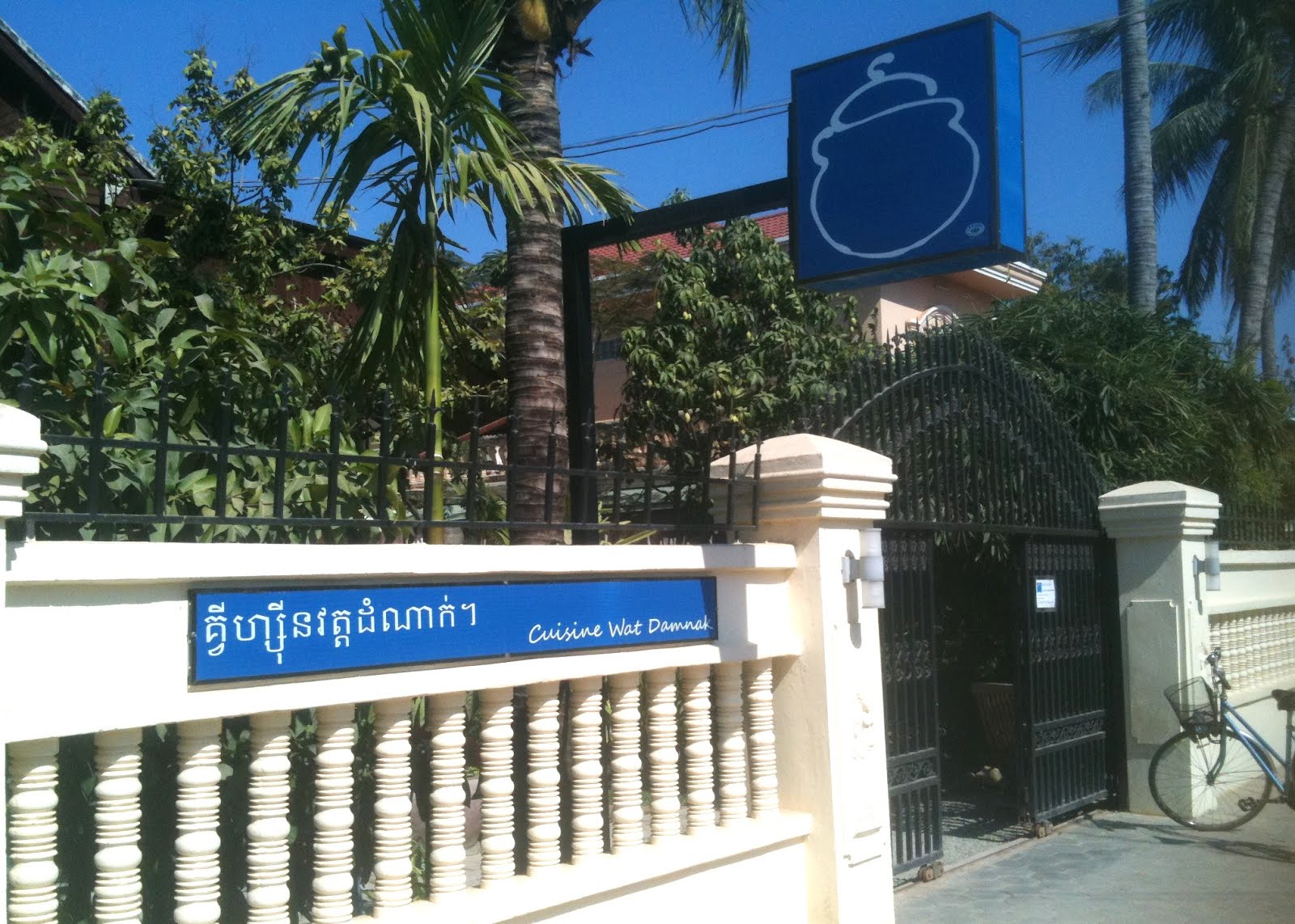
I walked along the dusty, crater-filled side streets near Wat Damnak temple, a mile or so from town, and then spotted the restaurant’s blue logo. The place had been converted from a traditional Khmer house, with a large kitchen extension at the back, and was set in a beautiful garden.

Rivière emerged from the kitchen with fat beads of sweat rolling down his forehead. He gestured me to a seat flanked by herb pots and we shared two bottles of ice cold water as the midday sun beat down.

He was good company, and very self-effacing given his credentials. You only had to look at him to see he had cooking and restaurants in his blood. He grew up working in his family’s small restaurant in Roanne, in the Loire region of France, and then went to chef school for three years before working as a pastry chef in Nantucket and Philadelphia.

He then decided he needed a change of scene and moved to Cambodia, working as a volunteer for two years teaching impoverished kids cooking and hospitality skills at the French NGO-run Sala Bai Hotel School in Siem Reap.

But savings don’t last forever, however much Buddha’s on your side, and he spent the next five years as executive chef of one of the northern city’s most prestigious venues, Hotel de la Paix, launching its renowned Cambodian degustation menu. In April last year, during Cambodia’s hottest month, and at the beginning of the low season, he and his wife Carole opened Cuisine Wat Damnak “with the aim of serving delicious and imaginative Cambodian food to locals, expats and travellers alike”. They also had a baby.

“It wasn’t a very clever idea,” chuckles Rivière, rubbing his eyes. “I wouldn’t recommend to have a baby and open a restaurant at the same time. It’s extremely tiring! You finish work at midnight and then you have to wake up at 6am, and it’s like this every single day!”

It wasn’t the most auspicious start. Business was fairly slow, and then he was hit by last year’s severe flooding and had to close for two months. But the word slowly got round as foodie tourists and expats and rich Khmers from Phnom Penh flocked to see a Frenchman showcasing traditional Cambodian recipes using seasonal fish, fruit and vegetables that are nearly impossible to source.

“I wanted to open a restaurant like you would in France or England by focusing on the products, which is actually very rarely the case in Cambodia. So I base all the recipes on that. If I find a good fish then we change the menu, and put the fish on the menu,” he says.


Rivière built up a network of local suppliers, getting freshwater fish from the Tonle Sap and pigs from farms near the world-famous temples of Angkor Wat. “The two good meats in Cambodia are fish and pork,” he explains. “If you can get Cambodian pork - because 70% of the pork here is imported from Vietnam, and is industrially farmed.”

The beautifully-white local pig meat is showcased in dishes like braised pork shank with star anis, caramelised palm sugar, fresh bamboo shoots, and crispy trotter. But it’s the freshwater fish he’s most proud of - a food that he says truly defines Cambodian cuisine.

“There are very, very good freshwater fish here. The Tonle Sap is actually the second biggest source of freshwater fish in the world after the Amazon, and because the ecosystem is so unique there is a variety of fish of all types.”


There are two fish on that day. Kay, which is originally from the Danube, but was introduced to Cambodia to help boost fish stocks. “They’re very, very bad in Europe - they taste like shit. But here they’re very good. They’re one of the best fish from the lake,” he says. It’s served as a fillet with tamarind reduction and pounded ambarella (golden apple).

The other is sanday (butter catfish), a big, torpedo-shaped predator with a large mouth and small tail that migrates between the Mekong and Tonle Sap. He serves that in a yellow curry sauce with green jackfruit.

Both are highly prized by Cambodians, and fetch high prices at the market, where Rivière, 32, follows the French tradition of shopping every morning for that night’s menu. With some foods only available for a month or two every year, he creates a new menu every week. But he’s given up describing his food as “local and seasonal”, cringing at the Noma-fuelled cliché it’s become.

“Everyone says that now,” he chuckles. “Now we say we choose premium products that happen to be seasonal...”

His food will dash any preconceptions about Cambodian food - or at least what most people think is Cambodian food - being bland and uninteresting. It’s piquantly flavoured with herbs, fish paste, fish sauce, and fermented soy beans. He’s a big fan of bold flavours like Cambodia’s famous fish ‘cheese’ prahok, and its more expensive sister maam, which is milder and more refined, if you can describe rotten fish that way, because it’s made using a different fermentation process.


He runs off to the kitchen and brings back a Tupperware box full of maam (pic above), which he will bake that night with minced pork and egg, and serve with herbs, flowers and local crudités.
“I always get it from the same supplier. She makes it for me without colour or MSG. The fish is salted for 24 hours then stacked in a jar with salted rice and galangal, and stored for one month until it becomes sour,” he says. “I don’t invent anything, I just use local products, and use quite traditional combinations, and then the technique and the presentation are definitely French.”


Another thing that differentiates his food is coriander. He doesn’t use it. It’s hard to find, because like carrots, potatoes, and onions, it doesn’t grow well in Cambodia. Instead, most restaurants use culantro, or lawn parsley, a coriander-tasting, jagged-toothed herb originally from the Caribbean (pic above). But he doesn’t use that either because he says it was brought here by Chinese immigrants, and you generally don’t find it in traditional Cambodian dishes.

Confusingly though, he does use ‘local thyme’ (chir slokkrahs, or pig’s ear - pic below), even though it’s another herb from the Caribbean. It’s a common fragrance often used in traditional Cambodian beef and tripe recipes, he explains. I don’t push the point any further.


He shows me the kitchen, pointing out the foot-high flood mark on the wooden door frame. It’s a lovely, airy space built on to the back of the house. When I mention how much it must have cost him, he just shrugs: “I have to spend 14 hours a day in here, so I want it to be a nice place.”


He leads me into a side chamber where a girl is prepping frogs for his pan-fried frog meat on a dry Vietnamese soup dish. Hang on - Vietnamese? I’m confused already. They have a short conversation in Khmer. From what I can tell she’s not too happy because the frogs aren’t as big as the last batch.


He leads me back into the main kitchen and proudly shows me the chicken stock simmering on the stove (pics below and above). He starts off by frying prahok paste, and then adds water, barbecued chicken, plenty of lemon grass stalks, lime leaves, and several heads of garlic, which will be carefully peeled and used as a garnish. The sour soup is then served with straw mushrooms, potulac, holy basil, and local thyme on the $17 five-course tasting menu.


Next to it is a tray of aubergines grilled to black. They’ll be made into a paste with ground smoked fish (pic below) to go with the fresh rice flake pancake. In the fridge is a bowl of chocolate and holy basil ganache, which is served on the second tasting menu, a six-courser for $24, with rice praline and salted caramel sheet.


I can tell from his passion, the presentation of the dishes, the quality of his ingredients, and the incredible smells why Blanc was so impressed - the fellow Frenchman describing his food as having “supreme command in the spicing, warm in the mouth, long flavours so perfect, complex but no sophistication: simply delicious.”

I ask him about the TV chef’s visit, but Rivière just shrugs.

“I knew his name but I wasn’t very familiar with his restaurant or anything. The chef from La Residence called me and said I want to book a table for Raymond Blanc - and I was fully booked. And he said ‘Oh come on, it’s Raymond Blanc!’ So we found him a table at the back in a dark corner of the terrace so he wouldn’t see too much,” he laughs.

Afterwards, Blanc asked for a tour of the kitchen and shook hands with the staff. He was intrigued by one of the dishes - ‘soup outside the pot’ - a vibrant, green dish of raw herbs and vegetables which at the last minute has broth made from dried fish and spices poured over it.

“He said I’ve never had such a thing before, this is genius! But it’s not something I invented, it’s very, very, traditional. Cambodians will put grated boiled eggs in it to thicken it up, but we don’t because it looks quite ugly...”

I ask whether it’s possible that Cambodia might be on its way to its first big restaurant award, given Blanc’s hyperbole, and the painfully-trendy vogue for locally-picked weeds, but Rivière just laughs in his usual modest manner.

“It’s not me who’d going to decide that,” he says.

Then I ask if I can do a day in his kitchen as part of the interview. He looks less surprised than reluctant. Then he suggests I meet him at the market at 7.45 on Wednesday morning and we take it from there...


MORE: In Defence Of Cambodian Cooking

My new book on training to be a chef, including stints at Rick Stein's and the Fat Duck, is available on Amazon CLICK HERE

"Reading this book is a serious test for any food writer. Not only has Alex Watts done what all of us say we would like to do, tested his mettle in a professional kitchen, he also writes about his experiences so well that you spend as much time being jealous of his writing skills as you do of his experiences. It's an annoyingly enjoyable read." - Simon Majumdar

Twitter Reviews:

"A rattling good read." - @chrispople

"It's a fab read. The Fat Duck chapters are class." - @Mcmoop

"If you claim to be a foodie you MUST buy this book." - @CorkGourmetGuy

"Bought your book and am hugely enjoying. Funny, engaging, interesting, lively." - @oliverthring

"A great read about the reality of working at The Fat Duck & other less famed restaurants." - @alanbertram

"Very funny, very close to the bone." - @AmeliaHanslow

"A great read and must have book for anyone in the industry." - @philwhite101

"Thoroughly enjoyed it." - @rosechadderton

"Excellent!" - @MissCay

"Just finished your book, and loved it! Thanks for ending on a happy note; it needed it after all the reality ;-)" - @voorschot

"Fab account of psycho chefs, plus work experience with Heston and Stein." - @Laurajanekemp

"Excellent read & loved the ‘scary duck’ tale! I look forward to the follow up book (no pressure ;D). Great memories of first being addressed as chef." - @granthawthorne

"Sensational account of a chef’s life, couldn't put it down. Get it from Amazon now!" - @Fishermansarms

"I'm loving your book. Very enjoyable. Some great one-liners. "His legs wobbled like a crab on stilts" had me chuckling." - @griptonfactor

"Highly recommended. A great book about changing careers for his love of cooking." @Whatsinmymouth

"Downloaded the book last Sunday and finished it the same day! Great read." - @MTomkinsonChef

"Very funny." - @SkyRuth

"Any of you who have flirted with chefdom, go and immediately download this book from Amazon - Down and Out in Padstow and London. Great read." - @el_duder

"Truly brilliant." - @kcassowary

"Just rattled through Down And Out in Padstow and London by Alex Watts in no time at all, what a great book." - @leejamesburns

"It's brilliant, a fine piece of work. If you've ever wanted to peer into a professional kitchen I can't recommend it highly enough." - @acidadam

"Fantastic read - the English Kitchen Confidential!" - @cabbagemechanic

"A great eBook to buy about serving your time (literally!) as a trainee chef." - @OkBayBach

"Great read." - @rankamateur

"Don't start reading it if you have things to do:)" - @NorthernSnippet

"Great book...couldn't put it down, read it non-stop on a train and finished it in one day." - @chunkymunki

"Jolly good read, feel free to do one more." - @esbens

There are also 12 reviews on its Amazon page.

Haven't got a Kindle? You can download a free Kindle reader app to read it on your computer. CLICK HERE.

Thursday, December 29, 2011

Khmer Food: In Praise Of Salt And Pepper


My love affair with salt and pepper began when I was a toddler. The dripping on toast my grandfather used to make with meat jelly and fat from the Sunday roast would have been nothing without the liberal amounts of salt and pepper he sprinkled on top.

And then there were the salt and pepper sandwiches my father got me into - thickly-buttered, white spongy slices from a sandwich loaf fresh from the bakers, filled with nothing more than a generous sprinkling of salt and freshly-ground black pepper. To me, it was a meal fit for a king as we sat in front of a roaring fire and drank cups of strong, brown tea during cold, wintry evenings.

Just as good were the boiled eggs and soldiers we’d have in the mornings, with a small mound of salt and pepper on the plate. We’d plunge the soldiers into the runny, golden goodness, and then into the two condiments - a simple, but delightful, dip that would leap me forward to eating Khmer food more than three decades later.

Over here, that magical combination is even better because of the abundance of Kampot pepper - the finest pepper in the world, and the country’s first product to get Geographical Indicator status. And if they are generous enough to give you the far superior and costly red pepper, as they do in one or two of the seafront restaurants in Kep’s famous crab market, then it’s out of this world.

But in Cambodia, they add something to the salt and pepper dip that makes it even more splendid - lime juice. It might not have been what I’d wanted with my soldiers in the morning all those years back. But I remember the flavour was always there in the dripping whenever we roasted a chicken because of the lemon quarters stuffed inside, which do incredible things to the succulence and flavour of the meat.


In restaurants here, they usually serve a mix of two thirds freshly-ground black pepper to one third salt, then carefully squeeze in two or three lime quarters and mix it in front of you. It might seem a laughably simple procedure that would scarcely trouble even the most cack-handed cook. But they take it as seriously as a chef de rang would the preparation of crepe suzette, pressed duck, or table-carved rib of beef, squeezing in the ‘correct’ amount of lime juice until there is the right moistness to the sauce.

The dip - called ‘tik marij’ in Khmer - works perfectly with a plate of selected cuts from a whole barbecued calf (ko dut), and even better with freshly-boiled seafood, particularly blue swimmer crabs, which although contain little brown head meat, and virtually no morsels in the claws, more than make up for it with the generously fleshy chine.

It always reminds me of seaside towns in Blighty, where a visit isn’t complete without a tub of whelks, liberally sprinkled with salt, white pepper, and malt vinegar, and eaten during a few bracing turns on the seafront. Over here, the lime juice takes the place of the vinegar. It’s fresher tasting, less acerbic, and far more complimentary to seafood. But I still miss those whelks...


It really is wonderful dipping crab meat into the tik marij and washing it down with ice cold beer. And what a way to spend an afternoon sitting in the crab market, gazing out to sea, and watching those women in their brightly-coloured hats checking their pots just 20 yards or so from the restaurant steps.

The crack of claws and chine, and that sweet meat magnified a hundred times by the pepper grown in the plantations behind the national park, sea salt from the neighbouring salt beds, and limes from the orchards. It’s an oasis where the land meets the sea and offers the very best the pair have in a tryst of gastronomic delight. In Singapore or Thailand, the crab might be smothered in chilli, in Vietnam it could take on an overriding taste of caramel, and in China it would most likely be in an MSG-laden sauce, thickened with cornflour.

But there is something delightfully, and deceptively, simple about Cambodian food - which is why it’s a shame it’s so overlooked. It’s the understanding of balance, simplicity, and the knowledge that fresh, local ingredients have a natural symmetry. And that’s why I love it. Simplicity in food is often dismissed as a lack of sophistication or technique, often engendering a lack of confidence in a country’s cuisine. But it couldn’t be further from the truth, and you’ve only got to look at the food in Italy to see it done to perfection.

Beef Lok Lak

The dish in Cambodia you’ll usually first encounter tik marij is beef lok lak (probably the country’s second most famous meal after its vastly over-rated fish amok). Many recipes call for the beef to be marinated in the sauce ingredients for an hour or two, but in my experience it’s unnecessary given the strength of the flavours, and the fact the salt does little for the tenderness of Khmer steak. Here’s how a friend of mine in a restaurant in Sihanoukville makes hers - simplicity in the extreme, and definitely worth making at home.

She starts by dicing a piece of steak (sirloin, rib-eye or rump work well) into smallish cubes, and then chops up two cloves of garlic. She heats a tiny amount of oil in a pan, and then fries the garlic until it begins to colour, and then throws in the meat to singe slightly.


She adds a sprinkling of sugar and salt to help the caramelisation process, and then cooks the meat for another minute or so. She then pours in a little water, and when it is bubbling, adds a glug of tomato ketchup and a couple of heaped teaspoons of oyster sauce.

She continues stirring, producing a velvety red and brown sauce. She cooks the meat until it is still quite bloody in the middle (about medium-rare) and then takes it off the heat to rest for a couple of minutes.


Meanwhile, she garnishes each plate with lettuce and three thick slices of tomato and onion, and then fries an egg. She mixes salt and pepper in a dish and squeezes in lime juice, and then serves.


My new book on training to be a chef, including stints at Rick Stein's and the Fat Duck, is available to buy on Amazon for Kindle, iPad, iPhone etc. CLICK HERE to buy for just £2.05, about the price of half a lager.

"It's a bargain and an easy read, I didn't want to put it down." @Mcmoop

"Should be required reading for anyone who has ever dreamed of leaving the monotony of the 9 to 5 rat race to open their own restaurant." Breil Bistro

"A great read and should be a set text if you're considering a change of career, or God forbid, applying to Masterchef." richard

Friday, December 16, 2011

Wake Up To A Full Cambodian - Chicken Porridge Soup


I can never be quite sure why I like this soup so much – but of all the great broths in Cambodia, and there are plenty, chicken porridge soup (bo bor sach moan) is my favourite.

Maybe it’s the heavy use of nutty, browned, but not burnt garlic (a common garnish in Khmer soups), or the herby fragrance of the chopped culantro sprinkled on top? Or the occasional limp crunch of bean sprouts poached in the heat of the broth? Or the pleasing discovery of a little piece of chicken or bone to suck on?

Or is it the soothing lightness of the chicken stock, hinting of lime leaf and lemon grass? Or the julienne strips of fresh ginger that are, like the bean sprouts, stirred in at the end moments before service so they take on an increasingly cooked texture as you finish the soup?

Because this is not a soup to be rushed. It takes time to finish. And as a breakfast, which is when it is traditionally eaten in Cambodia, it’s deliciously filling - and there’s no bacon and eggs in sight.


The great “all day English breakfast” as every cafe and restaurant seems to describe our beloved fry-up out here may leave you feeling stuffed for an hour or two with all that lovely fat and grease and ketchup. But in my experience, it often leaves you craving a second brekkie – especially if sausage sarnies are involved.

But this chicken rice soup keeps you going all day. And that was just as well for a friend of mine recently who was forced to experiment with living on $2 a day for food, which he managed to achieve by eating two bowls of bo bor sach moan every day at the central market in Phnom Penh - after he’d persuaded them to charge him the Khmer price, that is.

But it’s not just the flavours. It’s the love with which it’s made. I honestly thought I’d met the happiest two women in the world in Sihanoukville a few weeks ago. The twins ran a tiny street food stall that served only one dish – you guessed it, chicken porridge soup – and had two small tables that customers would cram round.


They gazed on happily, constantly joking and smiling, as they watched customers queue for a space, and then dive into the condiment trays of ground black pepper, sugar, fish sauce, lime segments, fiery red chillies, and fermented bean paste.

There were no wounded egos or chef tantrums – Khmer food is always served with plenty of condiments to balance the desired sweet, sour, spicy and salty tastes of each diner - because there is little arrogance in the kitchens out here, and no “right” way to flavour a dish. And it comes as a refreshing change if you’ve ever had the misfortune to work with the sort of brazen, dogma-driven robots Michelin-starred restaurants spew out.

But it’s not just the love and the bean sprouts and the zip from the Kampot pepper, and the hit of lemon grass and ginger, and the soothing crunch of gizzards (easily the best part of a hen for my money), and the soapy richness of the cubes of blood pudding, and the wilful perfume of dusky, browned garlic. It’s the gloop. It’s the way the jasmine rice splits and thickens the stock, creating a greyish, cloudy sheen to the liquor.


Like many great dishes, it takes you back to a memory of childhood. For me, it was the chicken and rice dish they served at school. I think they called it “chicken a la king” but it’s so long ago it’s hard to remember. It was chicken cooked in a creamy, yellow sauce that probably came courtesy of a tin of Campbell’s condensed soup - the base of many a casserole in those days. It always came with boiled rice and one or two triangles of fried bread. Fried to the same chestnut brown as the garlic at the street stall, I remember.

There was something splendid about the way you stirred the chicken and rice together to form a moreish mix, the softening fried bread dancing playfully on your tongue. And it’s that sort of texture you get from Cambodia’s famous soup, especially if you buy a baguette to dip into it as I sometimes do.


I’ve seen a dozen different ways of cooking it. But the way they make it at that down town food stall is my favourite. The cooks start the day by putting five or six whole chickens in a huge soup cauldron. They fill it with water, throw in some chopped shallots and garlic, lime leaves and a few bruised lemon grass stalks, and then rake up the charcoal and bring the pot to the boil.

Then they add enough turmeric to turn the liquid a golden yellow. It’s the only place in Cambodia I’ve seen that uses turmeric in porridge soup. The spice is heavily revered by the Khmers for its medicinal properties – particularly in the north, where pregnant women have it rubbed into their bodies to keep their skin tight after they give birth – but generally you only find it in kroeung, a curry paste that forms the base of many Cambodian dishes.


They let the stock simmer away for a couple of hours, topping up with water if necessary, and then season it with salt, fish sauce, sugar, and plenty of pepper. They fish out the chickens and put them in a bucket to cool, ready to be prepped.

Every part of the bird is laid out on a tray, including the yolks taken from the hens' ovaries, which glint like amber pearls and are absolutely wonderful. Diners choose which part of the bird they want, and the breast is shredded and carefully rationed, and laid on top.


In a smaller pot, they cook the rice until it begins to break up, and then put a scoop in each bowl of soup with a handful of blanched bean sprouts and some shredded ginger - to a rough proportion of one third rice to two thirds chicken stock, so the rice doesn’t completely smother the broth. When cooked a la carte, or at home, the rice is boiled in the chicken liquor, but when you’re dealing with vats of the stuff and keeping it hot all day, you have to keep them separate otherwise the rice dissolves and loses its porridge consistency.

Lastly, they make the garlic garnish by finely chopping dozens of cloves, and heating vegetable oil in a frying pan. When the oil begins to spit, they toss in the garlic and stir continuously for 30 seconds or so until it is brown but not burnt. Then they drain off the oil, and sprinkle the garlic on top with chopped culantro (use coriander if you can’t get this) and spring onion greens.

You should really try it, it’s a blinder. And if it’s excellent out here in the stifling heat of Phnom Penh’s markets, it must be even better on a dark, chill morning in wind-swept Britain...

MORE: Pho bo - Vietnam's traditional breakfast

BELOW: Cambodia's other famous breakfast - fried pork with pickles, rice, and, of course, soup...


My new book on training to be a chef, including stints at Rick Stein's and the Fat Duck, is available to buy on Amazon for Kindle, iPad, iPhone etc. CLICK HERE to buy for just £2.05, about the price of half a lager.

"It's a bargain and an easy read, I didn't want to put it down." @Mcmoop

"Should be required reading for anyone who has ever dreamed of leaving the monotony of the 9 to 5 rat race to open their own restaurant." Breil Bistro

"A great read and should be a set text if you're considering a change of career, or God forbid, applying to Masterchef." richard