Showing posts with label loc lac. Show all posts
Tuesday, February 07, 2012
Cambodian Food: The Chef Hailed As A Genius By Raymond Blanc
My nine-month quest to learn how to cook Cambodian food hasn’t been an easy one. There are only a few decent cookbooks on the subject, and even they’re filled with contradictions, making it even harder to get to the bottom of what is undoubtedly one of the world’s most overlooked cuisines.
You might have thought I’d lost a bet when I set out to do this, especially as I can only speak a few words of Khmer, or at least ones that are understood. But I really wanted to go somewhere that hasn’t been done to death. I’ve always loved Indian food, for instance, and haven’t been helped by the fact that there are a few very good Indian restaurants out here, when I should have been researching the local delicacies, but the world hardly needs another book or blog on Indian food.
But saying that, given that Cambodian cuisine was heavily influenced by the cooking of early Indian traders, and then much later by Cham Muslim, Vietnamese, and Chinese immigrants and invaders, and then French imperialists, whose only legacy in this beautiful country seems to be the humble baguette, it’s impossible to know where one food starts and another ends.
Take ‘loc lac’ for instance (beef steak stir-fried in oyster sauce and ketchup). It’s easily the second most famous Cambodian dish after the repulsive unofficial national dish of amok. It’s on every menu, even in places that do actually serve proper traditional dishes. But it’s undoubtedly Vietnamese - even the name is Vietnamese.
And calling it ‘English loc lac’ with the courtesy of a fried egg on top is just ridiculous - and shows just how unconfident Cambodians are about their food, and how reluctantly they reveal the real, pongy, delicious stuff that they hide near the ruins at Angkor Wat.
Talk to one chef, and they’ll say one thing, talk to another and they’ll say something else. Some will point out how the Khmer Empire ruled Thailand for hundreds of years, and gave its food as much as it took, and that tom yam soup is actually Cambodian. While others claim amok is a Thai dish.
No-one seems to be in agreement about anything. And it isn’t helped by the fact that it’s virtually impossible to find traditional ethnic Khmer food in Cambodia, and even when you do, it’s stuffed full of MSG and drenched in horrible bottled sauces.
You can still find it in the countryside, passed from mother to daughter in homes and a few restaurants and street stalls, as I’ve written about in the past. But I knew my quest wouldn’t be complete without visiting Joannès Rivière (pic above) - a chef widely seen as one of the world’s leading experts on Cambodian cuisine.
The Frenchman, who worked as a food consultant for Rick Stein when he visited the country for one of his programmes, has been shining the path in the Cambodian culinary capital of Siem Reap for the past nine years. Chefs and food writers kept telling me that what he doesn’t know about Cambodian food can be written on a 100 riel note.
I was convinced Rivière was the man to talk to, even if he was only going to dispel a few of my theories, and even more so when celebrity chef Raymond Blanc heaped huge praise on him last month during a visit to Cuisine Wat Damnak.
“Oh mon Dieu, this man can cook, he is blessed!” Blanc wrote on his blog after trying his Cambodian tasting menu.
The menu certainly sounded interesting - an amuse bouche of green mango salad; fresh rice flake pancake with prawn, smoked fish and aubergine puree; pan-fried chlang (an eel-like fish from the nearby Tonle Sap lake - pic above) with crisp vegetables and hyacinth blossom; quail curry with pumpkin and long beans; and a sticky rice crème brûlée (pic below).
“Those moments are rare when you know that you are in the presence of a very gifted craftsman,” added Blanc. “Remember this name: Joannès Rivière.”
That was it - I had to meet the man. I caught a bus from Phnom Penh to Siem Reap, and was about to give the chef a call when I got embroiled in a couple of news stories. Two weeks later, I rang and he told me to come round the next day.
I walked along the dusty, crater-filled side streets near Wat Damnak temple, a mile or so from town, and then spotted the restaurant’s blue logo. The place had been converted from a traditional Khmer house, with a large kitchen extension at the back, and was set in a beautiful garden.
Rivière emerged from the kitchen with fat beads of sweat rolling down his forehead. He gestured me to a seat flanked by herb pots and we shared two bottles of ice cold water as the midday sun beat down.
He was good company, and very self-effacing given his credentials. You only had to look at him to see he had cooking and restaurants in his blood. He grew up working in his family’s small restaurant in Roanne, in the Loire region of France, and then went to chef school for three years before working as a pastry chef in Nantucket and Philadelphia.
He then decided he needed a change of scene and moved to Cambodia, working as a volunteer for two years teaching impoverished kids cooking and hospitality skills at the French NGO-run Sala Bai Hotel School in Siem Reap.
But savings don’t last forever, however much Buddha’s on your side, and he spent the next five years as executive chef of one of the northern city’s most prestigious venues, Hotel de la Paix, launching its renowned Cambodian degustation menu. In April last year, during Cambodia’s hottest month, and at the beginning of the low season, he and his wife Carole opened Cuisine Wat Damnak “with the aim of serving delicious and imaginative Cambodian food to locals, expats and travellers alike”. They also had a baby.
“It wasn’t a very clever idea,” chuckles Rivière, rubbing his eyes. “I wouldn’t recommend to have a baby and open a restaurant at the same time. It’s extremely tiring! You finish work at midnight and then you have to wake up at 6am, and it’s like this every single day!”
It wasn’t the most auspicious start. Business was fairly slow, and then he was hit by last year’s severe flooding and had to close for two months. But the word slowly got round as foodie tourists and expats and rich Khmers from Phnom Penh flocked to see a Frenchman showcasing traditional Cambodian recipes using seasonal fish, fruit and vegetables that are nearly impossible to source.
“I wanted to open a restaurant like you would in France or England by focusing on the products, which is actually very rarely the case in Cambodia. So I base all the recipes on that. If I find a good fish then we change the menu, and put the fish on the menu,” he says.
Rivière built up a network of local suppliers, getting freshwater fish from the Tonle Sap and pigs from farms near the world-famous temples of Angkor Wat. “The two good meats in Cambodia are fish and pork,” he explains. “If you can get Cambodian pork - because 70% of the pork here is imported from Vietnam, and is industrially farmed.”
The beautifully-white local pig meat is showcased in dishes like braised pork shank with star anis, caramelised palm sugar, fresh bamboo shoots, and crispy trotter. But it’s the freshwater fish he’s most proud of - a food that he says truly defines Cambodian cuisine.
“There are very, very good freshwater fish here. The Tonle Sap is actually the second biggest source of freshwater fish in the world after the Amazon, and because the ecosystem is so unique there is a variety of fish of all types.”
There are two fish on that day. Kay, which is originally from the Danube, but was introduced to Cambodia to help boost fish stocks. “They’re very, very bad in Europe - they taste like shit. But here they’re very good. They’re one of the best fish from the lake,” he says. It’s served as a fillet with tamarind reduction and pounded ambarella (golden apple).
The other is sanday (butter catfish), a big, torpedo-shaped predator with a large mouth and small tail that migrates between the Mekong and Tonle Sap. He serves that in a yellow curry sauce with green jackfruit.
Both are highly prized by Cambodians, and fetch high prices at the market, where Rivière, 32, follows the French tradition of shopping every morning for that night’s menu. With some foods only available for a month or two every year, he creates a new menu every week. But he’s given up describing his food as “local and seasonal”, cringing at the Noma-fuelled cliché it’s become.
“Everyone says that now,” he chuckles. “Now we say we choose premium products that happen to be seasonal...”
His food will dash any preconceptions about Cambodian food - or at least what most people think is Cambodian food - being bland and uninteresting. It’s piquantly flavoured with herbs, fish paste, fish sauce, and fermented soy beans. He’s a big fan of bold flavours like Cambodia’s famous fish ‘cheese’ prahok, and its more expensive sister maam, which is milder and more refined, if you can describe rotten fish that way, because it’s made using a different fermentation process.
He runs off to the kitchen and brings back a Tupperware box full of maam (pic above), which he will bake that night with minced pork and egg, and serve with herbs, flowers and local crudités.
“I always get it from the same supplier. She makes it for me without colour or MSG. The fish is salted for 24 hours then stacked in a jar with salted rice and galangal, and stored for one month until it becomes sour,” he says. “I don’t invent anything, I just use local products, and use quite traditional combinations, and then the technique and the presentation are definitely French.”
Another thing that differentiates his food is coriander. He doesn’t use it. It’s hard to find, because like carrots, potatoes, and onions, it doesn’t grow well in Cambodia. Instead, most restaurants use culantro, or lawn parsley, a coriander-tasting, jagged-toothed herb originally from the Caribbean (pic above). But he doesn’t use that either because he says it was brought here by Chinese immigrants, and you generally don’t find it in traditional Cambodian dishes.
Confusingly though, he does use ‘local thyme’ (chir slokkrahs, or pig’s ear - pic below), even though it’s another herb from the Caribbean. It’s a common fragrance often used in traditional Cambodian beef and tripe recipes, he explains. I don’t push the point any further.
He shows me the kitchen, pointing out the foot-high flood mark on the wooden door frame. It’s a lovely, airy space built on to the back of the house. When I mention how much it must have cost him, he just shrugs: “I have to spend 14 hours a day in here, so I want it to be a nice place.”
He leads me into a side chamber where a girl is prepping frogs for his pan-fried frog meat on a dry Vietnamese soup dish. Hang on - Vietnamese? I’m confused already. They have a short conversation in Khmer. From what I can tell she’s not too happy because the frogs aren’t as big as the last batch.
He leads me back into the main kitchen and proudly shows me the chicken stock simmering on the stove (pics below and above). He starts off by frying prahok paste, and then adds water, barbecued chicken, plenty of lemon grass stalks, lime leaves, and several heads of garlic, which will be carefully peeled and used as a garnish. The sour soup is then served with straw mushrooms, potulac, holy basil, and local thyme on the $17 five-course tasting menu.
Next to it is a tray of aubergines grilled to black. They’ll be made into a paste with ground smoked fish (pic below) to go with the fresh rice flake pancake. In the fridge is a bowl of chocolate and holy basil ganache, which is served on the second tasting menu, a six-courser for $24, with rice praline and salted caramel sheet.
I can tell from his passion, the presentation of the dishes, the quality of his ingredients, and the incredible smells why Blanc was so impressed - the fellow Frenchman describing his food as having “supreme command in the spicing, warm in the mouth, long flavours so perfect, complex but no sophistication: simply delicious.”
I ask him about the TV chef’s visit, but Rivière just shrugs.
“I knew his name but I wasn’t very familiar with his restaurant or anything. The chef from La Residence called me and said I want to book a table for Raymond Blanc - and I was fully booked. And he said ‘Oh come on, it’s Raymond Blanc!’ So we found him a table at the back in a dark corner of the terrace so he wouldn’t see too much,” he laughs.
Afterwards, Blanc asked for a tour of the kitchen and shook hands with the staff. He was intrigued by one of the dishes - ‘soup outside the pot’ - a vibrant, green dish of raw herbs and vegetables which at the last minute has broth made from dried fish and spices poured over it.
“He said I’ve never had such a thing before, this is genius! But it’s not something I invented, it’s very, very, traditional. Cambodians will put grated boiled eggs in it to thicken it up, but we don’t because it looks quite ugly...”
I ask whether it’s possible that Cambodia might be on its way to its first big restaurant award, given Blanc’s hyperbole, and the painfully-trendy vogue for locally-picked weeds, but Rivière just laughs in his usual modest manner.
“It’s not me who’d going to decide that,” he says.
Then I ask if I can do a day in his kitchen as part of the interview. He looks less surprised than reluctant. Then he suggests I meet him at the market at 7.45 on Wednesday morning and we take it from there...
MORE: In Defence Of Cambodian Cooking
My new book on training to be a chef, including stints at Rick Stein's and the Fat Duck, is available on Amazon CLICK HERE
"Reading this book is a serious test for any food writer. Not only has Alex Watts done what all of us say we would like to do, tested his mettle in a professional kitchen, he also writes about his experiences so well that you spend as much time being jealous of his writing skills as you do of his experiences. It's an annoyingly enjoyable read." - Simon Majumdar
Twitter Reviews:
"A rattling good read." - @chrispople
"It's a fab read. The Fat Duck chapters are class." - @Mcmoop
"If you claim to be a foodie you MUST buy this book." - @CorkGourmetGuy
"Bought your book and am hugely enjoying. Funny, engaging, interesting, lively." - @oliverthring
"A great read about the reality of working at The Fat Duck & other less famed restaurants." - @alanbertram
"Very funny, very close to the bone." - @AmeliaHanslow
"A great read and must have book for anyone in the industry." - @philwhite101
"Thoroughly enjoyed it." - @rosechadderton
"Excellent!" - @MissCay
"Just finished your book, and loved it! Thanks for ending on a happy note; it needed it after all the reality ;-)" - @voorschot
"Fab account of psycho chefs, plus work experience with Heston and Stein." - @Laurajanekemp
"Excellent read & loved the ‘scary duck’ tale! I look forward to the follow up book (no pressure ;D). Great memories of first being addressed as chef." - @granthawthorne
"Sensational account of a chef’s life, couldn't put it down. Get it from Amazon now!" - @Fishermansarms
"I'm loving your book. Very enjoyable. Some great one-liners. "His legs wobbled like a crab on stilts" had me chuckling." - @griptonfactor
"Highly recommended. A great book about changing careers for his love of cooking." @Whatsinmymouth
"Downloaded the book last Sunday and finished it the same day! Great read." - @MTomkinsonChef
"Very funny." - @SkyRuth
"Any of you who have flirted with chefdom, go and immediately download this book from Amazon - Down and Out in Padstow and London. Great read." - @el_duder
"Truly brilliant." - @kcassowary
"Just rattled through Down And Out in Padstow and London by Alex Watts in no time at all, what a great book." - @leejamesburns
"It's brilliant, a fine piece of work. If you've ever wanted to peer into a professional kitchen I can't recommend it highly enough." - @acidadam
"Fantastic read - the English Kitchen Confidential!" - @cabbagemechanic
"A great eBook to buy about serving your time (literally!) as a trainee chef." - @OkBayBach
"Great read." - @rankamateur
"Don't start reading it if you have things to do:)" - @NorthernSnippet
"Great book...couldn't put it down, read it non-stop on a train and finished it in one day." - @chunkymunki
"Jolly good read, feel free to do one more." - @esbens
There are also 12 reviews on its Amazon page.
Haven't got a Kindle? You can download a free Kindle reader app to read it on your computer. CLICK HERE.
This blog was brought to you by the words...
amok,
Cambodia,
Cambodian cooking,
Cambodian cuisine,
Cuisine Wat Damnak,
freshwater fish,
Joannès Rivière,
Khmer food,
loc lac,
maam,
prahok,
Raymond Blanc,
Siem Reap
Friday, September 02, 2011
In Defence Of Cambodian Cooking
(Above: Prahok...Cambodia's famous fermented fish 'cheese')
I’ve grown to love Cambodian cooking – even though at first I gave it the thumbs down. It’s just a shame how hard it is to find in Cambodia. The proper stuff is hidden away from tourist spots like some fabled Angkor treasure, in people’s homes in the countryside, and occasionally in the restaurants and food stalls the locals recommend.
These are the traditional dishes passed down by memory rather than cookery books, most of which were burned during the Khmer Rouge’s 1975-1979 reign. The natural, primary tastes of salt, sweet, spicy and sour from the foraged herbs, unripe and ripe fruit, fresh vegetables, pickles, and fermented fish that characterise Cambodian cuisine.
(Chicken rice soup - steamed chicken, browned garlic, coriander)
But even then, it isn’t easy. One restaurant or stall does a very good rice chicken soup (above), but little else. Another serves a decent loc lac, but a terrible Khmer curry. One does a decent amok – something that is difficult to find even in Cambodia’s culinary capital, Siem Reap. But it is rare to find a real all-rounder.
So it takes a long time to get a sense of how varied and wonderful Cambodian cuisine can be. And why Cambodian food experts like chef and author Joannes Riviere describe it as one of the most balanced, healthy and fascinating foods in the world.
Like its people during the horrors of Pol Pot’s murderous regime, which saw nearly a quarter of the population worked, starved or tortured to death, Cambodia’s food has largely been ignored by the outside world.
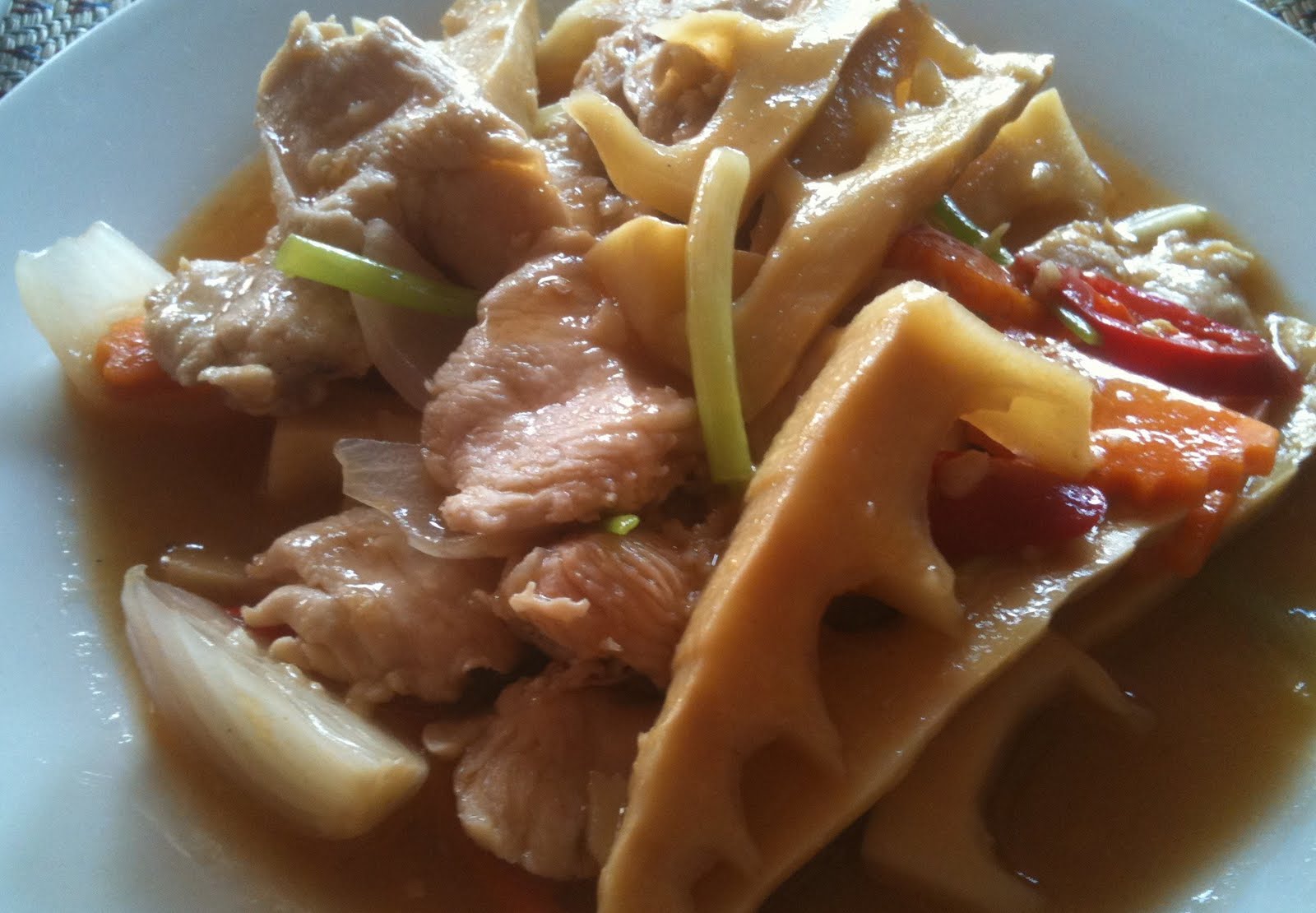
(Chicken wok-fried with bamboo shoots)
It is mostly dismissed as “Thai food without the chillies”, and sometimes “a bit like Vietnamese food but not as good”. But that is a disservice, as although it is definitely a magpie cuisine and shares a huge number of dishes with other countries, particularly China, Vietnam and Thailand, it has its own character and legacy.
The Khmer empire stretched across Vietnam and Thailand for hundreds of years, and gave their respective foods as much as it stole.
Before that, it was heavily influenced by Indian traders, who brought tamarind to the country (an essential ingredient in Cambodia’s many sour dishes), and inspired cooks to blend spice pastes, which became kroeung (Khmer curry paste), with the addition of pounded lemongrass, lime leaves, and galangal.
Later, Chinese, Cham Muslim, Thai and Vietnamese immigrants and conquerors brought their influences, which you can see today in the diversity of cooking styles and flavourings from soya and oyster sauce-based stir-fries to crispy duck to steamed, herb-packed spring rolls (above) to fried rice dishes to beansprout and shrimp-filled pancakes.
And then the food changed again under French rule – this time with the introduction of baguettes and thick beef stews (below), just like in neighbouring Vietnam.
(Khmer beef stew)
So what is traditional Cambodian cooking? The two words that probably best sum it up are freshness and seasonality. Cooks use what’s around them, whether it’s ripe or unripe, and forage in the hedgerows and rice paddies for mysteriously sour herbs and leaves that do magical things to a simple piece of meat or fish.
It’s amazing how green and crunchy everything is. Most dishes contain herbs – varieties of mint, coriander, basil, and sawleaf - sometimes cooked but mostly raw, and come with trays of crisp vegetables like banana blossom, long beans, cucumber and cabbage.
(Banh chiao: Pancake with prawns, minced pork, beansprouts)
There are no reduced sauces, dairy goods, or pretty much any use of fat as you’d find in more glamorous cuisines, and yet the dishes are delicious, and what they lack in refinement and technique they make up for in freshness, colour, and taste.
The flavour that really defines Cambodia is prahok – freshwater fish fermented in barrels of brine for so long they acquire the powerful, roof-of-the-mouth-etching taste of blue cheese.
(Fish in a salt barrel at a prahok market near Battambang)
It sounds awful, but is curiously addictive. The milky, grey liquid left behind is used as a sauce, and the meat is pressed into a paste (top pic). The sauce – sometimes with the addition of chillies, chopped herbs and peanuts - is served as a condiment with barbecued meat and fish, whereas the paste is best fried with beaten eggs, chopped pork, and finely chopped vegetables to make Cambodia’s deliciously savoury omelette.
Fish sauces are used across the world, of course, from Roman-inspired thick anchovy essences to the whisky-coloured liquids of Vietnam and Thailand. But none of them have the peculiar, cheesy-salt taste of prahok.
Another ‘unique’ flavouring is preserved lemon (below), used in Cambodia’s renowned ngam nguv chicken soup, but rarely found anywhere else in Asia. The lemons are dried in the sun, and then soaked in brine, and a few quarters poached in a soup give a citrus tang immediately evocative of Moroccan cooking.
But there are other, less defining, characteristics too. Khmer noodles (nom banchok) are made from just rice, water and salt, and so lack the richer, eggy flavour of Chinese noodles and pasta. Its dumplings are made from cassava (and sometimes with yams or sweet potatoes) rather than flour – and are often filled with fresh vegetables. The ones containing chopped kale are so delicately seasoned they taste like bubble and squeak.
(Amok - a highly contentious recipe - as served by a chain-style restaurant boldly calling itself Amok, in Siem Reap)
For a cuisine so overlooked, it’s surprising how great – and varied - some of its dishes are. Why amok (above) became its best known meal is anyone’s guess.
It really is quite average compared with, say, its incredible fried aubergine with minced pork dish, which combines the grandest tastes of Mediterranean cooking with the sticky sweetness of The Orient.
Soup is integral to Khmer cuisine, and is served with every meal, where each of the shared dishes brings sour, sweet, spice or salt to the always present bowl of sticky rice. But so are salads, and you'll usually find a dozen of each on most menus.
When you find a good place, Khmer beef salads can be as good as any carpaccio, escabeche or ceviche-style dish I’ve ever tasted. The sirloin is thinly sliced and marinated in lime juice and spices for a couple of hours.
The soused meat and juice are then tossed in a vibrant salad of onion, carrot, green tomatoes, green pepper, white cabbage, toasted peanuts, green beans, chillies, purple shallots, garlic, lemon grass and basil sprigs. They make the dish in the north-east of the country with goat meat, which melts in your mouth and has a far gamier taste.
But its most famous salad has to be smoked fish and green mango. The fish (above) are barbecued on a wooden grate over smouldering coals, sometimes for as long as eight hours, which gives them a strong, smoky taste and a chewy, dried texture.
Half of a small fish is broken into pieces and pounded in a pestle and mortar with chillies and garlic, and then tossed into strips of green mango, charred peanuts and herbs (below). The salty smokiness of the fish cuts through the sharpness of the fruit, and makes a truly great dish - and, in the culinary pragmatism of all peasant dishes, especially Cambodian ones, makes a little bit of protein go a long way.
Cambodia’s gravlax-like phork (cured fish with fermented black rice) is another winner as are its pickled vegetables that are often served in saucers with a main dish. The veg is cut into julienne strips and packed in jars in a pickling mixture of salt, brown sugar, galangal, kaffir lime leaves, lemon grass, and water that rice has been washed in to give it a sour taste.
They don’t go in for desserts much. Usually it’s just a plate of tropical fruits, sometimes in a coconut sauce. But who can blame them given the quality of the fruit? The country is famous for its foul-smelling durian, the most highly-prized being from the Kampot area, which also supplies its incredible pepper – the first food in the country to be given Geographical Indicator (GI) status.
But just as good are its leathery-skinned mien, which have a sugary, marshmallow taste, green oranges from Battambang, and amazingly sweet dwarf bananas.
If you ever come here, throw away the guidebook, avoid all Westernised restaurants showcasing Khmer food, with their trendy, orange sofas and cocktail bucket-quaffing tourists, where the food tastes like it’s been cooked at TGI Friday’s, and eat what the locals really eat - in their homes, and at stalls with the biggest queues - and you can still find proper Cambodian food, and it really is, or at least can be, wonderful.
Sadly, it is a cuisine fast disappearing, but more on that next time.
:: The above is based on personal experiences, research, and interviews with dozens of Khmer and Western chefs and restaurant/stall owners in Cambodia. If you disagree with any of it, or think I have missed something, and/or would like to add thoughts of your own, please leave a comment below.
This blog was brought to you by the words...
amok,
Cambodian cooking,
Cambodian cuisine,
Khmer curry,
Khmer salad,
loc lac,
prahok,
preserved lemons,
smoked fish and green mango salad,
sour soup
Subscribe to:
Posts (Atom)