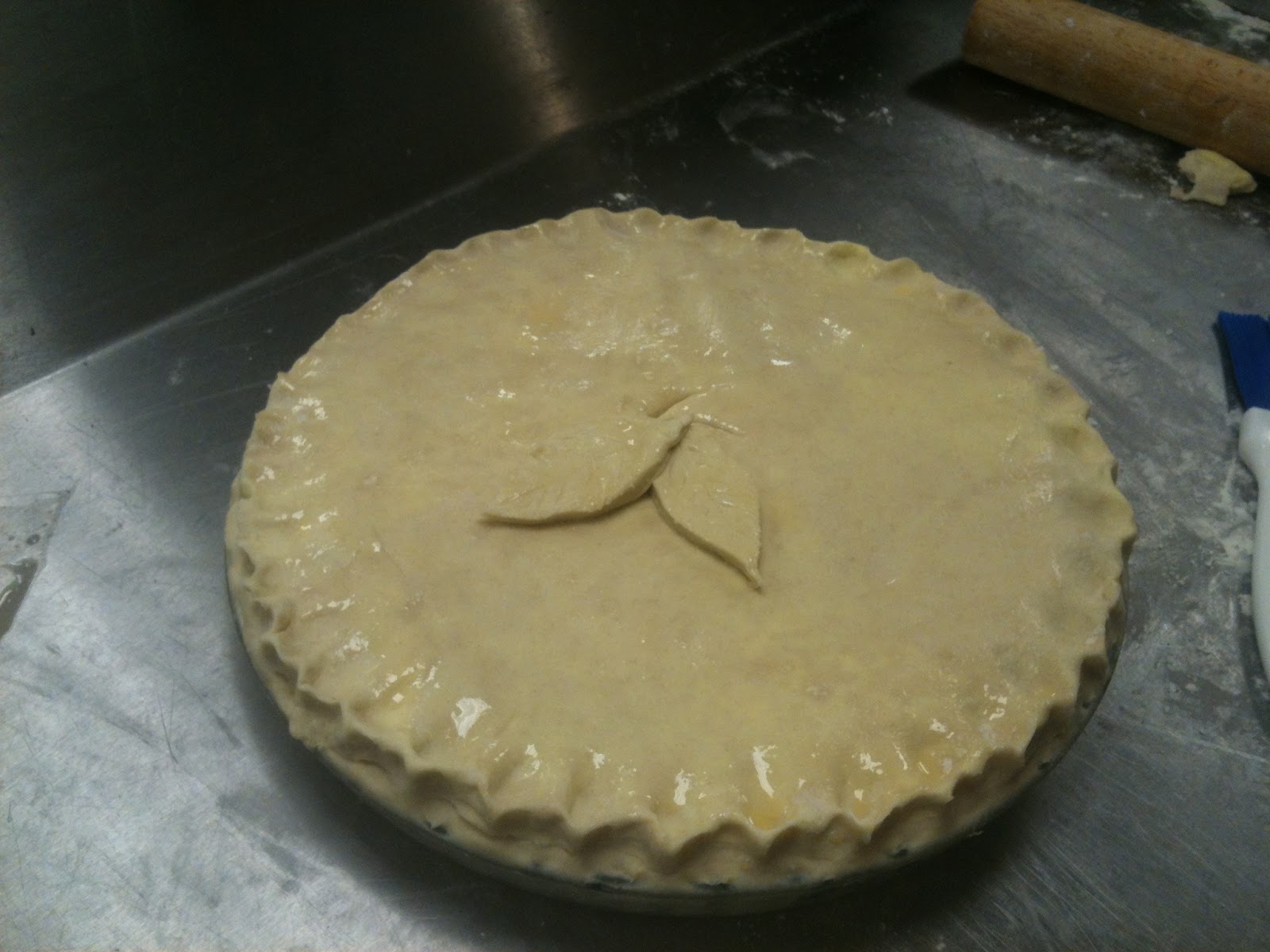
The pastry for this pie comes from one of the apprentices on my cheffing course. He modestly says he's only good at turning potatoes, and jokes that if he was a superhero his one special power would be the ability to instantly turn vegetables into perfect, seven-sided barrels. However, he's pretty good at making pies as well.
He should be really, because the rest of the week, he works at a gastropub that specialises in pies. Every morning, he makes the pie dough using this recipe below. The chef assessor spent a few hours in his kitchen, ticking off units in his apprenticeship file, and came back raving about the pie crust.
It was deemed so good, he asked the apprentice to fill in for our masterchef lecturer one morning to show us how to make the perfect pie. "I don't want to blow smoke up your arse, but that's probably the best rough puff pastry I've ever tasted," the masterchef told him afterwards before trying to sell us the pies we'd made at a fiver a pop, pointing out that they'd probably be £25 in a deli.
At the gastropub, they use shortcrust pastry for the bottom of the pie and rough puff for the top. But we used rough puff for both. It rises very well and is deliciously crispy owing to all the butter in it. The pies in the picture above should probably have been cooked about five minutes less, as the pastry is a little too brown, but some idiot, uh hum, forgot to put the timer on the oven. I had nothing to do with the ludicrous Man U decoration though.
Rough Puff Pastry
1kg plain flour
750g butter
Cold water
Cut the butter into cubes, about the size of Oxo cubes. Sieve the flour into a bowl and add the butter cubes. Mix briefly with a wooden spoon until the cubes are evenly covered in flour. Add cold water, a little at a time, and stir until the pastry comes together in a ball. Don't over mix it - you still want pieces of butter in the pastry.
Cover the pastry in clingfilm and chill in the fridge for 20 minutes. Take out, flour the work surface and roll out into a long rectangle. Fold the top third into the middle, the bottom third into the middle. Fold in half, then turn 90 degrees and roll out into a rectangle again.
Repeat this three more times, then put the pastry back into the fridge. Chill for another 20 minutes, then take out and repeat the procedure. Chill until ready for use. If you have more pastry than you need, wrap it in clingfilm and freeze.
Poached Chicken
I whole chicken
2 onions
4 sticks celery
3 bay leaves
10 peppercorns
Put your fingers under the skin at the neck end and carefully pull the skin from the chicken. Chop off the feet and pull the leg skin off. Put the whole skinned chicken in a stock pot and cover with water. Add the celery, onion and spices. When the water starts to boil, turn the heat down and cook for one hour.
Take the chicken out, and using a probe, check the inside of the thigh is at least 65C. Even when it is 85C, the chicken meat is still moist because it has been cooked in a wet heat rather than dry heat. But I find about 70C is the best.
Pick the meat from the chicken carcass, and lay on a tray then chill in the fridge. Return the chicken carcass and bones to the stockpot. Continue simmering the stock until you are ready to make the veloute sauce (see below).
Asparagus
Cut off the bottom inch or so of the asparagus. Then boil the spears for two minutes. Take out and refresh in iced water. When cold, slice into discs, about the thickness of £1 coins. Put in the fridge.
Onion Veloute Sauce
1 large onion
100g butter
100g flour
1 litre chicken stock
Chop the onion very finely and fry in the butter over a low heat until the onion has 'melted'. It should be soft and very yellow. Add the flour and stir well. Cook the roux over a low heat for three minutes until coloured slightly - make sure it doesn't catch on the bottom of the pan.
Heat up the sieved stock from the chicken if it has gone cold, and add a ladle at a time to the roux, stirring constantly, and adding the next ladle when the water is absorbed. Then whisk the rest of the stock in, and simmer for 10 minutes. Add salt to taste. Chill the sauce in the fridge.
Pie Filling
When the chicken meat, asparagus and veloute sauce are all chilled, mix together in a bowl. Add salt and pepper to taste.
Making The Pie
Lightly flour the work surface and roll out the pastry to about 1/2cm thick. Cut out a circle three inches wider than the pie dish's circumference. Grease the pie dish with butter and sprinkle with flour. Then lay the pastry circle in the dish, pushing down into the corners. Leave the extra pastry hanging over the edge of the dish. Fill the pie with filling.
Roll out another circle of pastry the same thickness as before, and lay on top of the pie. Push it down on the pastry beneath. Then hold the dish up with one hand and with a knife in the other, neatly trim off the excess pastry. Crimp the edges together using your thumb and index finger on your left hand (if right-handed) and thumb on your right hand. Glaze the top with beaten egg yolk.
Baking The Pie
Put the pie dish on a tray. Bake in a pre-heated oven at 180C - or 160C if you've got a fan-assisted oven - for 45 minutes.
Showing posts with label stock. Show all posts
Thursday, January 28, 2016
Chicken And Asparagus Pie
This blog was brought to you by the words...
asparagus,
chicken,
flour,
onion veloute,
pie,
poached chicken,
rough puff pastry,
stock
Sunday, January 09, 2011
How To Make The Perfect Stock

I’ve been cheffing in restaurants for the past few days trying to get my knife skills back up to speed before I head off on my cooking trip to California.
Although I’ve agreed not to write anything about the place itself (other than it’s a vastly overpriced restaurant in the Chilterns) I thought I’d share some of the techniques I’ve been (relearning) with you.
Some of you will already know all of this already, especially as there are some far more skilled chefs than me who read this blog, but I thought I’d post my thoughts anyway. Besides, isn’t that what blogs are for – to point out the bleeding obvious? And it’s always good to get other people’s slant on a cooking technique.
One of my main duties has been making the beef, chicken, fish and vegetable stocks, and reducing them for the demi-glace sauces, so I thought I’d start with these...
In my opinion, making stocks (not just because I’ve been doing it) is one of the most important jobs in the kitchen (obviously depending on what type of cuisine you’re cooking – in my case English and French).
Once you’ve got some good quality beef, chicken, vegetable or fish stocks you can make all manner of sauces, meat glazes, and jellies very easily. Popping in a few tablespoons of demi-glace to the cooking juices after pan-frying a steak or chop will completely transform the dish, and take your cooking from the perfectly acceptable to the sublime.
Indeed, the success of many famous dishes depends very much on the quality and richness of the stock. But don’t use cubes – they give an unpleasant taste, despite what Marco Pierre White is paid to say. And never buy the pre-made stocks you find on supermarket shelves – they cost a fortune and are as bland as Adrian Chiles.
Oh, and while we are on the subject of naffness, don’t use the words ‘jus’ or ‘nage’ when describing your offerings - they just sound pretentious, and belong solely in the domain of wanky gastropubs.
Every chef has a different method for making stocks, and the complexity varies enormously. Some Michelin-starred restaurants spend days making them, continually skimming, freezing and separating the fat so only an intense, perfectly clear liquid remains (the turbot stock at the Fat Duck takes a week to make for instance, which is why I was so fearful of dropping it when running to and from the prep room). Whereas other restaurants pad out the stock with cubes, gravy mixes, and other poisonous compounds and thicken it with corn flour.
Here is the best method for making a basic veal stock as far as I’m concerned. It will make a couple of litres of well-flavoured stock, or if reduced further, a small tub of rich demi-glace.
4kg of veal bones
1kg stewing or braising beef or veal
3 large or 6 small onions
1 leek
1 large carrot
4 celery stalks
1 garlic head
2 bay leaves
10 black peppercorns
2 tbsps tomato puree
1 star anise
1 bunch of thyme
4 juniper berries
1 bottle red wine
Place the bones in a tray and roast them for about an hour until well-browned. Slice the onions in half and blacken the cut-side over a gas flame until brown – this will release a lovely caramel flavour. Chop the rest of the mirepoix (leek, carrot and celery) into a rough dice and fry gently in a little vegetable oil in a stockpot or large pan.
When the vegetables are soft add the bones. Pour some boiling water into the tray the bones were roasted in to release the sticky brown bits of intensely-flavoured meat and juices stuck to the bottom. Pour into the stockpot, with about four litres of water.
Bring to the boil and skim a couple of times to clear the stock. Cut the garlic head in half horizontally so that all the cloves are exposed. Add this with the rest of the ingredients to the pot and simmer slowly for a few hours, skimming when necessary.
You can add trimmings to the pot – and in kitchens this is a good way of using left-overs, but be very careful what you put in. Never put in vegetables that will make the liquid cloudy - like potatoes, greens or broccoli stalks. But tomato trimmings, mushroom stalks, herbs and the like are all good additions.
Some chefs I’ve worked for never used fish heads when making fish stock, claiming it made it cloudy, but I’ve never found this, and most chefs use the heads, but cut out the gills with scissors because they have a bitter taste. Also never add the liver when adding giblets to chicken or turkey stock as this has the same result.
Other stocks can be made in the same way, by substituting pork bones, chicken carcasses, lamb bones, pheasant and venison bones for game stock etc. depending on the type you’re making. If you want a white chicken stock use uncooked chicken, if you want a brown chicken stock, roast the bones before you put them in, throwing in some onion skins for extra colour.
Then strain the liquid through a fine-meshed sieve, and return to the pan and reduce by a third. Either store in the fridge or freezer as stock to be used in casseroles and soups etc or reduce it by half again to make a demi-glace or meat glaze. This will set to a firm jelly when cool.
For a good meat glaze, you need to get the liquid boiled down so that it becomes syrupy and will coat the back of a spoon. You can then add it to the cooking juices and flavour it with say rosemary if you’re making a sauce for lamb, thyme for chicken, sage for pork, medlar jelly for venison, whisky for grouse and so on. And the glaze freezes well so you can make batches at a time. It’s a good idea to freeze it in an ice-cube tray so you can just pop a couple out when you need them.
That's it. Easy. So come on! Tell me your method...
This blog was brought to you by the words...
Adrian Chiles,
demi-glace,
Fat Duck,
Marco Pierre White,
meat glaze,
stock
Thursday, April 30, 2009
Week Two In The Fat Duck House

Somehow I got through the first week of my stage at the Fat Duck, and slept most of the Sunday and Monday. The alarm went off at 7am on the Tuesday morning, and it felt like I hadn’t slept at all. I forced the stone coffin off my chest and got out of bed, struggling against the temptation of snuggling back under the sheets, and forgetting all about the crazy idea of becoming a chef.
I had come a long way over the past two months. But working at the Fat Duck had only highlighted how much hard graft goes into three Michelin star cooking. I wanted to be somewhere with a far simpler menu and less hours.
Being on my feet 15-plus hours a day was soul-blanching tedium at best, however much I convinced myself that I loved cooking. The fact that I was both the oldest and crappest chef in the kitchen by a country mile made it all the more unbearable.
There was no doubt about it - those friends who had thought I was out of my mind for even attempting to get into cheffing had been right all along. It was indeed a young man’s game, and that became clearer every day as the pain in my feet, knees and back got worse. But something made me get up and face the long week ahead. It was not an in-built passion or love for the job - the buzz by then had become asthmatic to say the least - it was just I didn’t know what else to do with my life. And I couldn’t suffer the ridicule of going back to the paper. Not yet anyway.
I got in a few minutes late, panicking about whether the clocks had gone forward. My first job was shifting the boxes of veg piled up outside the prep room door. Danny, the fat Canadian, was in charge and slunk against the wall giving orders. Then he got us carrying stock across the road, tackling the fearsome assault course of vacuum cleaners, plastic bags and waiters.
We chatted to take our minds off the grapefruit, but none of the chefs had done much over the weekend – they were all too tired. I didn’t tell them I’d spent mine with my hands smeared in manuka honey to help heal the oyster wounds.
:: This blog eventually became a bestselling book, called Down And Out In Padstow And London by Alex Watts, about my disastrous attempt to train as a chef, including stints at Heston Blumenthal's Fat Duck and Rick Stein's kitchens in Padstow. You might like it if you're a foodie or have ever entertained the ridiculous idea of entering the padded asylum of professional cooking. It's here on Amazon as a paperback or Kindle book if you want a read...
This blog was brought to you by the words...
celebrity chef,
chef,
donkey work,
Fat Duck,
grapefruit,
Heston Blumenthal,
Michelin,
prep-grunt,
stock
Subscribe to:
Posts (Atom)