Showing posts with label flour. Show all posts

Thursday, January 28, 2016

Chicken And Asparagus Pie

The pastry for this pie comes from one of the apprentices on my cheffing course. He modestly says he's only good at turning potatoes, and jokes that if he was a superhero his one special power would be the ability to instantly turn vegetables into perfect, seven-sided barrels. However, he's pretty good at making pies as well.

He should be really, because the rest of the week, he works at a gastropub that specialises in pies. Every morning, he makes the pie dough using this recipe below. The chef assessor spent a few hours in his kitchen, ticking off units in his apprenticeship file, and came back raving about the pie crust.

It was deemed so good, he asked the apprentice to fill in for our masterchef lecturer one morning to show us how to make the perfect pie. "I don't want to blow smoke up your arse, but that's probably the best rough puff pastry I've ever tasted," the masterchef told him afterwards before trying to sell us the pies we'd made at a fiver a pop, pointing out that they'd probably be £25 in a deli.

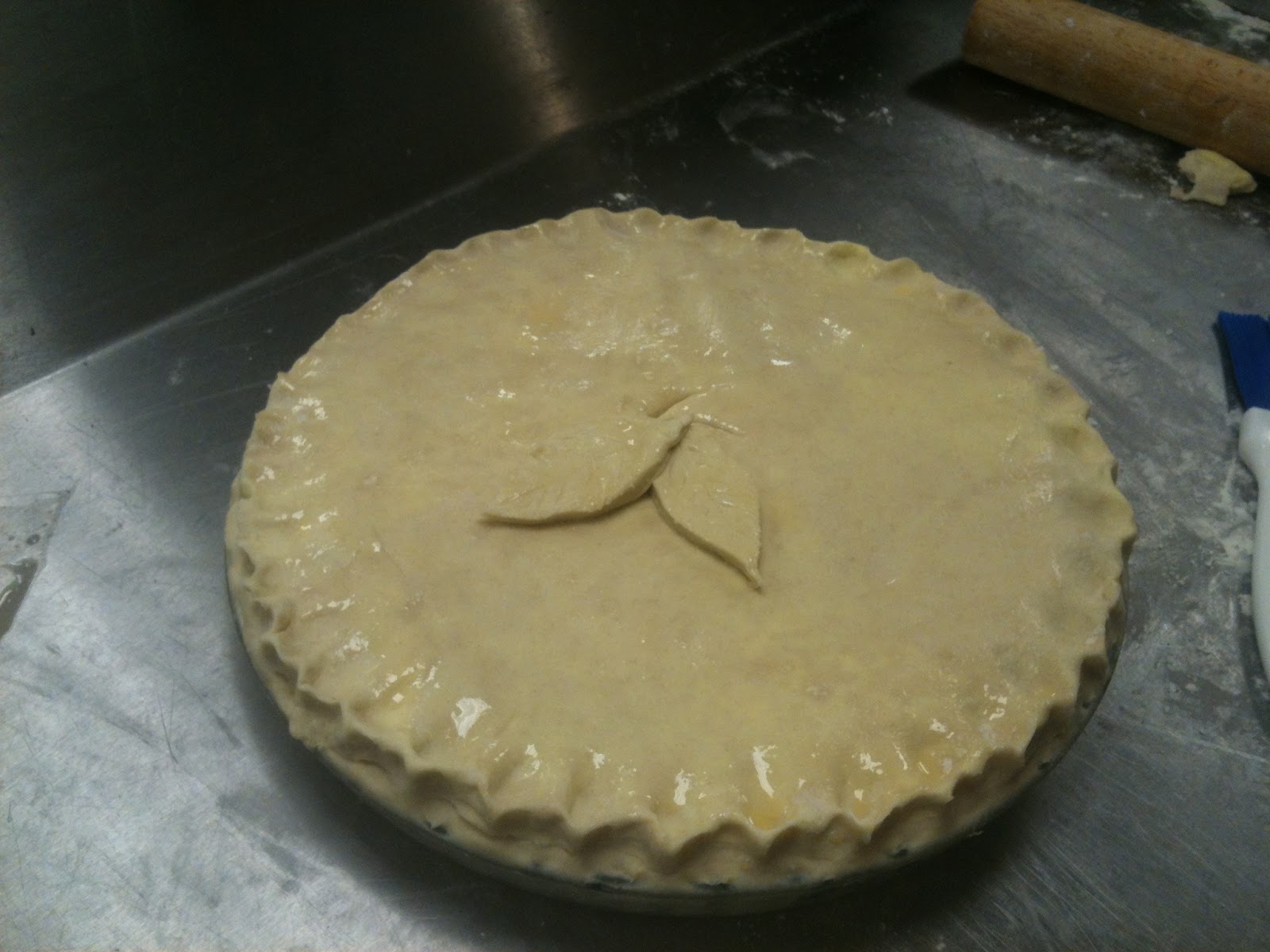
At the gastropub, they use shortcrust pastry for the bottom of the pie and rough puff for the top. But we used rough puff for both. It rises very well and is deliciously crispy owing to all the butter in it. The pies in the picture above should probably have been cooked about five minutes less, as the pastry is a little too brown, but some idiot, uh hum, forgot to put the timer on the oven. I had nothing to do with the ludicrous Man U decoration though.

Rough Puff Pastry

1kg plain flour
750g butter
Cold water

Cut the butter into cubes, about the size of Oxo cubes. Sieve the flour into a bowl and add the butter cubes. Mix briefly with a wooden spoon until the cubes are evenly covered in flour. Add cold water, a little at a time, and stir until the pastry comes together in a ball. Don't over mix it - you still want pieces of butter in the pastry.

Cover the pastry in clingfilm and chill in the fridge for 20 minutes. Take out, flour the work surface and roll out into a long rectangle. Fold the top third into the middle, the bottom third into the middle. Fold in half, then turn 90 degrees and roll out into a rectangle again.

Repeat this three more times, then put the pastry back into the fridge. Chill for another 20 minutes, then take out and repeat the procedure. Chill until ready for use. If you have more pastry than you need, wrap it in clingfilm and freeze.

Poached Chicken

I whole chicken
2 onions
4 sticks celery
3 bay leaves
10 peppercorns

Put your fingers under the skin at the neck end and carefully pull the skin from the chicken. Chop off the feet and pull the leg skin off. Put the whole skinned chicken in a stock pot and cover with water. Add the celery, onion and spices. When the water starts to boil, turn the heat down and cook for one hour.

Take the chicken out, and using a probe, check the inside of the thigh is at least 65C. Even when it is 85C, the chicken meat is still moist because it has been cooked in a wet heat rather than dry heat. But I find about 70C is the best.

Pick the meat from the chicken carcass, and lay on a tray then chill in the fridge. Return the chicken carcass and bones to the stockpot. Continue simmering the stock until you are ready to make the veloute sauce (see below).
Asparagus

Cut off the bottom inch or so of the asparagus. Then boil the spears for two minutes. Take out and refresh in iced water. When cold, slice into discs, about the thickness of £1 coins. Put in the fridge.
Onion Veloute Sauce

1 large onion
100g butter
100g flour
1 litre chicken stock

Chop the onion very finely and fry in the butter over a low heat until the onion has 'melted'. It should be soft and very yellow. Add the flour and stir well. Cook the roux over a low heat for three minutes until coloured slightly - make sure it doesn't catch on the bottom of the pan.
Heat up the sieved stock from the chicken if it has gone cold, and add a ladle at a time to the roux, stirring constantly, and adding the next ladle when the water is absorbed. Then whisk the rest of the stock in, and simmer for 10 minutes. Add salt to taste. Chill the sauce in the fridge.
Pie Filling

When the chicken meat, asparagus and veloute sauce are all chilled, mix together in a bowl. Add salt and pepper to taste.

Making The Pie

Lightly flour the work surface and roll out the pastry to about 1/2cm thick. Cut out a circle three inches wider than the pie dish's circumference. Grease the pie dish with butter and sprinkle with flour. Then lay the pastry circle in the dish, pushing down into the corners. Leave the extra pastry hanging over the edge of the dish. Fill the pie with filling.
Roll out another circle of pastry the same thickness as before, and lay on top of the pie. Push it down on the pastry beneath. Then hold the dish up with one hand and with a knife in the other, neatly trim off the excess pastry. Crimp the edges together using your thumb and index finger on your left hand (if right-handed) and thumb on your right hand. Glaze the top with beaten egg yolk.
Baking The Pie

Put the pie dish on a tray. Bake in a pre-heated oven at 180C - or 160C if you've got a fan-assisted oven - for 45 minutes.

Thursday, November 12, 2015

Bulletproof Recipe For Pate Brisee


This is a classic French pie pastry, which works well for both sweet and savoury dishes. It's almost the same as traditional short crust pastry - which uses one portion of fat to every two of flour - but uses egg and a higher fat ratio (64% rather than 50%) and rolls much better.

It also has a richer flavour and crumblier texture, and is perfect for Cornish pasties or similar. Indeed, we used this to make amuse bouche pasties filled with confit pheasant and grapes for a function at the college where I'm studying my Level 2 NVQ Diploma in Catering (see pics below).


As with all pastries, it's vital not to overwork the dough. Just bring it together with a spoon, and when using your hands, use your fingers rather than the heel of your palm as you would with bread dough, as the heel is the warmest part of your hand. It's also essential to chill the dough well before you roll it out.

Pate Brisee

160g butter
5g salt (or one level teaspoon)
250g plain flour
1 egg
1 tbsp cold water

Use chilled butter straight from the fridge and cut it into small squares. Sieve the flour and salt into a bowl and add the butter. Using the tips of your fingers, crumble the flour and fat together to make breadcrumbs.


Then add the egg and water, and using a spoon, work it all together into a ball. Wrap in clingfilm and leave in the freezer for 20 minutes.


Roll out the pastry to about the width of a £1 coin and use for tarts, pasties, pies etc.

Friday, January 30, 2015

Devilled Herring Roe On Toast


Herring melts or milts – the soft, creamy roe of male herrings (vastly different from the female ‘hard roe’) -  have to be one of the most underrated foods in my book. Especially given the fairly cheap price – about £4 a kilo. You often see them on fish counters, but I never see anyone buying them. Just the odd pensioner - probably an overhang from a time when they were a lot more popular – which is a real shame as they make a delicious lunch or light supper.

There are plenty of ways of cooking them, but I think the best is to have them on toast with ‘devilled’ spices thrown in, as in this recipe below. They have the texture of scrambled egg, somehow, and are apparently packed full of vitamin D, whatever that is.

200g herring melts
3 tbsp flour
2 tsp mustard powder
2 tsp smoked paprika
1 garlic clove, finely chopped
Salt and pepper
2 tbsp butter

Put the roes in a colander and swill under the cold water tap, then drain in the colander. Meanwhile, get a clean plastic bag and put in the flour, mustard, garlic, paprika and salt and pepper. Pinch the top of the bag and shake. Then toss in the roes.

Grip the top of the bag again, and give the bag a good shake to ensure the melts are evenly coated in the seasoned flour. Melt the butter in a frying pan over a medium heat for a minute or so and then lay the melts in the pan. 

Cook for three minutes until well sealed on the bottom then turn over and cook for another two minutes. Season to taste. Serve on hot buttered toast.