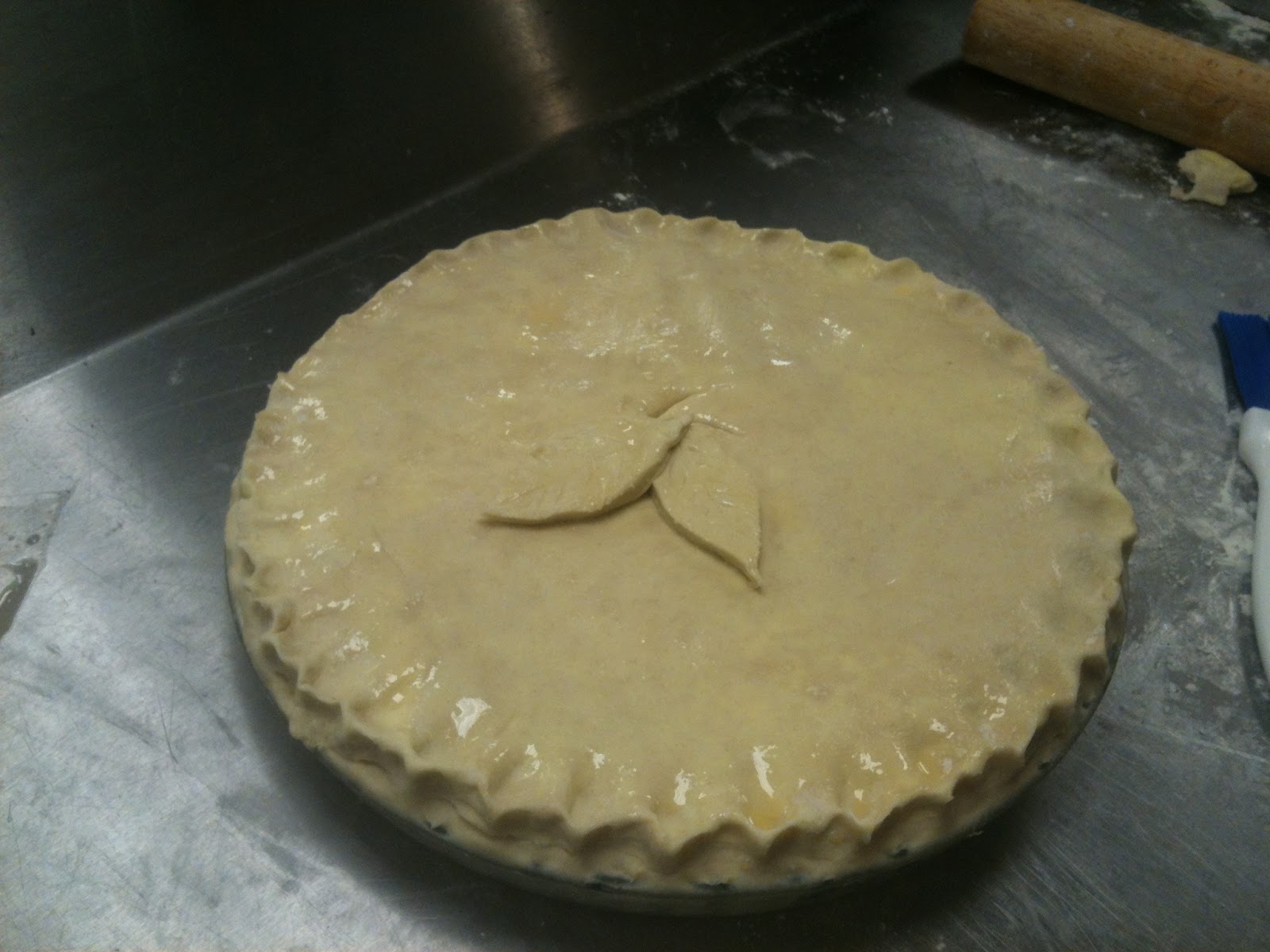
The pastry for this pie comes from one of the apprentices on my cheffing course. He modestly says he's only good at turning potatoes, and jokes that if he was a superhero his one special power would be the ability to instantly turn vegetables into perfect, seven-sided barrels. However, he's pretty good at making pies as well.
He should be really, because the rest of the week, he works at a gastropub that specialises in pies. Every morning, he makes the pie dough using this recipe below. The chef assessor spent a few hours in his kitchen, ticking off units in his apprenticeship file, and came back raving about the pie crust.
It was deemed so good, he asked the apprentice to fill in for our masterchef lecturer one morning to show us how to make the perfect pie. "I don't want to blow smoke up your arse, but that's probably the best rough puff pastry I've ever tasted," the masterchef told him afterwards before trying to sell us the pies we'd made at a fiver a pop, pointing out that they'd probably be £25 in a deli.
At the gastropub, they use shortcrust pastry for the bottom of the pie and rough puff for the top. But we used rough puff for both. It rises very well and is deliciously crispy owing to all the butter in it. The pies in the picture above should probably have been cooked about five minutes less, as the pastry is a little too brown, but some idiot, uh hum, forgot to put the timer on the oven. I had nothing to do with the ludicrous Man U decoration though.
Rough Puff Pastry
1kg plain flour
750g butter
Cold water
Cut the butter into cubes, about the size of Oxo cubes. Sieve the flour into a bowl and add the butter cubes. Mix briefly with a wooden spoon until the cubes are evenly covered in flour. Add cold water, a little at a time, and stir until the pastry comes together in a ball. Don't over mix it - you still want pieces of butter in the pastry.
Cover the pastry in clingfilm and chill in the fridge for 20 minutes. Take out, flour the work surface and roll out into a long rectangle. Fold the top third into the middle, the bottom third into the middle. Fold in half, then turn 90 degrees and roll out into a rectangle again.
Repeat this three more times, then put the pastry back into the fridge. Chill for another 20 minutes, then take out and repeat the procedure. Chill until ready for use. If you have more pastry than you need, wrap it in clingfilm and freeze.
Poached Chicken
I whole chicken
2 onions
4 sticks celery
3 bay leaves
10 peppercorns
Put your fingers under the skin at the neck end and carefully pull the skin from the chicken. Chop off the feet and pull the leg skin off. Put the whole skinned chicken in a stock pot and cover with water. Add the celery, onion and spices. When the water starts to boil, turn the heat down and cook for one hour.
Take the chicken out, and using a probe, check the inside of the thigh is at least 65C. Even when it is 85C, the chicken meat is still moist because it has been cooked in a wet heat rather than dry heat. But I find about 70C is the best.
Pick the meat from the chicken carcass, and lay on a tray then chill in the fridge. Return the chicken carcass and bones to the stockpot. Continue simmering the stock until you are ready to make the veloute sauce (see below).
Asparagus
Cut off the bottom inch or so of the asparagus. Then boil the spears for two minutes. Take out and refresh in iced water. When cold, slice into discs, about the thickness of £1 coins. Put in the fridge.
Onion Veloute Sauce
1 large onion
100g butter
100g flour
1 litre chicken stock
Chop the onion very finely and fry in the butter over a low heat until the onion has 'melted'. It should be soft and very yellow. Add the flour and stir well. Cook the roux over a low heat for three minutes until coloured slightly - make sure it doesn't catch on the bottom of the pan.
Heat up the sieved stock from the chicken if it has gone cold, and add a ladle at a time to the roux, stirring constantly, and adding the next ladle when the water is absorbed. Then whisk the rest of the stock in, and simmer for 10 minutes. Add salt to taste. Chill the sauce in the fridge.
Pie Filling
When the chicken meat, asparagus and veloute sauce are all chilled, mix together in a bowl. Add salt and pepper to taste.
Making The Pie
Lightly flour the work surface and roll out the pastry to about 1/2cm thick. Cut out a circle three inches wider than the pie dish's circumference. Grease the pie dish with butter and sprinkle with flour. Then lay the pastry circle in the dish, pushing down into the corners. Leave the extra pastry hanging over the edge of the dish. Fill the pie with filling.
Roll out another circle of pastry the same thickness as before, and lay on top of the pie. Push it down on the pastry beneath. Then hold the dish up with one hand and with a knife in the other, neatly trim off the excess pastry. Crimp the edges together using your thumb and index finger on your left hand (if right-handed) and thumb on your right hand. Glaze the top with beaten egg yolk.
Baking The Pie
Put the pie dish on a tray. Bake in a pre-heated oven at 180C - or 160C if you've got a fan-assisted oven - for 45 minutes.
Showing posts with label pie. Show all posts
Thursday, January 28, 2016
Chicken And Asparagus Pie
This blog was brought to you by the words...
asparagus,
chicken,
flour,
onion veloute,
pie,
poached chicken,
rough puff pastry,
stock
Wednesday, November 11, 2015
Venison And Wild Boar Pie
We made this for a mediaeval banquet for the catering college's restaurant - I'm not sure what is particularly mediaeval about it. But it is a great recipe nonetheless, and a fantastic winter warmer.
It uses hot water crust pastry - and it worked really well. It had the sort of crunch you get from a good pork pie, but was still moist and not too biscuity. We cooked the pies in a steam oven, but you can get near this by using a normal oven and putting a tray of water on the bottom rack.
500g plain flour
200ml water
120g butter
70g lard
1 tsp salt
Sieve the flour and salt into a bowl. Heat the water in a pan, and when boiling, add the butter and lard. Stir until the fat has dissolved, then pour into the flour. Let it cool slightly, then knead it for a few minutes to form a ball with the consistency of Play-doh. Cover the dough to stop it drying out while you get on with the rest of the ingredients.
Take a medium-size loaf tin and brush the inside with oil. Then cut a piece of greaseproof paper the width of the tin base, but long enough so it hangs over the ends. Line the tin making sure a few inches of paper are sticking out on either end - you'll use these as 'handles' to remove the pie from the tin. Brush the paper with oil.
Then this is where the Play-doh consistency comes in. Take pieces of dough, and flatten into patty shapes and form the pie crust, making sure you push it into the corners. Make sure the crust is about an inch taller than the loaf tin. You want the crust to be about the width of a pencil.
Next fill with the meat mixture. You can use whatever you want for this - thinly-sliced pork loin with finely chopped bacon and onion works very well. For ours, we used freshly-minced venison and wild boar. We put sage, pepper and salt in the pork, and nutmeg, salt, pepper and mustard powder in the venison.
We then fried off a little of each to check the seasoning. The tutor said the venison was too "tight", so we added eggs, breadcrumbs and red wine to loosen it up.
We then built up the pie, starting with a 100g layer of pork, then a 100g layer of venison, and so on, so the pie had a two-tone effect. When the pie was filled an inch past the top, we rolled out the rest of the dough and cut out a piece for the lid. We moulded the overhanging dough into the lid and then trimmed and fluted the edges.
We cut a hole in the top to allow the steam to escape, and baked the pies at 160C in a steam oven for about an hour. You know it's ready when the middle of the pie is 75C. Take the pie out of the oven and carefully remove from the tin using the overhanging paper. Then let them cool on a wire tray.
Meanwhile, we had made chicken stock from trimmings from a dish the other Level 2 NVQ Diploma in Catering class had made. When this was ready we boiled down a couple of litres and added enough gelatine so it set easily in the fridge. We poured this through the pie holes and then let them sit in the fridge for the jelly to set.
It uses hot water crust pastry - and it worked really well. It had the sort of crunch you get from a good pork pie, but was still moist and not too biscuity. We cooked the pies in a steam oven, but you can get near this by using a normal oven and putting a tray of water on the bottom rack.
Hot water crust pastry
(makes one large pie)
500g plain flour
200ml water
120g butter
70g lard
1 tsp salt
Sieve the flour and salt into a bowl. Heat the water in a pan, and when boiling, add the butter and lard. Stir until the fat has dissolved, then pour into the flour. Let it cool slightly, then knead it for a few minutes to form a ball with the consistency of Play-doh. Cover the dough to stop it drying out while you get on with the rest of the ingredients.
Take a medium-size loaf tin and brush the inside with oil. Then cut a piece of greaseproof paper the width of the tin base, but long enough so it hangs over the ends. Line the tin making sure a few inches of paper are sticking out on either end - you'll use these as 'handles' to remove the pie from the tin. Brush the paper with oil.
Then this is where the Play-doh consistency comes in. Take pieces of dough, and flatten into patty shapes and form the pie crust, making sure you push it into the corners. Make sure the crust is about an inch taller than the loaf tin. You want the crust to be about the width of a pencil.
Next fill with the meat mixture. You can use whatever you want for this - thinly-sliced pork loin with finely chopped bacon and onion works very well. For ours, we used freshly-minced venison and wild boar. We put sage, pepper and salt in the pork, and nutmeg, salt, pepper and mustard powder in the venison.
We then fried off a little of each to check the seasoning. The tutor said the venison was too "tight", so we added eggs, breadcrumbs and red wine to loosen it up.
We then built up the pie, starting with a 100g layer of pork, then a 100g layer of venison, and so on, so the pie had a two-tone effect. When the pie was filled an inch past the top, we rolled out the rest of the dough and cut out a piece for the lid. We moulded the overhanging dough into the lid and then trimmed and fluted the edges.
We cut a hole in the top to allow the steam to escape, and baked the pies at 160C in a steam oven for about an hour. You know it's ready when the middle of the pie is 75C. Take the pie out of the oven and carefully remove from the tin using the overhanging paper. Then let them cool on a wire tray.
Meanwhile, we had made chicken stock from trimmings from a dish the other Level 2 NVQ Diploma in Catering class had made. When this was ready we boiled down a couple of litres and added enough gelatine so it set easily in the fridge. We poured this through the pie holes and then let them sit in the fridge for the jelly to set.
This blog was brought to you by the words...
hot water crust pastry,
mediaeval banquet,
mustard powder,
nutmeg,
pie,
pork pies,
steam oven,
vension,
wild boar
Subscribe to:
Posts (Atom)