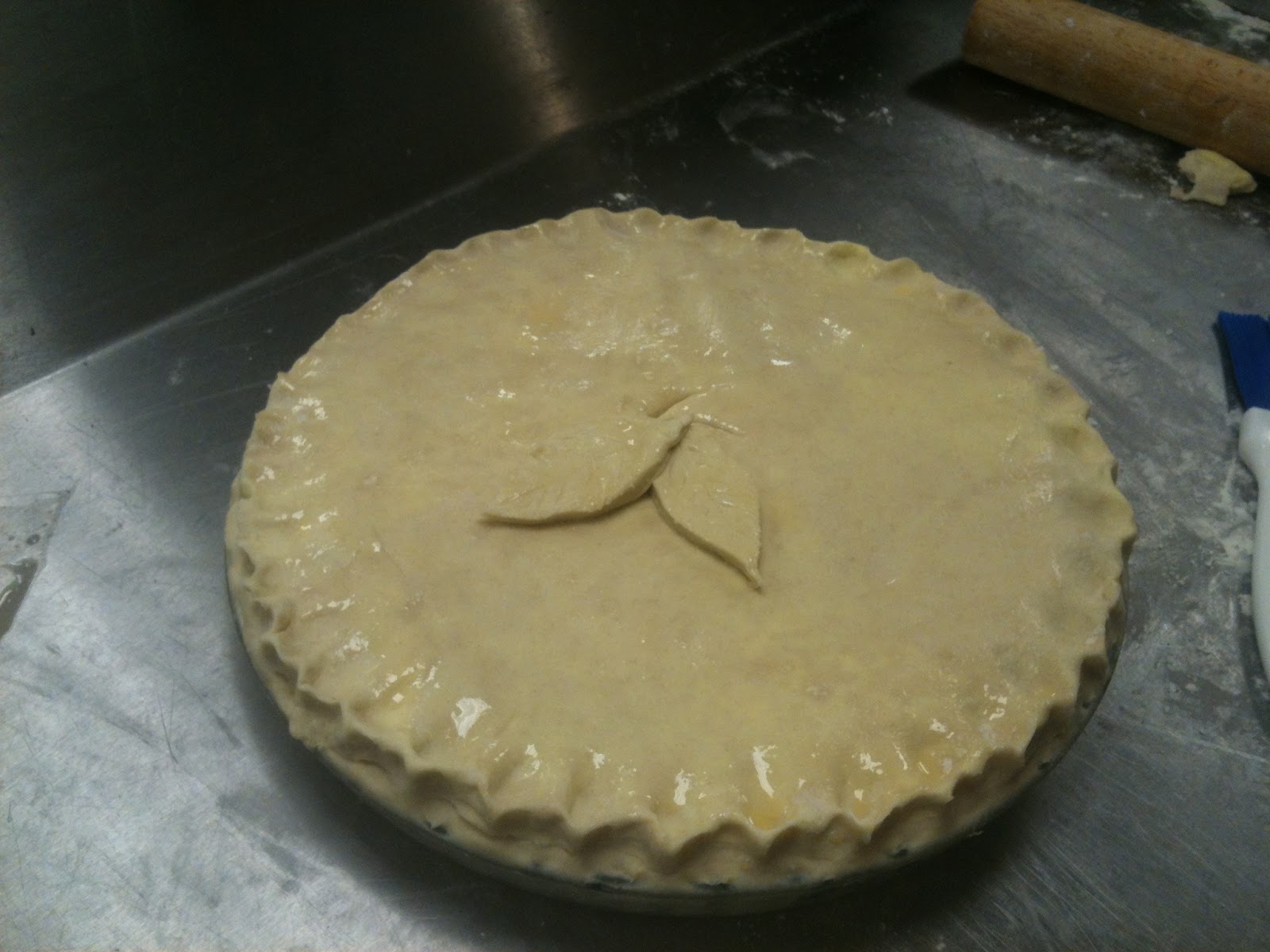
The pastry for this pie comes from one of the apprentices on my cheffing course. He modestly says he's only good at turning potatoes, and jokes that if he was a superhero his one special power would be the ability to instantly turn vegetables into perfect, seven-sided barrels. However, he's pretty good at making pies as well.
He should be really, because the rest of the week, he works at a gastropub that specialises in pies. Every morning, he makes the pie dough using this recipe below. The chef assessor spent a few hours in his kitchen, ticking off units in his apprenticeship file, and came back raving about the pie crust.
It was deemed so good, he asked the apprentice to fill in for our masterchef lecturer one morning to show us how to make the perfect pie. "I don't want to blow smoke up your arse, but that's probably the best rough puff pastry I've ever tasted," the masterchef told him afterwards before trying to sell us the pies we'd made at a fiver a pop, pointing out that they'd probably be £25 in a deli.
At the gastropub, they use shortcrust pastry for the bottom of the pie and rough puff for the top. But we used rough puff for both. It rises very well and is deliciously crispy owing to all the butter in it. The pies in the picture above should probably have been cooked about five minutes less, as the pastry is a little too brown, but some idiot, uh hum, forgot to put the timer on the oven. I had nothing to do with the ludicrous Man U decoration though.
Rough Puff Pastry
1kg plain flour
750g butter
Cold water
Cut the butter into cubes, about the size of Oxo cubes. Sieve the flour into a bowl and add the butter cubes. Mix briefly with a wooden spoon until the cubes are evenly covered in flour. Add cold water, a little at a time, and stir until the pastry comes together in a ball. Don't over mix it - you still want pieces of butter in the pastry.
Cover the pastry in clingfilm and chill in the fridge for 20 minutes. Take out, flour the work surface and roll out into a long rectangle. Fold the top third into the middle, the bottom third into the middle. Fold in half, then turn 90 degrees and roll out into a rectangle again.
Repeat this three more times, then put the pastry back into the fridge. Chill for another 20 minutes, then take out and repeat the procedure. Chill until ready for use. If you have more pastry than you need, wrap it in clingfilm and freeze.
Poached Chicken
I whole chicken
2 onions
4 sticks celery
3 bay leaves
10 peppercorns
Put your fingers under the skin at the neck end and carefully pull the skin from the chicken. Chop off the feet and pull the leg skin off. Put the whole skinned chicken in a stock pot and cover with water. Add the celery, onion and spices. When the water starts to boil, turn the heat down and cook for one hour.
Take the chicken out, and using a probe, check the inside of the thigh is at least 65C. Even when it is 85C, the chicken meat is still moist because it has been cooked in a wet heat rather than dry heat. But I find about 70C is the best.
Pick the meat from the chicken carcass, and lay on a tray then chill in the fridge. Return the chicken carcass and bones to the stockpot. Continue simmering the stock until you are ready to make the veloute sauce (see below).
Asparagus
Cut off the bottom inch or so of the asparagus. Then boil the spears for two minutes. Take out and refresh in iced water. When cold, slice into discs, about the thickness of £1 coins. Put in the fridge.
Onion Veloute Sauce
1 large onion
100g butter
100g flour
1 litre chicken stock
Chop the onion very finely and fry in the butter over a low heat until the onion has 'melted'. It should be soft and very yellow. Add the flour and stir well. Cook the roux over a low heat for three minutes until coloured slightly - make sure it doesn't catch on the bottom of the pan.
Heat up the sieved stock from the chicken if it has gone cold, and add a ladle at a time to the roux, stirring constantly, and adding the next ladle when the water is absorbed. Then whisk the rest of the stock in, and simmer for 10 minutes. Add salt to taste. Chill the sauce in the fridge.
Pie Filling
When the chicken meat, asparagus and veloute sauce are all chilled, mix together in a bowl. Add salt and pepper to taste.
Making The Pie
Lightly flour the work surface and roll out the pastry to about 1/2cm thick. Cut out a circle three inches wider than the pie dish's circumference. Grease the pie dish with butter and sprinkle with flour. Then lay the pastry circle in the dish, pushing down into the corners. Leave the extra pastry hanging over the edge of the dish. Fill the pie with filling.
Roll out another circle of pastry the same thickness as before, and lay on top of the pie. Push it down on the pastry beneath. Then hold the dish up with one hand and with a knife in the other, neatly trim off the excess pastry. Crimp the edges together using your thumb and index finger on your left hand (if right-handed) and thumb on your right hand. Glaze the top with beaten egg yolk.
Baking The Pie
Put the pie dish on a tray. Bake in a pre-heated oven at 180C - or 160C if you've got a fan-assisted oven - for 45 minutes.
Showing posts with label asparagus. Show all posts
Thursday, January 28, 2016
Chicken And Asparagus Pie
This blog was brought to you by the words...
asparagus,
chicken,
flour,
onion veloute,
pie,
poached chicken,
rough puff pastry,
stock
Thursday, January 20, 2011
Raw Food Smoothies And Live Frogs

Last week I told you about the green smoothies I’ve been making, which came about after I took a wrong turn at the end of the corridor and found myself in a vegan raw food class rather than a ‘how to make your own cider press’ workshop.
For 19 long days now I’ve been having a raw food smoothie every morning, and I do feel quite good. Although, as I said last time, it is really about being able to spend the rest of the day downing booze and smoking fags relatively guilt-free, knowing that I have had my blast of vitamins for the day, and therefore will live forever, and not be struck down by some foul disease.
Ok, hands up. I do admit the recipe I gave you last time was fairly disgusting, and it did come under fire from a fair few food writers, not least Trish Deseine (@TrishDeseine), who was horrified to learn I was putting raw kale in there, and demanded video evidence that I was actually drinking them, and Lotte Duncan (@lotteduncan), who said she would much rather just stick to her margaritas.
I found it a little unfair because although my ‘wonderful earth smoothie’ did leave a lot to be desired in the taste and texture stakes, it was certainly not the worst health-boosting smoothie I’ve ever come across.
That was in the Colca Canyon, in Peru, when I spotted a load of villagers queuing up at a stall. When I got closer I saw a man pulling objects out of a small aquarium, chopping them up, and putting them in a blender. The smoothie was a strange pinkish colour and wasn’t altogether too pleasing on the eye.
Creeping further still, I could see that it was live frogs he was blitzing. The villagers downed the liquid in turn, and some even looked like they were enjoying it. Apparently, they believed the frog smoothie helped ward off flu and chest infections.
Anyway, I’m going off the point slightly because my whole mission over the past week has been to try to find a way of making green smoothies more palatable, and with the description above I’ve probably completely put you off, and you are no longer reading.
So I started thinking about raw foods and what I could put in to make the smoothies taste better. Then I realised my favourite raw food in the world is oysters. In fact, it is probably true to say that oysters are my favourite food in the world. No vinegar, no Tabasco, no lemon. Just as nature intended. In fact, is there any better food this side of Mars?
I’d bought a couple of delicious Irish oysters the night before, and then as I opened the fridge, my heart sinking at the thought of that morning’s raw food smoothie, a golden light shone out and I realised what I needed to do. Shuck the bastards and chuck them in. And the result was out of this world! And what a wonderful colour to boot – as green as leprechaun’s piss, so it was.
Well, it was a massive improvement on last week’s smoothie anyway. Although that wasn’t too difficult. But I’m being unfair, because it really was quite drinkable and the zinc and sea water helped cut through the taste of the raw kale.
I know that any vegans reading might be offended, and I know the militant veggies who were in the ‘living in the raw’ class I went to by mistake will definitely be disgusted, but oysters ARE raw, and I really couldn’t care less what they think anyway (the vegans, not the oysters). Go on try it – it’s really not that bad. I know I said that last time, but go on, seriously, give it a go...
The Green As Leprechaun’s Piss Smoothie
Two oysters
Four young kale leaves
Two spinach leaves
Three asparagus spears
Handful of rocket leaves
Two small eating apples, cored
Squeeze of lemon juice
Few drops Worcester sauce
Salt and pepper
1/2 pint water
Shuck the oysters (if you haven’t got an oyster knife, I find a screwdriver works very well, but careful with your hands) and put the meat and liquor into a blender. Add the rest of the ingredients and blitz until smooth and wonderfully green. Drink at once (before you change your mind).
Tuesday, March 17, 2009
Fat Duck: The Dreaded Grapefruit

After we finished the wrapping, Graham, the Fat Duck’s sous chef, appeared and thumbed a few sweets. Then he led us over the road to the prep room, which would be our prison for the next month.
It was 100 yards or so away from the restaurant, in an old building perched on the side of a car park. The prep room was downstairs - and Heston’s famous laboratory upstairs. I wondered what sorcery was going on up there, and for some reason thought about the Soup Dragon in the Clangers. But there were no tours to be had, or soup for that matter, and they quickly got us to work.
A young chef called Laurent ran the prep room. At first I thought he was French – he had a unique blend of Gallic arrogance and nonchalance – but it turned out he was Swedish.
My first job was measuring out the venison and frankincense tea into 65g portions. It was probably the easiest job in the kitchen, but I managed to mess it up. I had to pour the broth into small plastic bags and vac-pack them. But a couple of bags exploded, and I’d clean the vacuum packing machine down and start again. They could tell I was a novice – it wasn’t just the Tesco bag containing my two blunt knives that gave me away.
I spent the rest of the morning prepping asparagus spears for the ‘salmon poached in liquorice gel’ dish on the taster menu (see photo above). Each one had to be perfect. You cut a circle just below the bud, and peeled the stalk into a slender white arrow.
Eighty were needed for service, and the amount of waste was shocking. Handfuls of perfectly good trimmings, glistening like slimy green tagliatelle, were thrown in the bin. And so much for that sleb chef guff about seasonality and local produce – it was March, and the stuff was from Peru. But it was hard to knock Heston Blumenthal for food miles when some of his customers flew thousands of miles just to eat there. Some of them had carbon footprints bigger than Wales.
The jobs kept rotating and quickly became brain-numbingly dull. One minute we’d be slicing exquisite Joselito ham into julienne strips for the snail porridge, the next we’d be cutting onions on the slicer. It reminded me of those factory lines I’d worked on as a student. It was the sort of humdrum work that I’d always promised myself I’d never do again.
:: This blog eventually became a bestselling book, called Down And Out In Padstow And London by Alex Watts, about my disastrous attempt to train as a chef, including stints at Heston Blumenthal's Fat Duck and Rick Stein's kitchens in Padstow. You might like it if you're a foodie or have ever entertained the ridiculous idea of entering the padded asylum of professional cooking. It's here on Amazon as a paperback or Kindle book if you want a read...
It was 100 yards or so away from the restaurant, in an old building perched on the side of a car park. The prep room was downstairs - and Heston’s famous laboratory upstairs. I wondered what sorcery was going on up there, and for some reason thought about the Soup Dragon in the Clangers. But there were no tours to be had, or soup for that matter, and they quickly got us to work.
A young chef called Laurent ran the prep room. At first I thought he was French – he had a unique blend of Gallic arrogance and nonchalance – but it turned out he was Swedish.
My first job was measuring out the venison and frankincense tea into 65g portions. It was probably the easiest job in the kitchen, but I managed to mess it up. I had to pour the broth into small plastic bags and vac-pack them. But a couple of bags exploded, and I’d clean the vacuum packing machine down and start again. They could tell I was a novice – it wasn’t just the Tesco bag containing my two blunt knives that gave me away.
I spent the rest of the morning prepping asparagus spears for the ‘salmon poached in liquorice gel’ dish on the taster menu (see photo above). Each one had to be perfect. You cut a circle just below the bud, and peeled the stalk into a slender white arrow.
Eighty were needed for service, and the amount of waste was shocking. Handfuls of perfectly good trimmings, glistening like slimy green tagliatelle, were thrown in the bin. And so much for that sleb chef guff about seasonality and local produce – it was March, and the stuff was from Peru. But it was hard to knock Heston Blumenthal for food miles when some of his customers flew thousands of miles just to eat there. Some of them had carbon footprints bigger than Wales.
The jobs kept rotating and quickly became brain-numbingly dull. One minute we’d be slicing exquisite Joselito ham into julienne strips for the snail porridge, the next we’d be cutting onions on the slicer. It reminded me of those factory lines I’d worked on as a student. It was the sort of humdrum work that I’d always promised myself I’d never do again.
:: This blog eventually became a bestselling book, called Down And Out In Padstow And London by Alex Watts, about my disastrous attempt to train as a chef, including stints at Heston Blumenthal's Fat Duck and Rick Stein's kitchens in Padstow. You might like it if you're a foodie or have ever entertained the ridiculous idea of entering the padded asylum of professional cooking. It's here on Amazon as a paperback or Kindle book if you want a read...
This blog was brought to you by the words...
Andrew Fairlie,
asparagus,
Culinary Institute of America,
Fat Duck,
grapefruit,
Heston Blumenthal,
Hinds Head,
Joselito ham,
salmon liquorice,
snail porridge,
venison and frankincense tea
Subscribe to:
Posts (Atom)